The Tree of Knowledge, The Fall of Man, and Who Was the Serpent in the Garden? Part 2
A deep dive into the creation story
(This is a continuation from a previous article, please read part 1 if you haven’t.)
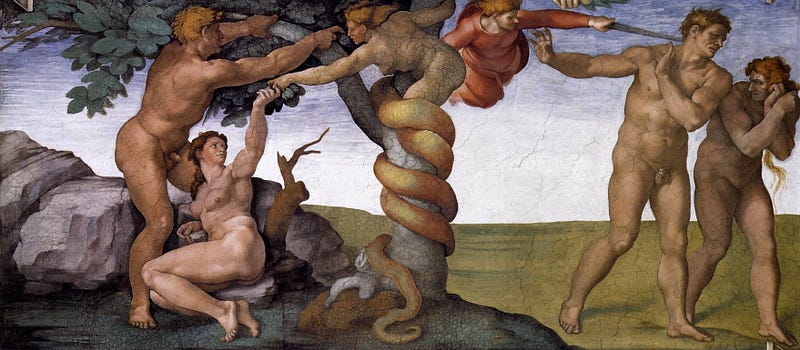
We’re also taught as Christians to believe that the serpent is the devil in this scenario, but interestingly there isn’t anything in the Bible to back up that claim, other than this entity going against god’s wishes. The only other reference to the devil being a serpent is in Revelations, so not even in the Jewish Bible at all, and there is one very loosely interpreted verse in Ezekiel about the King of Tyre, who Christians try to contribute to being the devil.
Christians also try to use this verse as part of the origin story of the devil’s fall, and the devil being in the garden. This is a perfect example of confirmation bias, however, and a story that Christians invented and then looked for “proof” of in the Bible.
The funny thing is the story of the serpent being the devil, and even the devil’s fall from heaven has been repeated so many times that most Christians seem to believe it’s actually in their holy book.
But both of the verses they use to create the devil’s fall from heaven story are derived from very loosely translated and allegorical verses, that are very likely not referring to this character at all…but I digress. I will however likely have to make a part two to my article about the devil.
The serpent character in Genesis, that gives the fruit to man, basically is bestowing a higher knowledge on a lesser being. Prior to eating the fruit the man and woman knew nothing of good or evil, right from wrong, and according to what Yahweh (god in Genesis) says when he cast man out, mankind had possibly gained more since they feared eating of the other tree would allow man to “become like us.”
Now let’s pose a question outside of religion, could this scenario be some allegory to whatever occurred during human evolution that caused our leap in mental capacity past other primates?
One theory that some scientists have even put forth was that the Tree of Knowledge may be symbolic of early man eating psilocybin mushrooms and that somehow this expanded our brains. Which, given some new research into psilocybin’s effects on the brain’s wiring, and essentially being able to help rewire it, could possibly be a valid theory.
But let’s go back to mythologies, we see a similar story about a higher being bringing knowledge of the gods down to man in the story of Prometheus, in Greek mythology. Prometheus steals fire from the gods, and gives it to man, thus allowing man to advance past a primitive state.
This of course could be symbolic of something more than just fire, although fire really is a huge stepping stone to all of the advancement in every aspect of our modern world. But, due to Prometheus giving man fire, he is condemned by the angry king of the gods Zeus. Zeus has him chained to a rock where an eagle comes daily to eat out his liver, for eternity.
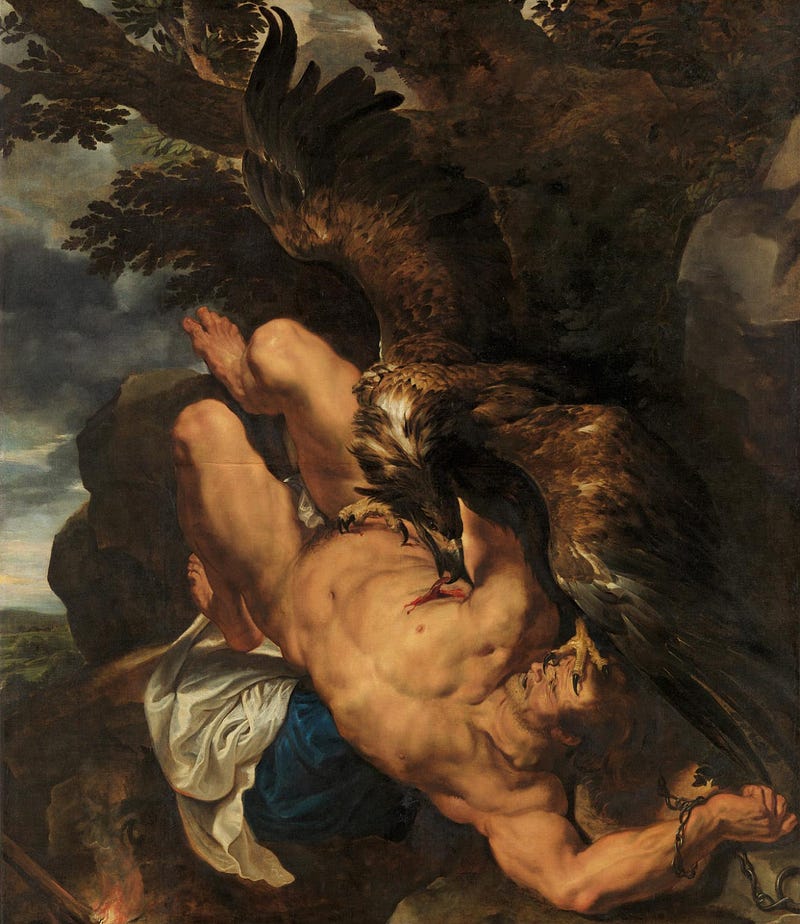
We can of course see the similarities here, the serpent gives man the fruit, thus imparting wisdom, and is cursed for his action by an angry god. Prometheus gives man fire, thus giving him the tool to advance, and is cursed by an angry god. But since the Greek story came after the Jewish Genesis story we can assume that possibly they modified this older story and made it their own. So do we have anything older we can look at?
Up until the late 1800s many believed the Bible was the oldest work on earth, and many of course still believe it is holy inspired by God, thus infallible. So how old is our oldest copy of the Bible?
Well as far as a copy of the New and Old Testaments, the oldest complete manuscript is the Codex Sinaiticus from 330–360 A.D. that’s a Greek translation from the original works. The discovery of the Dead Sea Scrolls actually gave us older copies of many of the books, these were discovered in 1947 and the oldest date back to 202–107 B.C.
202 B.C. is pretty old (2224 years as of this writing), but in 1893 the University of Pennsylvania sent out an expedition to Mesopotamia to try to find evidence to back up the book of Genesis (Definitely had Christian funding obviously). However, they ended up finding a much older source for the origin story, that didn’t entirely match up with that of what Genesis contains.
In Mesopotamia, Nippur to be exact, they discovered a single cuneiform stone tablet that contained what later would be known as The Eridu Genesis, this tablet dates to around 1600 B.C. (so 3602 years old as of this writing).
This tablet, and even older tablets such as the Barton Cylinder (4400 years old), recount the origin of the gods and the universe, and give a much different story to that of Genesis, yet retain many parallels.
The Sumerian tablets detailed many of the same aspects of the biblical Genesis account. God created man from earth (clay vs dust), a “paradise”, Eridu in some writings, that contained a tree of life that was fed by the Tigris and Euphrates rivers (two of the rivers mentioned to be near the Garden of Eden in the Bible.) There are many more similarities such as a goddess named Ninhursag who has the title of Ninti or “the mother of all living”, which is the same title given to Eve in the biblical story.
For the sake of this article though, I’m going to stick to the ones pertaining directly to the garden, and the serpent, and perhaps pick up on the vast amount of similarities in a future installment.
The Sumerian story picks up with three gods involved in the creation of man, An (father god and ruler of the heavens), Enlil (son of An, and later ruler of the gods), and Enki (god of wisdom and the waters). You will also sometimes see An referred to as Anu due to that being his name in the later Akkadian texts, as well as Enki being referred to as Ea, here I will just refer to them by their original Sumerian names however.
Unfortunately, some of the original stone tablets from the Sumerian stories were destroyed, luckily we have later Akkadian texts that fill in some of the gaps of the stories.
In the Bible, god creates man for what reason? It’s never explained, and I’ve never been given a satisfactory answer from any Christians. This has especially perturbed me because you have an allegedly perfect, all-knowing eternal god, who creates mortal man on a planet that he had already cast the source of evil down to, according to Christians.
In their tale, the devil had been cast down to earth with his fallen angels, prior to mankind being made. So god, being infinitely wise would’ve known the devil was there (he put him there), and god knowing all things, would’ve known that the devil would appear as a snake and corrupt man eventually, right? But then why did god make man in the first place, and why allow the snake/devil into the garden anyways?
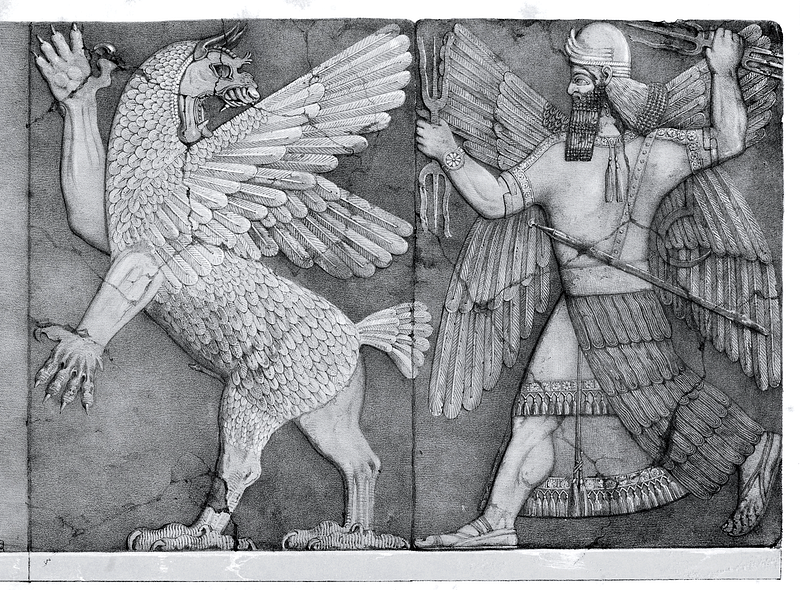
In the Sumerian myth, there are primarily three gods involved that I mentioned above. An (Anu in some writings) who seems to be in charge, but the least involved, is the god of the sky or heavens. Enlil seems to later take on the role of a father/king god and ruler of wind and later earth. Then there is Enki, the god of wisdom and water.
Enki takes on the role of the one who actually creates man. Although this is different in some versions, giving credit to Enlil, and at other times to a female god named Namma, who kneaded clay, placed it in her womb and actually birthed man.
Yet in another later myth Marduk, Enki’s son, directly created man by mixing clay with the blood of a primordial god Qingu who had been slain, he had been the consort of Tiamat. But in all cases, man was made from clay.
Originally the gods had a slave class of lesser gods that worked for them called the Igigi, normally portrayed as younger servants of the Anunnaki. By some accounts, they are described as half beast half man lesser deities. These were semi-intelligent, or not at all, and were thought to be what the Bible describes as demons or non-human spirits.
Could these be part of the origin of the Nephilim described in the Bible? In some later writings, it seems that the Igigi were just a class of gods less than the Anunnaki and that Marduk, at times credited as one of, or even the most powerful god, was actually part of this class.
The gods (Anunnaki) had these lesser deities working in “Paradise”, as this quote from the myth of Atrahasis shows.
When the gods, man-like,
Bore the labour, carried the load, The gods’ load was great, The toil grievous, the trouble excessive. The great Anunnaku, the Seven,
Were making the Igigu undertake the toil.
Eventually, these lesser deities went on strike against the tyrant god Enlil, and burned their tools. So the gods decided to make a new creation to serve their purpose of working the lands, mankind.
After the creation of man, Enki is credited with bringing “the gift of civilization” to man, as well as uniting man under one language. There are two parallels I notice here, one is that “the gift of civilization” could easily be the knowledge bestowed upon Adam and Eve by the fruit of the Tree of Knowledge, or the fire given to man by Prometheus.
Only one of these stories makes the gift of knowledge a bad thing… and, interestingly enough, that same book also makes all of humanity speaking one language a bad thing (Tower of Babel).
As mentioned above the creation of mankind takes different paths depending on the tablet, and what time period it was written in. Ultimately though, the god Enlil begins to tire of mankind being too “noisy”, and starts sending famines and plagues against mankind to lessen their numbers.
Each time Enki gets involved and helps to save humanity, but eventually Enlil comes up with a plan to flood the earth and destroy all of humanity. Enki is bound by oath not to intervene this time but ends up telling one human how to build a boat and save himself and his animals. The flood takes place and lasts for 7 days, much shorter than the biblical one, but has the same end result.
An interesting side note, serpents are portrayed as symbols of wisdom throughout many cultures, and here we have the god of Wisdom saving mankind over and over, and bestowing the initial gift of civilization…Enki is also often portrayed as having the skin of a fish, with scales. Not a reptile, but one could see how that might get misinterpreted over time.
The parallels here are staggering, for someone who grew up hearing the biblical stories, and later started seeing all of the holes in them. We see a direct parallel between the Garden of Eden (Paradise/Eridu), the serpent (Enki), an angry father god who wants to destroy humanity multiple times, using various methods, most glaringly a great flood (Enlil/Yahweh/Old Testament God.)
We also get a better explanation of who the Old Testament god Yahweh was talking to. In the Sumerian story there are multiple gods involved with the Garden of Eden, so very likely even that part of Genesis where god says, “let us cast them out", was lifted directly from this story. Especially since the Jewish faith is monotheistic, and god wouldn’t have been consulting with anyone else about banishing man.
What the Sumerian myth gives us, that the bible doesn’t, is a more cohesive story. One with a plot that actually makes sense. Instead of man being made for no stated reason at all, he was made as a slave class to work for seemingly higher beings. The Bible portrays mankind gaining wisdom by eating the fruit as the biggest sin we ever could’ve committed, and that man is born into sin due to that initial sin, thus we are paying for the sin of our forefather
Even though the bible directly states that shouldn’t be the case.
Ezekiel 18:19
19 “Yet you ask, ‘Why does the son not share the guilt of his father?’ Since the son has done what is just and right and has been careful to keep all my decrees, he will surely live. 20 The one who sins is the one who will die. The child will not share the guilt of the parent, nor will the parent share the guilt of the child. The righteousness of the righteous will be credited to them, and the wickedness of the wicked will be charged against them.
However, the Sumerian origin story, which is much older, paints us gaining the wisdom of civilization as a gift from a higher being, meant to help us survive and thrive. The Christian myth paints the gaining of this initial wisdom and even having an inquisitive mind as a sin and something to be shunned lest the devil trick you into damning your soul.
This is why so many Christians know nothing of other religions or myths. If they did, then they would see that the minute you begin to look at the origins of the Bible or question the story arcs, the whole narrative begins to fall apart.
The pastors likely know this, and think it better for them to control their congregation with fear-mongering, rather than let them actually think, and be “led astray”.
Related Articles