
The Treaty of Paris (1763) and the Redistribution of Colonial Territories
How Geopolitics of the Era, Altered the Map
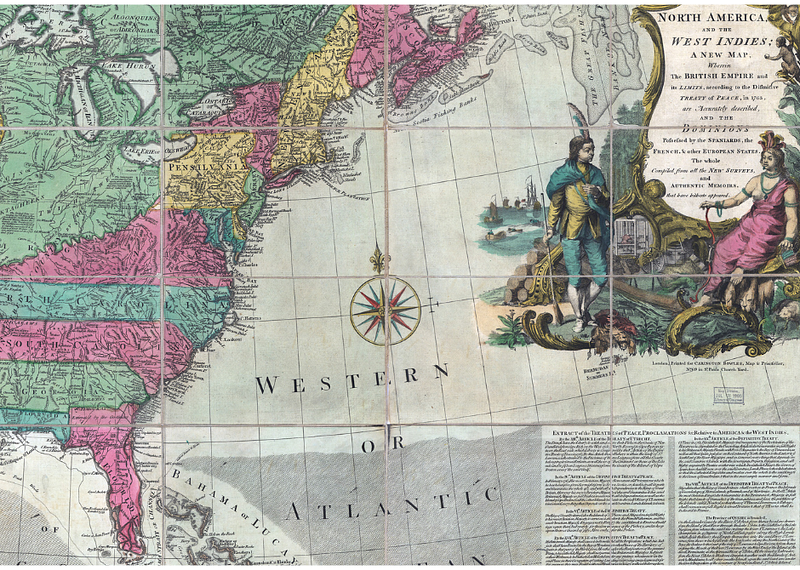
The Seven Years’ War, often dubbed the ‘first global war’, set the stage for a fierce battle among major European powers over colonial supremacy.
Central to this struggle was the intense rivalry between Britain and France — both vying for expansive territories and the promise they held.
Culminating in 1763 with the signing of the Treaty of Paris, it was a conflict that resulted in one of history’s most pivotal peace settlements.
For the Treaty of Paris didn’t just conclude the war, it also reshaped the global geopolitical landscape too.
By redrawing the colonial map, it heralded the ascent and descent of mighty empires, while also realigning colonial dynamics in ways that would sow the seeds for future conflicts and the forging of new national identities.
Beneath these power shifts lay a darker narrative again too: the subjugation and exploitation of indigenous peoples and their invaluable resources
The Historical Context of the Seven Years’ War
Europe’s relentless pursuit for colonial supremacy can be traced back to the latter part of the 15th century, when explorers like Christopher Columbus set their sights on unknown lands.
By the time the Seven Years’ War erupted, this colonial ambition had spread far beyond European shores, encapsulating regions from North and South America to India, Africa, and pockets of Asia.
Though it began as a skirmish between Britain and France over colonial territories in North America, it quickly escalated, drawing in a slew of European powers and their colonial subjects.
Native populations and colonies often found themselves ensnared in the geopolitical struggles of distant European capitals.
And at the heart of these conflicts was the prize of control: control over lucrative trade routes and abundant natural resources in each of the claimed European colonial strongholds.
Colonies, with their reservoirs of commodities, including sugar, tobacco, and cotton, became invaluable assets — they not only supplied raw materials coveted in Europe but also emerged as fertile grounds for European exports.
Fuelled by a mercantilist conviction that global riches were limited, nations clamoured to secure the lion’s share.
Dominance over certain territories translated to mastery over pivotal trade channels, both terrestrial and maritime.
It was a strategic game; establishing a foothold in regions like the Caribbean, for example, enhanced a nation’s naval prowess in the Atlantic.
The Caribbean, with its lucrative sugar islands, controlled mainly by the British and French, became hotspots of naval engagements.
Today, remnants of this imperial contest remain with the Caribbean still dotted with forts from various colonial epochs — serving as a testament to this turbulent past.
In North America, British colonists clashed with French forces, with Native American tribes often serving as important allies on both sides.
And in India, the British East India Company and its allies fought against the French East India Company and its Indian allies.
South America and Africa also saw limited but significant engagements over strategic ports and trading posts too.
By 1762, exhausted by prolonged warfare and burdened by financial strains, the major powers sought a diplomatic solution.
The Path to Negotiation
By the end of 1762, the British had achieved significant victories, particularly in North America and India.
Their naval superiority allowed them to seize key territories, placing them in a favourable position at the negotiation table.
The war had also been financially draining for all parties involved. The national debts of both France and Britain had skyrocketed. This economic pressure played a pivotal role in pushing the nations towards a negotiated peace.
Shifts in leadership and political dynamics, especially in Britain and France, also influenced this drive for peace.
Before the official Treaty of Paris, there had been several backdoor negotiations and treaties.
Notably, the Treaty of Hubertusburg (between Prussia, Austria, and Saxony) and the Treaty of Fontainebleau (a secret agreement between France and Spain) set the stage for the broader negotiations that would follow in Paris.
Preliminary peace talks began in earnest in 1762, culminating in the formal signing of the treaty in Paris in 1763.
The Negotiations and Signatories
The Treaty was not a singular negotiation but a set of agreements.
Chief players included Britain, France, Spain, and Portugal, with each having vested interests in different parts of the globe.
The negotiations encompassed the aspirations, anxieties, and foresights of these empires, each keenly aware of the implications of their decisions.
Against this, indigenous populations and smaller colonial entities found themselves caught in the machinations of these great powers — their fates decided in far-off European halls.
The aftermath of the Seven Years’ War, sometimes branded the first “world war” due to its expansive reach, culminated in a seismic shift of colonial territories among Europe’s giants — notably Britain and France.
These territories, in addition to the value of their land and resources, were seen as strategic assets in the European’s intricate global game.
Their transfer mirrored Europe’s evolving power dynamics and underscored the lengths to which nations would go to fulfil their ideological, economic, and strategic visions.
The Treaty’s outcomes were transformative too.
Britain emerged as the preeminent colonial power, acquiring Florida from Spain; and Canada and various territories in India and Africa from France.
France ceded Louisiana to Spain as compensation for the loss of Florida, and received territories in Senegal from Britain.
Spain transferred control of the Philippines and Cuba to Britain, in exchange for the return of Manila and Havana.
This vast reshuffling of territories marked a seismic shift in the global balance of power.
The British Empire, with its newly-acquired territories, stood poised to further extend its influence.
For France, the Treaty was a bitter pill, marking a significant setback in its colonial ambitions. However, it would use this period to refocus its energies, laying the groundwork for its later colonial endeavours in Africa and Southeast Asia.
Spain, having lost some territories but gained Louisiana, faced the challenge of integrating its new territory while grappling with the decline of its once-mighty empire.
The Treaty also sowed the seeds for future conflicts.
The redistribution of territories, while resolving immediate disputes, created new tensions, rivalries, and territorial claims that would later erupt in subsequent wars and revolutions.
The Long-Term Impact
The Treaty of Paris firmly cemented Britain’s position on the global stage. Before the treaty, while Britain was indeed a significant colonial power, its territorial reach was in contention with other European powers, notably France.
However, post-treaty, the vast acquisition of territories — from parts of Canada to various Caribbean islands and regions in India — accelerated the growth of the British Empire.
This expansion wasn’t just geographical either — the British introduced their administrative systems, legal frameworks, and educational structures in these colonies.
Over time, English would become the lingua franca in many parts of the world, facilitating global commerce and diplomacy.
The British pound sterling also gained prominence as a leading trade currency, and British naval prowess ensured control over critical sea routes.
The Treaty also brought challenges for Britain too though.
The need to finance wars and manage an ever-expanding empire, for example, had led to the imposition of new taxes in the colonies.
In North America, policies like the Stamp Act and the Townshend Acts were perceived as heavy-handed, especially since the colonies had no representation in the British Parliament.
This notion of “taxation without representation” became a rallying cry, leading directly to the American Revolution in 1775.
Thus, the very act of territorial expansion sowed the seeds of colonial resistance too.
Implications for Indigenous Populations
For most indigenous populations, the Treaty of Paris was just an exchange of foreign rulers.
Each colonial power had its particular approach to governance, trade, and interaction with indigenous societies —some better and some worse— but all ultimately to the detriment of indigenous societies.
In some cases, British rule might have introduced certain legal protections or new economic opportunities, for example, but would also bring significant cultural disruption.
Traditional practices were often suppressed by the British, and lands seized or redistributed. Indigenous peoples found themselves subjected to foreign laws and customs that did not respect their way of life.
This was an era of intellectual and philosophical awakening for the Europeans — the “Age of Enlightenment”, spanning from the late 17th to the late 18th century, had ushered in transformative ideas on governance, rights, and society.
However, alongside these progressive ideologies, there existed a darker undercurrent, with many Europeans, buoyed by a sense of cultural and religious superiority, feeling a mission to disseminate their values.
This gave rise to the notion of the “white man’s burden” — a misguided belief in the European obligation to “civilise” indigenous populations in the lands they took.
The new boundaries drawn by European powers, also rarely took into account the existing tribal or ethnic territories, frequently forcing historically distinct groups to coexist under a single administrative entity, and leading to long-term ethnic and tribal tensions and conflicts in many parts of the world.
And where indigenous groups did resist the new colonial regime, they faced conflicts and skirmishes that rarely ended in their favour; often with significant long term trauma associated for their societies.
The Modern Perspective
In today’s interconnected world, the Treaty of Paris is frequently revisited by historians and scholars as a pivotal juncture in the narrative of global geopolitics.
The treaty, by delineating territorial claims, didn’t just redraw the world map; it reshaped the balance of power among European nations.
As a result of the Treaty, Britain emerged as a dominant colonial force, setting the stage for a British-centric world order that would influence global politics, economics, and culture for centuries.
The Treaty also serves as a window into the psyche of European empires in the 18th century — these powers were driven by more than just the thirst for territorial acquisition.
Behind the paper and ink of the treaty were complex webs of ambition, strategy, and rivalry.
Colonial empires were not only motivated by the immediate material gains they could extract from new territories but also by the long-term strategic advantages these lands offered — be it securing crucial naval routes, countering the moves of rival nations, or bolstering their prestige on the global stage.
The Treaty of Paris encapsulated these intricate power plays and ambition, revealing the lengths to which nations would go to secure their interests.
And while European powers deliberated and negotiated, indigenous populations found their fates being decided without their consultation or consent.
These communities often bore the brunt of colonial ambitions, with their lands seized, cultures suppressed, and traditional structures upended.
Today, as discussions about colonial legacies gain prominence, the Treaty stands as a symbol of the broader systemic injustices meted out to indigenous populations, alongside the Treaty’s relevance and impact on the modern day geopolitical order.


