
How an Angry River destroyed Nirmala’s home, family and Life
A river’s bounty is not always a good thing
It was 430 AM as the Miraj Express whizzed past the suburbs of Srinivaspura, rocking her carriages haughtily. The tracks shook and carried the vibrations down the muddy slopes a short distance away, where she lived. The two metal panels bolted to the door of her little brick and mud hut vibrated for the next full minute. The vibrations woke her mother up. And she shook Nirmala up, “Nirmala, get up. Its time to wash and go to the train station Remember, you should be there by 5 AM, else they will not pay you. And that means one more day without food”.
Nirmala walked briskly to the train station, about one kilometer away. Her morning job was to clean and mop the platforms, rooms, washrooms and parked coaches. A bright moon looked down upon the little village, as she carefully stepped away from the dung and feces-laden lane to the train station. A street dog followed her.
The pre-dawn dew drops suspended in clean air broke the distant streetlight into colorful little circles as they danced around her half-covered face. An overgrown banana tree menacingly cast her shadows on her as she trudged along. She was at least another five minutes away from the railway station.
She could see the railway station tower clock. A wicked moon looked down at her, a clear night sky, a cold wind, a dreaded memory. The dreaded moon always flooded her with tragic memories of a distant past and a deep scar that would never heal.
Srinivaspura, a rural extension about 20 km off the town of Hassan was an impoverished slum. Hassan, a bustling agricultural town, nestled in the plantation zone about 200 km west of Bangalore, the tech hub of India. A glistening four-lane expressway tied the cities together as the highway curved further west toward the Arabian sea. Hassan was a prosperous agricultural town, thanks to the irrigation projects that ensured perennial water supply to the cash crop in the area. Migrant workers flocked to the town looking for a livelihood, settled in hutments in the neighborhoods creating pockets of slums over the last decade. It was a convenient arrangement: the rich landlords didn’t complain as these slums provided cheap labor, politicians didn’t complain as it was an easy vote bank and the slums continued to grow.
In a cluster of about fifty-odd huts lived eighteen-year-old Nirmala with her father, a partially paralyzed mother, and one younger sibling. The family had migrated from Kathaguri, a coastal town in Assam that was constantly ravaged by the raging Brahmaputra river. Nirmala’s father farmed on a small piece of land on a tiny hillock, growing paddy and vegetables. Nirmala went to public school along with other girls in the village. Their wants were small and their simple living made it easy.
Five years ago, a major flood wiped out dozens of villages as it rained non-stop for four days. The district administration could do nothing as it had no more resources to deploy, the region was remote, weather unrelenting and all highways leading to the region were washed away.
On the second night of the big rains, Nirmala woke up in the middle of the night to cold and wet feet. Startled, she sat up and realized a pool of water had washed indoor. She swung into action, realizing her father’s bed was already soaked wet. Just then her mother woke up with a shriek. The younger kids were still blissfully asleep.
Her mother stood up and swiftly unlatched the rusty metal bar to open the door. As the wooden plank creaked open, some water sprouted through a crack and dripped for a moment disturbing the water surface. The moon shone on the smooth floor that was polished with mud and dung. Nirmala stood up just behind her mother.
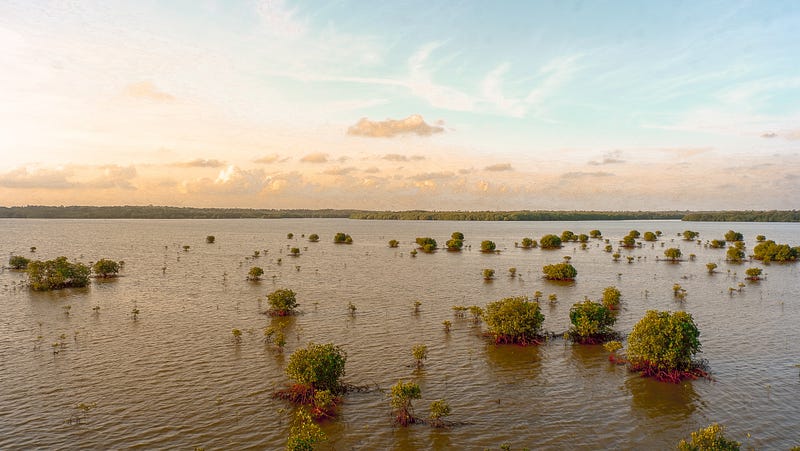
Taller than her mother, Nirmala had to duck her head to look outside. She couldn’t believe what she saw. In the light of the bright moon, as far as her eyes could travel, all she could see was water. The house was on a slightly raised piece of land about seven feet off the ground but everything below for the next two kilometers was underwater. Her school, friends’ homes, the paddy fields in between, the playground, the community hall in the temple premises had all disappeared under an enormous sheet of water in just one night.
And while she watched, there was no rain, the night sky was clear except for a large moon, shining as a silent witness. A wide, deep eerie silence surrounded her as the quite of the night was suddenly broken by a blast of cold wet air that sent a shiver through her. A gentle moan escaped her mother as she fainted.
Nirmala’s father pulled out a few metal trunks and some fertilizer sacks and piled them up so they could stay higher than the floor level and at least stay dry. They huddled together and waited for daybreak so they could assess the damage. As the long hours, before dawn passed and daylight broke, the damage was clear.
The endless sea of water below had cut them off completely from the rest of the village. There was no village left and you could hear wails of people waking up to discover lost belongings, cattle and people. The standing paddy crop was completely submerged under dull grey water with deep patches of mud. The bloated carcass of a buffalo floated by the waters edge around where the community hall compound lay.
Nirmala stepped into the wetland outside to find the cow stood in the tiny shed behind wet and shivering. She fed her some dry hay from the kitchen loft and caressed her dearly.
There was no question of stepping down from their little hillock to reach any of her friends or neighbors as they were not to be seen. Their only escape would be if someone brought a boat along or they were doomed.
The broad trunked mango tree just behind her house and a few guava trees were the only things that grew on the hillock besides some flowering plants and berries. Nirmala’s house was the last piece of a stretch of land in that area but it was the farthest from the river basin. Yet on this day the river had crossed all limits and lashed out to swallow everything in its path.
By noon, the rains were back in torrents and the family knew there would be more damage. If the rains poured even for a few hours the water would creep up the hillock and wash them away too. Nirmala’s father worried that all would be lost and told her their only option was to go up the mango tree and wait there until help arrived, should water level go any higher.
They hoped that the rains would stop and the water level drop. Meantime they hoped that someone would find them and take them to safety. But who? And when?
By evening the water was half-way up the hillock and then it was a matter of time. The rains paused sometime by the evening under an overcast sky threatening more rains in the night to come. The whole day Nirmala had seen no friends and some distant crying could be heard across the water surface. A vibrant living village with a few hundred residents just the other day now seemed like a ghost town.
By late evening, Nirmala’s mother managed to feed everyone with some dry rotis she had stocked earlier with milk. Nirmala’s little brother three-year-old Ram ate his evening snack in her arms and drank milk. She had to sing a lullaby, wrap him in warm clothing and put him to bed.
A mild rain began on the eastern side which seemed less threatening as the mango tree shielded the little house from direct rain. The concern of course was the water level would build up further and possibly enter the house. Or worse, wash it away.
Thick clouds hovered overhead, enveloping the entire area into pitch darkness. The family retired for the night back on their make-shift platform of old iron trunk cases and bedding, huddling close to each other sharing the warmth of their bodies. They could see nothing but could hear each other’s heartbeat and feel their breathing.
Tired, exhausted, and hungry the family must have dozed off for some time when suddenly a loud sound shook up the entire house. Already alert from the fear of what might go wrong, Nirmala, woke up with a jolt. As she strained her eyes in the darkness, she realized something had gone wrong. It took her a few minutes to realize that the wall under the window on the eastern side had developed ta massive crack and the wind was howling through it. Cold air screamed through like a jet stream and she knew it was a matter of time before the wall caved in and quickly thought how she could save the family from it.
Could she move everyone to the far side or should they go toward the front door? Or should she move to the cowshed closer to the mango tree? A loud sound shattered her thinking, as a strong wind blasted two bricks from around the crack in the wall. Nirmala’s mother and father woke up and held on to the children.
Nirmala boldly went up and pushed the bricks back in place to see if they would hold. She then felt the entire floor move, perhaps the house had tilted and was probably getting pushed from underneath. “Will we get washed away? Can we somehow reach the mango tree behind and hang on to it? Would we hit a watery grave?”.
Another set of bricks loosened and now a clear gaping hole opened into the sea of water below. She knew now it was a matter of minutes before the entire wall emptied into the waters below. She was determined she would save everyone.
She screamed ‘let’s get into the cowshed, father. That’s the only place now’. As they hurried up and moved toward the cowshed, the window collapsed with a rumble that sent everyone flying.
A massive wave of water slammed inward drenching everyone with cold water. In the melee, and getting her young daughters into the cowshed, Nirmala’s mother who was holding sleeping little boy in her arms slipped and fell.
Nirmala was carrying the young girl to safety and her father managed to hold on to the mother. For a brief split second, the mother’s hold on little Ram loosened and in a flash the boy was sucked into the open gap in the wall. The little child was flung into the large water body below, lost forever in its waters.
Nirmala cried inconsolably and so did the mother. But there was absolutely nothing anyone could do. The big rock behind the cowshed and the mango tree gave them some form of protection, the rest of the house structure still stayed but was too risky to go inside the house. Shortly after, the rains stopped, the wind died down, and the moon shone. The family was broken-hearted, silently suffering a tragedy, marooned on the one end of a raging river with no help, no hope, and no desire to live.
By morning, the sky cleared up to reveal a devastating scene of damage. The river had ballooned into a monster, seemingly insatiable. She had traveled an additional kilometer and had swelled up at least fifteen feet over her banks to reach Nirmala’s house. “Why did the river target little Ram?’ she kept asking herself. “It did not seem the river had any other objective at all.” Something inside her was broken forever.
‘The river is an ungrateful monster. She took our offerings every year at the river festival and finally took our lives away’, she cried inconsolably. Her mother lay in the cowshed, staring into oblivion, her eyes, lifeless.
By noon, there was a commotion outside. The army had sent teams of disaster relief workers by boats to ferry survivors to safety. Nirmala shouted at the top of her voice and waved desperately with a white cloth hoping to get their attention. She then brought out a mirror and sat on the tree trunk shining sunlight toward the teams calling loudly “help, help, please get us out of here’.
An hour later, a rescue team arrived at the house. A few minutes later the family was inside the boat. The parents slowly walked downwards carrying a small trunk with a few clothes in it as that is all they had. The mother held on to the little girl. Nirmala was busy untying the scared little cow and walked down the slush of what was left of the path into the boat.
The boat gently swayed on the waters and left the hillock back toward the town area. Nirmala looked behind at the hillock for one last time. The house she grew up in all these years clung precariously, ready to be flung into the waters anytime. The mango tree behind seemed to wave goodbye. How many times had she gone up and played in its branches, biting into its juicy fruit, spilling the juice on her clothes…even falling asleep in its broad trunk as a child? And little Ram. Where is he? Can we find him? Is he still in the waters here? She broke down.
After an hour, the rescue team reached the other side of town and offloaded the family. By then many of Nirmala’s friends and their families were also arriving. The air was thick with grief as people refused to accept the reality of what had struck them. There was screaming, hysteria, and grief everywhere. Every family had lost something, someone.
There were temporary tents set up for the rescued families while the district administration was looking for other arrangements and rehabilitation. The rains completely stopped two days later. The government office set up a station for refugees to buy or sell any of their goods or if they decided to go back to their homes, they would be assisted. With the water having receded many of the Nirmala’s friends who were living near the school, temple areas decided to return and rebuild their lives.
After three days, a district team officer addressed the families and told them they would be transported to the nearby train or bus station if they had places to go.
Sleeping in the tent, on the hard ground, it was time for the family that night to decide if they would go back to the hillock and rebuild their battered life or go somewhere else and live life afresh. Nirmala said ‘I will never trust the river again. All she has given us is a lifetime of misery. She has taken our little Ram. I can never forgive her’.
The next morning, Nirmala’s father sold the cow to a local farmer for cash and purchased some food and clothes. They reported at the train station as instructed. They boarded the first train heading south. The army issued a travel pass for the four of them ‘Give me your names so I can write them here. And tell me where you want to go’. Nirmala gave the names. She did not know where to go. The officer did not ask. He signed and issued the travel letter.
Before they boarded the train, a volunteering NGO group distributed food packets and bottled water to every passenger. The family took their seats as the train pulled out shortly after. It was their first time on a train.
A train leading to nowhere with no hopes, no dreams, no desires, no joy. They traveled for the next 24 hours with their little belongings. When the food ran out, they got off the train. They found out many days later the village was Srinivasapura. That was five years ago.