
The Tragic Death of a 21-year-old by Her Stalker
He stalked her, ruined her reputation, then had her killed.

With the #metoo movement and the recent shift in finally believing women’s stories of physical or sexual abuse, luckily there is less victim-blaming happening in the media. Unfortunately, this story is about a 21-year-old girl named Shiori Ino, who was not only stalked and eventually murdered but was also blamed for the crime. The police of Saitama Japan where the crime happened covered up the details and blamed the victim. Then the media ran with the fake news and slandered Shiori’s character.
Shiori’s only crime was trying to get away from the stalker who was harassing her, her family, and her friends. She, along with her family, went to the police repeatedly with evidence and information about the stalker, his threats, and the trouble he was causing. The police turned a blind eye and instead told her to continue seeing the man.
This is the story of an innocent and beautiful young university student who caught the wrong guy’s attention and because no one would help her, lost her life.
First Contact
On January 6, 1999, Shiori Ino, who was 21 years old, was with her friend in Omiya Station, Saitama, Japan. They were at a Japanese arcade center that Japanese people refer to as a game center. The game center had video games, slot machines, and picture booths that high school girls line up to take cute pictures of themselves.
Shiori and her friend were trying to put coins into the photo booth machine but it wasn’t working. That is when a 26-year-old man named Kazuhito Komatsu spotted her. He immediately asked her if he could help and started flirting with her. He then invited Shiori and her friend to join him and his friends at karaoke. At the karaoke shop, the pair got close and she gave him his cellphone number.
As the days went by, the two started exchanging messages and decided to date. Kazuhito, who was actually 26, told Shiori he was 23 years old and gave her a fake name. He also told her he was an aspiring entrepreneur. He was actually connected to brothels that masquerade as massage parlors.
Dating
Shiori agreed to go on dates with Kazuhito but started realizing she had made a big mistake. On the first couple of dates, Kazuhito drove her around in her Mercedes and took her to nice restaurants. But then, as his obsession with her grew, so did his presents.
He started bombarding her with luxury brand products like Luis Vuitton bags and jewelry and other lavish gifts. Shiori would try to reject the gifts but Kazuhito would instead make a scene in public and force her to accept the gifts.
As the weeks turned into months, Kazuhito’s behavior grew more erratic as he would start physically and mentally harassing Shiori and forced her to continue dating him. He started making constant phone calls to her home, sometimes just remaining silent on the phone. Other times he would threaten to kill her and her family.
Breaking Up
Shiori realized Kazuhito wouldn’t stop and despite many attempts to break up with him, he wouldn’t leave her alone. She was also slowly finding out that Kazuhito was not who he said he was. She was worried that he was connected to bad people because he had two Mercedes cars, carried thousands of dollars in the trunk of his car, and once when he was in a car accident, many Yakuza gang-type of people came to visit him in the hospital.
After Shiori kept refusing to date Kazuhito and tried to end the relationship, he threatened her saying if she didn’t return all the money he spent on her, he would force her to work in a sex shop and ruin her family. He contacted a credit bureau to investigate Shiori’s father’s company. And when Shiori started dating another man, he threatened the man by saying, “If you get close to Shiori, I will sue you.”
He also told Shiori his plan if she continued to stay away from him,
“If you still want to break up, you’ll be mentally hunted down and punished. I will ruin your father and destroy your family. Don’t think of me as an ordinary man. I won’t forgive the woman who betrays me. I can use my personal connections and all my fortune to crush you. I don’t need to do it myself, there are many people who I can control with money.”
On June 14th, Kazuhito, his brother Takeshi, and another friend arrived at Shiori’s home. They told her father that Kazuhito had embezzled money from his company and given it to Shiori, and he wanted the money back. But Shiori’s father demanded proof and requested them to call the police so the matter can be settled honestly.
The trio left angry and said they wouldn’t forget what happened. Luckily Shiori had recorded the conversation, lies, and threats the trio had thrown out and decided to go to the police.
Incompetent Police
The day after the visit, Shiori took the recording to the police. She explained her story from first meeting Kazuhito until the visit the night before. She also told them about his behavior, threats, constant gift-giving, and stalking phone calls. However, instead of receiving protection or support, the police told her she had no basis for a complaint.
They believed that Shiori was the actual guilty party as she had hurt the man’s feelings by cutting off their relationship and exploited him by accepting his gifts. One of the detectives who listened to her story responded,
“No, this is not an incident. If you say that you want to break up after receiving so many gifts, a man usually gets angry. Didn’t you think it was a bad idea? That’s why the police can’t help you.”
The next day, Shiori returned with her parents but the police once again refused to help and instead recommended they try a free legal clinic run by the Chamber of Commerce. Once again, the lawyers there refused to help, asking, “But she had a lot of things bought for her, right?”
After both failed attempts at getting support from the police, when Kazuhito called her and demanded they get back together, Shiori refused and told him she had reported him to the police. Angered, Kazuhito hung up.
On June 21st, Shiori took all the gifts and money that she had received from Kazuhito during their time together and mailed it all back to him in hopes that he would give up stalking and harassing her and be happy to get all his presents back.
Kazuhito’s Revenge
Angered by Shiori’s constant rejections, he, his brother, and their friends continued to harass both Shiori and her family. On July 13th, posters with Shiori’s face calling her a gold-digger, slut, and prostitute with her personal information were posted on telephone polls around her neighborhood and her university. The police still refused to interfere.
In Japan, to keep the crime rate low, police try to get parties to resolve issues on their own. Rather than file official complaints, they ask victims to think about it and see if things settle down on their own. Especially in cases where domestic issues are concerned, police hope to keep the crimes off the record.
But on July 29th, Shiori finally wanted to file an official complaint against Kazuhito because his harassment had gotten much more threatening and extreme. Death threats, phone calls, and reports showed that she had also been taken against her will, been sexually assaulted by Kazuhito’s brother and friends, and had the rape taped. The police accepted the complaint but told her they were busy so it would take time to follow up.
With no help or contact from the police, on August 23, 1200 letters of false information and defaming comments were sent to the office, branch office, and head office of Shiori’s father’s company. Shiori’s father once again took the letters and brought them to the police in hopes that they would finally do something to stop Kazuhito. However, the detective who saw the letter just laughed and said to ignore the letters as they were pointless.
Police Pressure
A few weeks after the letter incident, police finally visited Shiori’s home to talk about the complaint she filed against Kazuhito. But rather than gather more evidence against him and try to bring him to justice, instead they wanted Shiori to withdraw the complaint.
They lied to her and said if she withdrew it, she could refile a complaint again if something happened. But according to police procedures, once a complaint is withdrawn it can’t be refiled for the same offense. Despite the police’s efforts to cancel the complaint, Shiori and her family refused.
The police, who were receiving pressure from higher-ups to keep the crime rates and unresolved cases low, were hoping to be done with this issue of Kazuhito and Shiori so their police department would look like they were doing a good job, fighting crime. But because Shiori’s family refused, they falsified the report and changed the complaint about an official complaint into just a report of an incident, therefore not requiring any official outcome.

The Plan
Kazuhito, shunned by Shiori and enraged because she brought the police into their dispute decided along with his brother, that it was time to make her pay. They decided to end Shiori’s life. But instead of doing it themselves, to avert suspicion they hired a manager from their brothel, who they knew would be happy to accept money in exchange for murder.
Yoshifumi Kubota, along with his two associates Akira Kawakami and Yoshitaka Ito accepted 18 million yen or about US $175,000 to kill Shiori. They watched her for a few months figuring out her schedule to and from school as well as common areas where she visited.
To avoid suspicion and for an alibi, Kazuhito decided to take a trip to Okinawa.
The Crime
On October 26, 1999, at around 1 pm in front of Okegawa Station, Shiori grabbed her bike and was about to head to her university when Kubota approached her and stabbed her in her side. Then a fatal stab to her heart. Bleeding out, people who saw her fall helped her and called the police but it was too late and she died on the street before an ambulance arrived. According to an eye-witness, the man who stabbed her had a grin on his face as he walked away from her collapsed body.
One of Kubota’s two associates, Kawakami was waiting in a getaway car while the other Yoshitaka was watching Shiori’s house to report when she was leaving so the other two could get ready to commit the murder.
Despite Kazuhito hiring a killer in hopes to evade suspicion, the police were quick to realize that the crime had been orchestrated by Kazuhito, his brother, and his associates. But before the police could capture anyone, they had one more thing left to do to protect their incompetence.
Smear Campaign
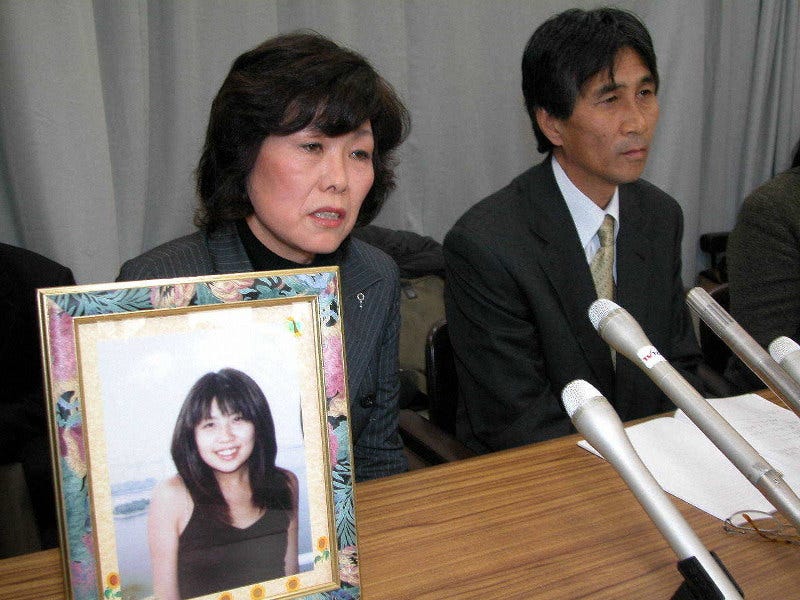
“The criminal who killed my daughter, the police who neglected to investigate, and the media that hurt her honor killed her three times. The wounds do not heal over time,”
-Father of Shiori
As soon as the media got a hold of details of the murder and possible suspect, the police tried everything to paint Shiori as a gold-digging, prostitute. They fabricated lies such as Shiori was actually a sex worker working at Kazuhito’s sex parlors and was getting money and lavish gifts from Kazuhito. They were trying to portray Shiori as a money-hungry slut who deserved what she got.
Unfortunately, the campaign worked and many media outlets and tabloids ran with the story. Instead of an innocent university student who was a victim of stalking, Shiori was seen as a streetwalker, looking to do anything to fill her pockets.

Saving Grace
Though most of the public believed the lies the police were spreading, there was one journalist named Kiyoshi Shimizu who did his own investigation in the case and wrote a huge expose in FOCUS Magazine that finally shun a light on the entire ordeal between Shiori and Kazuhito.
Everything from the stalking, threats, and even a picture of Kazuhito was published. The investigation also showed how the police had lied and falsified documents.
Finally, other media outlets realized the truth and also started reporting on the true identity of Kazuhito and his background. News of his connection to sex shops and illegal activity came to light. Police were forced to do their job and look for Shiori’s killers.
Arrests & Sentencing
Kazuhito was still not back in Saitama and news was he was still in Okinawa. But in the meantime, on December 19th, police arrested and brought into questioning Kubota, the massage parlor manager who had killed Shiori. When they questioned him, he said Kazuhito’s brother, Takeshi, had paid him and his associates to kill Shiori.
On December 27th, Kazuhito’s body was found frozen in a lake in Hokkaido. He left a suicide note in his luggage and had committed suicide. He was able to escape justice but his brother Takeshi, Kubota, and his two associates were all arrested and charged for Shiori’s murder.
Kubota, who actually stabbed and killed Shiori was given 18 years in prison by the Saitama District Court. His two accomplices were given 15 years each for assisting him in his crime. Surprisingly, Kazuhito’s brother, Takeshi, ended up getting the harshest sentence. He was sent to prison for life. Due to his involvement in the constant harassment of Shiori and planning of the murder with his brother, the court said,
“He was the mastermind who paid a large amount of compensation to his accomplices without doing anything himself.”
He appealed the decision but the appeal was dismissed.
The police department involved in falsifying documents and not properly investigating the crime also were investigated. It was found that there had been many mistakes made and three senior officers were dismissed. The family received compensation for Shiori’s death but the penalties for most of the police officers were very light. Most of them just got a 5% to 10% monthly salary reduction for a few months.
Furthermore, before the police trial, the Saitama Police Chief said, “If we had listened to Shiori and her parents’ complaints seriously, it would be a pity to think that her daughter would not have been killed,”
But during the trial, the police changed their tune saying, “there was no causal relationship between the murder of Shiori and the police’s negligence in the investigation.”
Silver Lining
With the failure of the police department, the smearing of Shiori in the media, and the fact that a murder could have been avoided, this was one of the biggest blunders Japanese society had seen. But luckily, Shiori did not die in vain. Once the public found out the truth and realized that the police had let a stalker continuously harass a girl and her family and finally have her killed, they knew things had to change.
In 2000, Japan created the Anti-Stalker Act which prohibited “pursuit” and “stalking” of a person. This gave more power to those who were being harassed to fight back. Although this still doesn’t stop police from trying to coerce victims to handle the problem themselves, it gives more power to victims to make an actual criminal complaint.
The Anti-Stalker Act was revised in January 2017 to include cyberstalking and online harassment with revisions that increased the criminal penalty for stalking from six months to one year and allow prosecution even without a victim filing an official criminal complaint.
And as bullying, stalking, and harassment have moved from physical to online as well, this act ensures that police don’t overlook cases of cyberbullying and cyberstalking. Hopefully, something as dreadful as what happened to Shiori will not happen again.


