
The Tragedy Of The ‘Dark Forest’ Universe.
Fermi’s paradox and the Dark Forest theory.

‘Let’s turn the kindness we show toward the stars to members of the human race on Earth and build up the trust and understanding between the different peoples and civilizations that make up humanity. But for the universe outside the solar system, we should be ever vigilant, and be ready to attribute the worst of intentions to any Others that might exist in space. For a fragile civilization like ours, this is without a doubt the most responsible path.’
— Postscript to US version of The Three-Body Problem, Cixin Lee
I have just finished the second part (with thanks to Sadie Seroxcat for getting me into this awesome trilogy) of the Remembrance Of Earth’s Past by Cixin Liu and it is a mighty great read. The Dark Forest — which is Book 2 — deals with many scientific theories and propositions in an easily followed way as it is done through the lives of characters within the very realistic narrative of First Contact with an alien species.
In The Dark Forest, the author Cixin Liu provides an answer — a very dark answer — to a very famous paradox which is called the Fermi paradox. It is this that I wish to discuss, as it is examined, in Liu’s brilliant exposition. There are a few spoilers ahead.
So let's briefly start with Fermi’s paradox. Italian-American physicist, Enrico Fermi’s name is associated with the paradox because of a casual conversation in the summer of 1950 with fellow physicists Edward Teller, Herbert York, and Emil Konopinski. While walking to lunch, the men discussed recent UFO reports and the possibility of faster-than-light travel. The conversation moved on to other topics until during lunch Fermi blurted out, “But where is everybody?” Meaning extraterrestrials not the human beings in his vicinity.
Fermi was not the first to ask the question. An earlier implicit mention was by Konstantin Tsiolkovsky in an unpublished manuscript from 1933. He noted “people deny the presence of intelligent beings on the planets of the universe” because “(i) if such beings exist they would have visited Earth, and (ii) if such civilizations existed then they would have given us some sign of their existence.” This was not a paradox for others, who took this to imply the absence of ETs. But it was one for him since he believed in extraterrestrial life and the possibility of space travel. Therefore, he proposed what is now known as the zoo hypothesis and speculated that mankind is not yet ready for higher beings to contact us.
That may have put his mind at rest but it still leaves a number of scientific facts which contradict his very original zoo hypothesis. These are contained in the famous and stimulating (Frank) Drake equation of 1961,
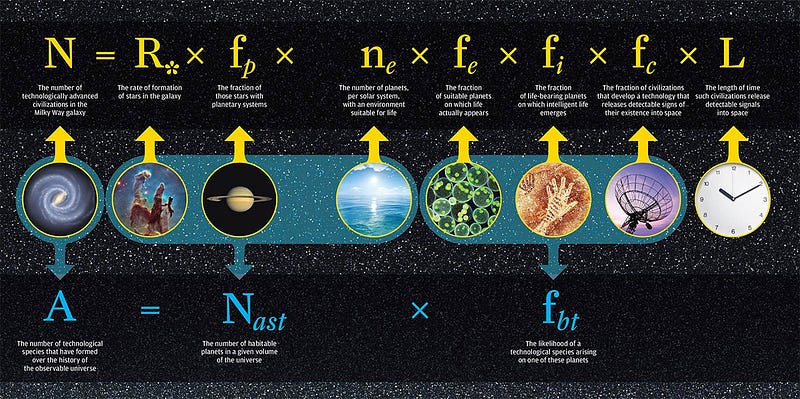
The equation is a probabilistic argument and was never seen as a determining equation for life in the universe. It was meant to inspire the search for extraterrestrial life which it most certainly did accomplish. Yet we have heard nothing. A silentium universi or the silence of the universe. Absolutely nothing.
However, if there are no other intelligent civilizations in the Universe apart from ourselves then this would itself be a paradox. Would it not? For our existence proves that intelligent civilizations can and do arise but then where are the others that we are the living noisy proof of? Here is the paradox. Only one — singular — civilization? Where else in our known universe do we find only one of anything? I can wait.
But life is not singular. It divides to create another and then multiplies to create more life. It cannot be singular for that then is nothing. And,
“Nothing will come of nothing”
— King Lear, Wiliam Shakespeare
But back to Cixin Liu. In The Dark Forest, he creates a First Contact narrative that answers the Fermi paradox with a very very dark metaphor. His narrative creation is built upon solid scientific logic, that the universe is a dark forest where advanced civilizations are hiding — by being silent — from other civilizations in case, they are discovered and eaten/invaded by a superpredator/technologically superior civilization. This answer to the Fermi paradox is presented in a logical argument with axioms voiced by one of the main characters, a Wallfacer, called Luo Ji (罗辑). He builds upon the axioms provided by Ye Wenjie (叶文洁) — an astrophysicist who initiated initial contact between Earth and Trisolaris — to conclude that the result can only result in the ‘Dark Forest’ state of the universe.
The logical argument for the ‘Dark Forest’ (and its axioms) is formulated partially upon the Tragedy of the Commons. This is the second and third axiom of Dark Forest theory which goes like this. First, (Axiom 1), proposes that each civilization’s main motivation is to survive. Second, (Axiom 2) suggests civilization will continuously grow and expand even as all matter in the universe remains constant. (The Commons) That means (Axiom 3) each civilization has to compete with other civilizations for a limited amount of resources as it expands beyond its home planet. (The Tragedy of the Commons).
So here we have the antithesis of the universe of ‘Star Trek’. Gene Roddenberry also used the Drake equation as the guiding foundational light to his vision of a plethora of civilizations in this fictional universe. Technology is shared from advanced to less advanced civilizations when necessary. Although the Federations Prime Directive forbids interference in more primitive worlds and the conquest of such worlds. A very noble concept but a contradiction to the logical argument of the Dark Forest theory and the Tragedy of the Commons.
There are not enough resources in the universe to allow for the unlimited expansion of advanced civilizations. Therefore they will become competitors in resource acquisition and control. But some will already be more equal — technologically — than others. More advanced. They will need more and will view a (and any) competitor as a threat. That creates a superpredator, who at the first opportunity — location of the prey — will attack.
Such a cynical view of life in the universe isn’t necessarily unusual among both science fiction storytellers and scientists. Many researchers — including physicist Stephen Hawking — have warned about the possible dangers from hostile extraterrestrial civilizations. In that spirit, some have argued strongly against the idea of Earth trying to send active signals to extraterrestrial civilizations.
And now Cixin Liu has shown in a gripping narrative exactly why and the logical rationale behind ignoring any attempt at contact. It could well be a trap laid to extinguish our attempts to gain promotion in the league of advanced civilizations, and then one day, join the league of superpredator advanced civilizations in the universe. I am inclined to decline the ‘invitation’ to answer because I very much doubt we are alone in the universe.


