

Feature
The Tragedy of Sabrina Spellman
Chilling Adventures of Sabrina’s hero might also be its villain.
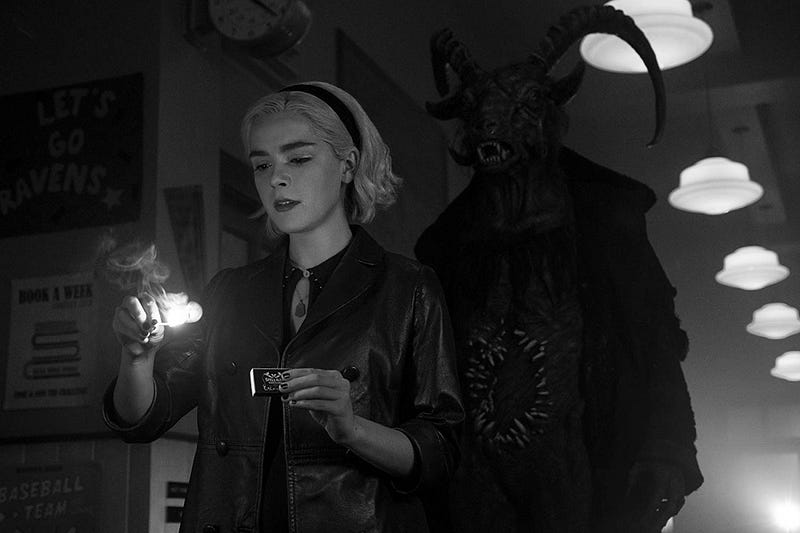
A half-witch, half-mortal choosing between two worlds. That’s how Sabrina Spellman (Kiernan Shipka) describes herself, but it’s an innocent description — as her conflict boils down to picking between two schools. And when she says it, in voiceover during Chilling Adventures of Sabrina’s opening scene, that’s exactly what she thinks she’s doing. But whether to attend the Academy of Unseen Arts or stay in Baxter High isn’t her real concern; even the potential loss of her mortal friendships is just a symptom of a larger internal struggle. That struggle is at the core of the show, and it makes Sabrina Spellman one of television’s most fascinating protagonists.

Our Hero?
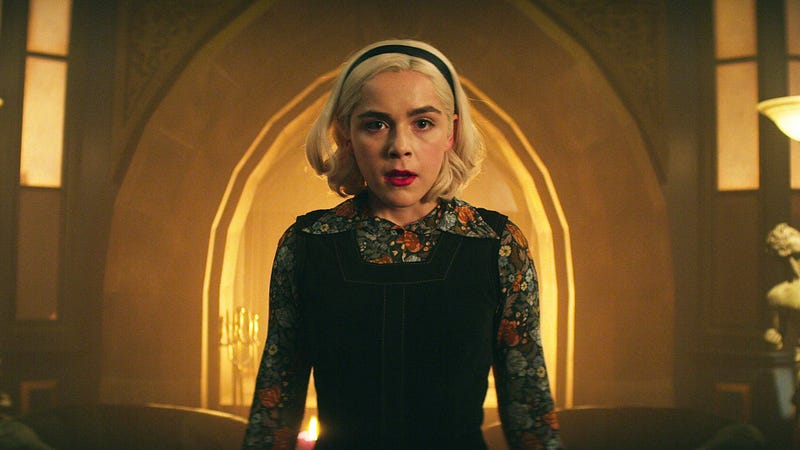
Sabrina is an outsider. Her parents died when she was a baby and she was raised by her aunts to be part of a magical satanic cult — the Church of Night. But her ignorance over key traditions suggests her family sheltered her more than they’d care to admit. The rare witch to have a mortal mother, Sabrina’s consequently given a roughly normal life among humans before turning 16, but must lie to even her closest friends to protect her secret. Lying is a habit she never kicks throughout the series, but one that points directly at her insecurities. She internalised the idea her friends might hate her if they knew what she was and, consequently, came to fear she’s evil at her core.
Evil, naturally, is the trait she insists she lacks to High Priest Faustus Blackwood (Richard Coyle) in the second episode. The Church of Night admittedly has flaws, beginning with cannibalism, but it’s a curious wording from Sabrina’s perspective. She doesn’t know about the cannibalism yet, and her family’s religion portrays the Devil (Luke Cook) as a wrathful but ultimately benevolent force. The Christian influence on her worldview has an easy explanation in her mortal — and Christian — friends. They praise God, not Satan, an opposing worldview. Without them, choosing between her witch and mortal halves would be about lifestyle, not morality.
If even the doe-eyed puppy [Sabrina’s] adopted as a boyfriend thinks her witch blood makes her evil, how then could she justify herself as good?
This is clearest in “Dreams in a Witch House,” season 1’s fifth episode, where Sabrina becomes trapped in her own nightmares. Her worst fear’s not just that her boyfriend Harvey Kinkle (Ross Lynch) would break up with her for being a witch, but that he would condemn her as evil — killing her for it in the dream. That fear makes her quick to wipe Harvey’s memories after she confesses the truth to him in the first episode. It’s a violating action, coming before Harvey’s even had the chance to process a haltingly explained revelation about both his girlfriend and the functioning of the universe. Judging from that same nightmare in the fifth episode, Sabrina feels enormous guilt about it, but it’s also an understandable response from a teenager panicking that the truth might make her unlovable. If even the doe-eyed puppy she’s adopted as a boyfriend thinks her witch blood makes her evil, how then could she justify herself as good? Best to never risk finding out.
It’s ironic to commit an evil act to avoid confronting one’s dark side, but it’s a mistake Sabrina makes repeatedly. She plays the hero almost performatively, regardless of whether her damsels want to be saved, fixing whatever she thinks is broken to prove her goodness. Her friend Theo (Lachlan Watson) would never want his bullies mind-controlled into having sex with each other so that they can be blackmailed with revenge porn, but Sabrina orchestrates what’s essentially magical rape to prove she can stand up for her friend. The extremity is the point: Sabrina might be leaving their shared high school, Baxter High. If she protects her friends, she won’t feel as guilty abandoning them. Theo never learns about her intervention, so the only person she’s trying to convince is herself. Her genuine instinct to help others is heightened by her own insecurities until it becomes toxic.
And when she does help people, she clearly feels good about it. There’s a thrill to it, that’s potentially more a thrill for power. Here, the show’s explicit. Her cousin Ambrose (Chance Perdomo) is the first to call out Sabrina for it, for enjoying torturing Principal Hawthorne (Bronson Pinchot) with spiders, and by season 2’s finale, Sabrina herself has embraced her own ambition. But there’s a line between ambition and enjoying power over others, and Sabrina invariably seems thrilled whenever she puts another in their place. Her pride befits the Devil’s daughter, a sense of righteousness built from solving problems she shouldn’t have been the one to solve.
Lilith (Michelle Gomez), Satan’s undercover devotee, manipulates Sabrina by telling her what she wants to hear: that she has power and can use it for good. Sabrina should probably question why a witch she barely knows helps her conduct an experimental exorcism, but Lilith validates Sabrina for playing God instead of criticizing her. Sabrina isn’t an idiot, but her ego makes it easy for others to manipulate her.
How an Angel Falls
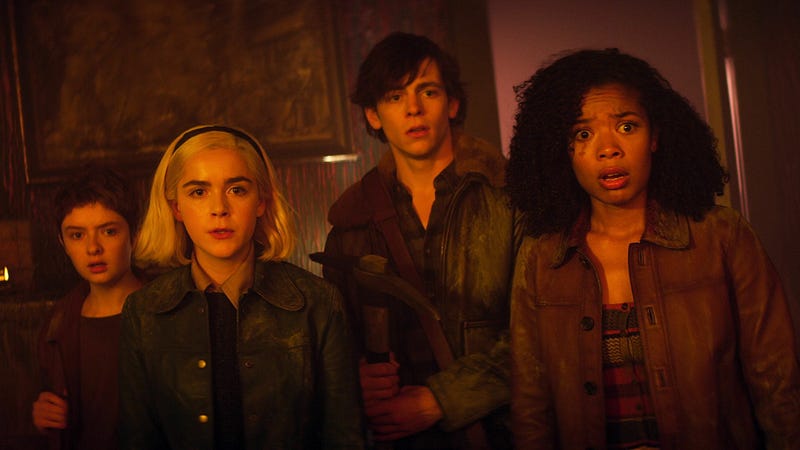
It doesn’t hurt that Sabrina has plenty of successes playing God, including the exorcism. The formerly-possessed Jesse Putnam (Jason Beaudoin) might die, but he found peace in his final moments. Yes, he’s then crucified and slowly ripped apart by vultures in Hell, but Sabrina doesn’t know that until later, so she doesn’t realise how outmatched she is. Torturing Hawthorne with spiders lets her create a women’s advocacy group, violating the jocks stops Theo’s bullying, and she seemingly beats the Dark Lord in court. The craven, misogynistic Faustus Blackwood more than deserves Sabrina’s insolence, and her scepticism saves the life of Prudence (Tati Gabrielle) during the cannibalistic Feast of Feasts, while nearly ending the gruesome tradition entirely.
… resurrection seems normal for Sabrina, considering one of her aunts continually kills the other.
There’s a reason Sabrina’s confident she can bring back the dead when Harvey’s brother Tommy (Justin Dobies) dies. Blackwood and her family claim it’s too dangerous, but they’ve already spent their credibility defending a corrupt status quo. Plus, resurrection seems normal for Sabrina, considering one of her aunts continually kills the other. Agatha (Adeline Rudolph) seemingly bears the risk in Sabrina’s plan, and she murdered Tommy in the first place. And aside from Agatha’s frankly deserved illness, the resurrection scheme would have worked if Lilith hadn’t sabotaged Sabrina while in Limbo.
Sabrina makes a mistake that leads to her boyfriend shooting his brother’s soulless husk, but the mistake isn’t trying to help; it’s not asking Harvey before taking high-risk actions that could change his life. She rationalises that he would do the same for her. But in her imaginary scenario, she obviously wants him to, a consent she never allows the real Harvey a chance to give. Harvey’s entirely capable of making this choice himself: Sabrina could just tell him the truth.
She’s terrified of the consequences of that, but her avoidance goes deeper. Even after Harvey knows she’s a witch, she still doesn’t consult him before curing his father’s alcoholism. Sabrina’s pride and need to be the hero can make her controlling. She assumes that she alone knows how to save the day and that consulting others is just patriarchal bureaucracy. It’s an understandable impulse when dealing with the Church of Night, but not with her devoted partner.
Sabrina does learn this eventually, giving her friend Roz (Jaz Sinclair) the choice to heal her sight, but only after it costs her the boy she loves. Harvey would have accepted her just like Rosalind and Theo do if she hadn’t violated his memories and accidentally forced him to shoot his brother. Her palpable fear when Roz and Theo ask if she’s a witch shows how much she cares about her friends’ judgements. To avoid receiving them, she repeatedly takes away their choices.
Sabrina’s fearful need to see herself as good is eventually weaponized by Lilith. Lilith only convinces Sabrina to sign the Book of the Beast, selling her soul to the Devil, when it seems like a heroic action — self-sacrifice for the greater good. The firstborn mortals of Greendale could be killed unless Sabrina unleashes her full powers by signing her name. In Sabrina’s defence, she doesn’t yet know she’s Satan’s heir, that her signature’s different than her aunt’s, or that Lilith created this crisis to force Sabrina’s hand. But she already knows that Lucifer’s making exceptions for her, compelling her to attend the Academy even without a signature. If she stopped to think, she might have wondered why Lilith couldn’t use her own powers. Only a few witches can summon the needed hellfire, but Sabrina only learns this after signing herself away. For that matter, all other options hadn’t been exhausted.
But unlike at her dark baptism, the trade here is to help others, not herself. And once given the pretence, Sabrina’s desire for power makes the Devil’s bargain an attractive proposition. If she did catch that her name means more to Satan than typical, then she already considers herself exceptional. Her heroism, ambition, and pride are inextricable, and all three lead to her signing her name. Ironically, all three are rooted in her desire to be good, and specifically better than her patriarchal coven and tense family. Sabrina literally embodies the proverb that the road to Hell is paved with good intentions. Praise Satan that no character has pointed it out.
Playing the Devil’s Game
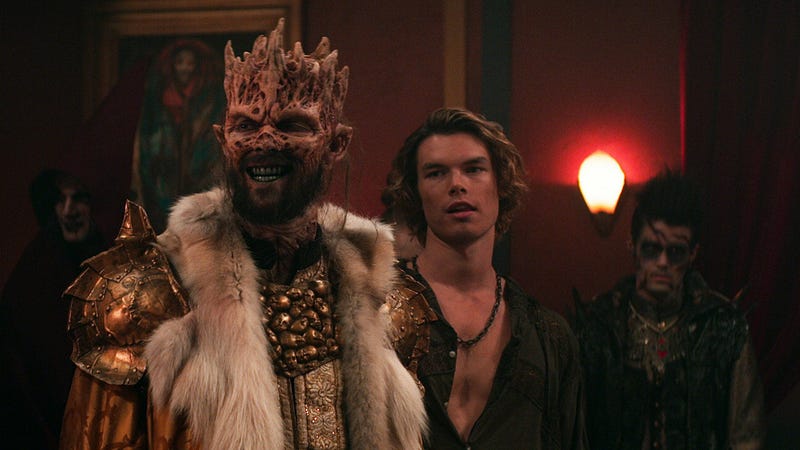
The practical effect of signing the Book is presumably psychological. While season 2 confirms that the coven genuinely draws its powers from Satan, if the Book functions as advertised, their coup against Satan and prolonged imprisonment of him should be effectively impossible. This is consistent with Satan’s tests in “The Passion of Sabrina Spellman.” If Satan’s followers literally can’t disobey him, there would be no need to test them; making Salem sick, putting marks on people, and generally irritating Sabrina is well within Satan’s demonstrated range of powers, Book or no Book. Signing really is a mostly symbolic gesture as Blackwood first described to Sabrina.
But if the Book of the Beast is a purely psychological weapon, then it’s an effective one, transferring blame for Satan’s acts onto the victim and pre-emptively convincing his followers that dissent is hopeless. In Sabrina’s case, signing the Book gives her an excuse to focus on her witch half and cut off her mortal friends.
Sabrina, to her knowledge, places her friends in danger with the stroke of a bloody quill. But she’s not known for caution and more than willing to fight to be with Nick (Gavin Leatherwood) in season 2, so it’s hard to believe her sole motivation for ghosting Harvey, Roz, and Theo is risk mitigation. Her relationship with Harvey is already a mess and leaving it “to protect him” lets her avoid admitting fault. Furthermore, his negative experiences with magic mean she’d need to stifle half her identity to be with him. Harvey later gains a more nuanced view of magic, but that requires space from Sabrina and her constant manipulations.
And for Sabrina, those manipulations are suddenly unsustainable. Harvey finally has the chance to tell her that he doesn’t consent. If she continues, she’d have to admit to controlling him, an unsustainable proposition when her worst fear is her own darkness. It’s easier to sever the relationship so that she can continue to act the same way without being judged for it. Notably, Sabrina never explains to Harvey that she signed the Book of the Beast. She’s still afraid of how he’d respond to the truth; if she’s really trying to protect him, she would explain her reasoning to save him from heartbreak instead of hiding it.
Her connections to Roz and Theo are less formally broken, but she clearly feared they would desert her when she confessed to witchcraft, and signing the book reasserts that fear. She’s now formally aligned with the forces of darkness; terrified of confronting the implications, she isolates herself from potential sources of criticism.
Sabrina also surrounds herself with people who encourage her down the Path of Night. If we inevitably become our friends, then Sabrina’s decision to focus on the Academy is a glorified surrender to Satan. She signs the Book under duress but the commitment evolves her identity from rebellious outsider to reformist within the system. Instead of outwitting the Dark Lord, now she plans to be High Priestess, his representative in the coven, and promote gender equality — technically in his name.
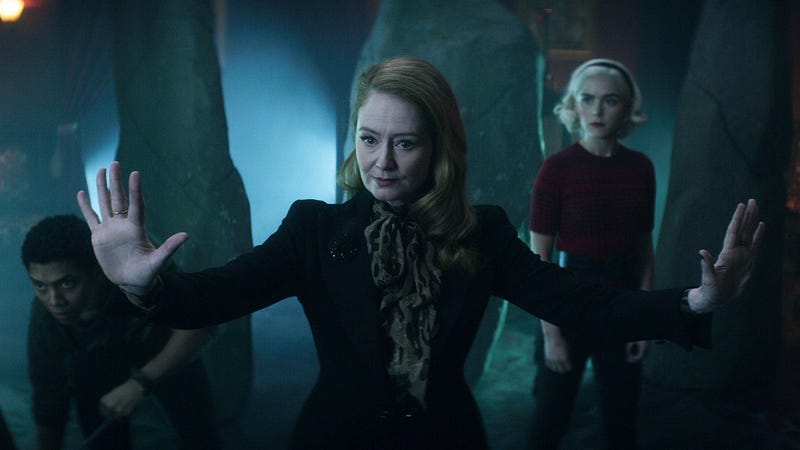
She dates Nicholas Scratch — a warlock who likewise scoffs at cannibalistic rituals but is content to be a conscientious objector not above a pre-Feast orgy with the entrée. Nick’s reasoned moderation is absurd considering what the coven actually does, but he’s had his whole life to normalise their behaviour. Sabrina risks the same happening to her. Dorcas (Abigail Cowen) and Agatha murdered her ex-boyfriend’s brother, but she still hangs out with them after signing. Even the signing itself is an act of normalising, deciding that everything she’s seen Satan’s followers do is an acceptable price for resolving the immediate crisis, like a reluctant Trump voter casting aside their doubts to stop Hillary Clinton.
The Limits of The Book
All that said, Lilith’s right when she says Sabrina’s fundamental nature leans towards goodness. Just because that goodness can be manipulated doesn’t mean it won’t be a slow process. Satan eventually gets Sabrina to steal a pack of gum, normalising another wicked behaviour by letting her “win” on his more extreme demand that she burns down Baxter High. At that point, she supposedly doesn’t even need to steal the pack; she does it as a thrill after a supposed victory for her free will. But the road between shoplifting and supporting Hell on Earth is a long one, and not always straight; Sabrina’s rift from her mortal friends after signing the Book proves only temporary. The Dark Lord is even prouder than Sabrina, and consequently less patient. His downfall comes from playing his hand too soon, instead of first dragging Sabrina closer to his level.
Satan does manage to shock her with the reveal that she’s the Herald of Hell. Her briefly held belief that she’s destined to spread her “father” Edward Spellman’s (Georgie Daburas) teachings gives Sabrina a chance to see herself as wholly good without sacrificing any parts of her identity. The sudden confirmation of her worst nightmare, that she’s seemingly destined to be evil, sends her into a spiral. Creating the mandrake version of herself is the same kind of mistake she made signing the Book of the Beast, an easy route that feels heroic. But this time there’s no immediate crisis inciting it except for the existential one in her head. Her good intentions lead to more evil actions: Hurting her friends and family by making herself mortal and then killing the mandrake. Accidently triggering the apocalypse she was trying to prevent shakes her identity enough that she’s willing to listen to Satan for answers.
Sabrina wants to control, not to be controlled.
Satan’s reveal that he’s her father is a smart play. It’s the worst possible news for Sabrina, connecting her intimately with evil. Additionally, Edward Spellman is Sabrina’s example that a witch in her society can be good; Now her familial connection’s lost, while the revelation raises questions over Edward’s virtue.
Satan revealing that Nick’s been working for him is less smart. Sabrina wants to control, not to be controlled. And Satan fails to make his case to her. At his side, she could bring back everyone she’s lost, reform the Church of Night, and whatever else she desires. He humiliates Blackwood, her archenemy, while she’s not present, and never downplays what Hell on Earth would actually entail. If Sabrina wants to integrate witches and mortals, surely the case could be made for integrating demons as well? He assumes he’s already won the mind game because he always wins the mind game. The ego and controlling instincts he shares with his daughter stop him from connecting with her.
The specific mechanics of the Flesh Acheron have a tinge of deus ex machina. Trapping Satan inside Nick and Nick inside Hell ensures Sabrina rescues them both in an overly neat fashion while giving her the chance to take over Hell. But that’s because Sabrina repeatedly prioritizes individual people over the bigger picture, an impulse extending beyond her family and friends, like when she risks her new position to let the chess player (Beau Daniels) go to Heaven. If Prince of Hell Caliban (Sam Corlett) takes the throne from her, he would attack the Earth, so securing her position is strategically more important than an individual soul, however heartless letting an old man burn in Hell might seem. Even at its most sincere, Sabrina’s desire to be good leads her closer to the apocalypse.
And at that moment, her desire to be good is especially strong, because she feels guilty about seizing Hell’s throne, especially when she’d previously offered it to Lilith. While necessary to protect Earth, it’s an uncomfortably public display of ambition, one privately supported by Satan.
Her coup also protects Nick, and Sabrina seizes upon this detail to explain her actions. It fits her own idea of heroism, which excludes even the best-intentioned Machiavellian schemes. Unfortunately, her desire to prove that Nick was the reason she took the throne makes her pointedly ignore the duties that throne entails. To prove her humility, she risks a coup that would lead to Earth’s invasion. Nick himself informs Sabrina she seized her birthright for power, not for him, a cynical take needed to push her to action.
By then, unfortunately, a pagan group had taken advantage of the power vacuum in Hell to attack humanity themselves. After Nick’s talk, Sabrina prioritizes beating Caliban’s leadership challenge over the earthbound dilemma, which Nick also criticizes, because he’s been through a lot and wants to complain. Both threats are apocalyptic, and Sabrina can’t be in two places at once (yet), though she could probably run sometimes.
That Hell even has succession laws suggests Satan never planned to rule forever, a thread future seasons may well continue.
There is, however, one solution she doesn’t take: Caliban’s proposal of marriage. Agreeing would turn the leadership contest into a formality, letting her focus on the pagans, and through his offer would take Hell invading Earth off the table.
An unresolved hole in this plan is Satan, who presumably wouldn’t want a Morningstar merely co-ruling Hell. It’s curious that Satan accepts the leadership contest’s legitimacy at all, supporting his daughter’s claim rather than retaking the throne himself. He seems to intend to eventually replace her with her soon-to-be-born brother, suggesting Satan may be genuinely ready to retire. This tracks with his decision to have a child after waiting for millennia and then rushing making her Queen. Under his original plan, Sabrina would be under him, but perhaps he meant to start a transition. That Hell even has succession laws suggests Satan never planned to rule forever, a thread future seasons may well continue.
Regardless, we never see his reaction to Caliban’s plan, because Sabrina rejects it. Only ruling Hell part-time is nominally what Sabrina wants, but when it’s through Lilith as a regent, Sabrina still has formal control. With Caliban, she would have to give up power. Sabrina signed her name away to the patriarchy once before, and while a wedding contract isn’t the Book of the Beast, she’s learned her lesson. Unfortunately, rejecting Caliban leads to an apocalypse only prevented through time-travel.
A Tale of Two Teenage Witches
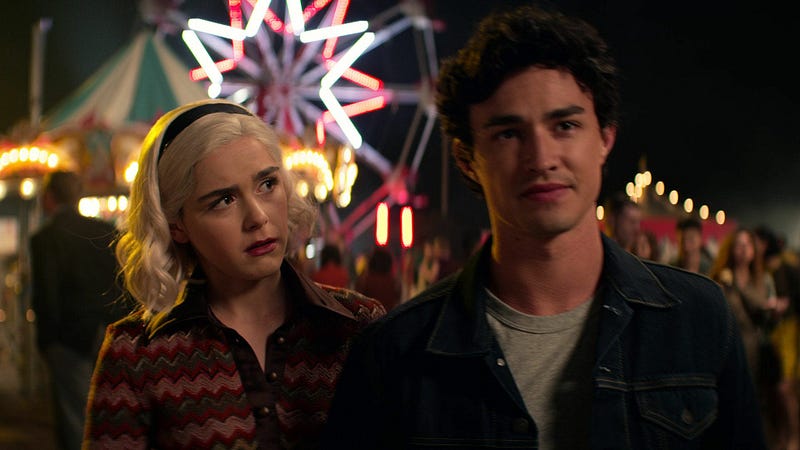
When Sabrina decides not to kiss Harvey to gain the Judas coins, she chooses yet again what looks right over what saves lives, especially when she could have explained afterwards. Letting Caliban, disguised as Judas, hold the coins after she acquires them is another example, but one that admittedly pushes her characterization to the extreme. Caliban’s plan here is also pointlessly risky, and the resulting time paradox is impossible; she already has to be free to free herself, and completing the loop, as Ambrose recommends, would seemingly leave Sabrina trapped in Hell’s 9th circle forever. Sabrina herself discourages overthinking this plot point, but it does cause the brilliant creation of two identical versions of Sabrina, who decide between themselves that one will rule Hell while the other stays with their family.
Both will be miserable. Sabrina compulsively needs both the power to help others and her family and friends to ground her. Splitting duties just leaves two Sabrinas half-fulfilled. The only one likely to have it all is the viewer: Chilling Adventures of Sabrina always wanted to be a character-driven tragedy and a campy adventure, to let Sabrina be an anti-hero and a hero at the same time. Now the writers have exactly that option, to explore both paths for their teenage witch.
If the Devil offers freedom or power, but not both, because he’s a man, then God is likely no better.
The obvious choice for the tragic Sabrina is the one ruling Hell, isolated from her mortal half as the Dark Lord always intended. But while Sabrina’s overt desire to be good often leads her down the easy path and closer to the dark, here the same impulse might save her. She knows the danger to her soul and can work consciously to resist it.
The “normal” Sabrina, however, has finally laid her worries to rest. Separating herself from her hellish heritage alleviates the fear of her own darkness, even as the psychological temptation remains. Sabrina’s powers go a lot further when she’s surrounded by mortals, and there will always be a need for magic. Sabrina’s worst excesses have previously come helping her mortal friends, from resurrecting Tommy Kinkle to trying to spare Earth from the apocalypse by making the mandrake. No one can escape their fundamental nature and trying to do so puts both Sabrinas at risk of morally declining. But, going forward, only one will likely be aware of the problem. Notably, when her Aunt Zelda (Miranda Otto) sees a vision of her future, only one Sabrina comes to her death bed, and she’s clearly been away a long time. Her tender words to Zelda imply that this Sabrina is still good, and ruling Hell would explain her absence.
There’s also another possibility: that this Sabrina isn’t Queen of Hell… but Heaven. She’s always liked playing God, and season 2’s fanatical angels suggest Satan’s only one side of the same patriarchal coin. If the Devil offers freedom or power, but not both, because he’s a man, then God is likely no better. Sabrina once intended to take down the system, only to settle on reforming it from the inside. Faustus Blackwood already made Zelda, Prudence, and Ambrose pay for the same logic. Patriarchy is institutional and it’s more likely to absorb a reformer than be changed by one.
Signing your name in the Book only lengthens the Book; the only way to stop the Book is to burn it away entirely. If the story of Sabrina Morningstar Spellman really is a tragedy, it’s because she never drops that match.
