
The Torn Posters in the Paris Metro (February 2024)
Highlights from last month’s wanderings below the French capital

There’s an old saying that you should never work for free.
But based on my observations from the Paris Metro, some people seem to enjoy giving their labour for nothing in return.
Okay, perhaps the idea of ripping up advertising posters might stretch the definition of work — especially in light of the fact that their work is, well, not exactly sought after.
But regardless of their intentions, the fact remains that someone is voluntarily performing services that no one asked for, and which few, presumably, appreciate.
Among those who admire their work, however, is me — who over the course of four years has documented and collected over 400 such torn posters. While not every photo I’ve taken has been necessarily beautiful or visually engaging, there’s nonetheless something inherently interesting — at least for me — about these rips.
Which is why, whenever I come across them, my natural instinct is to snap them and preserve the humblest of cultural ephemera.
In January 2024, after returning from the Christmas break, I must admit I hadn’t stumbled across many posters. Most days were spent going to and from work, and a taxing schedule meant that I had neither the time nor the inclination to go much further afield than the place where I offer my own services — in return, in my case, for compensation.
But as I’ve come to discover, when it rains, it pours.
I’m inclined to consider portraits with tastefully conceived rips as the holy grail of metro tears. They tend to look good online as they contain a clear subject, attention-grabbing rips, and few distracting elements.
And as luck would have it, they were abounding underground.
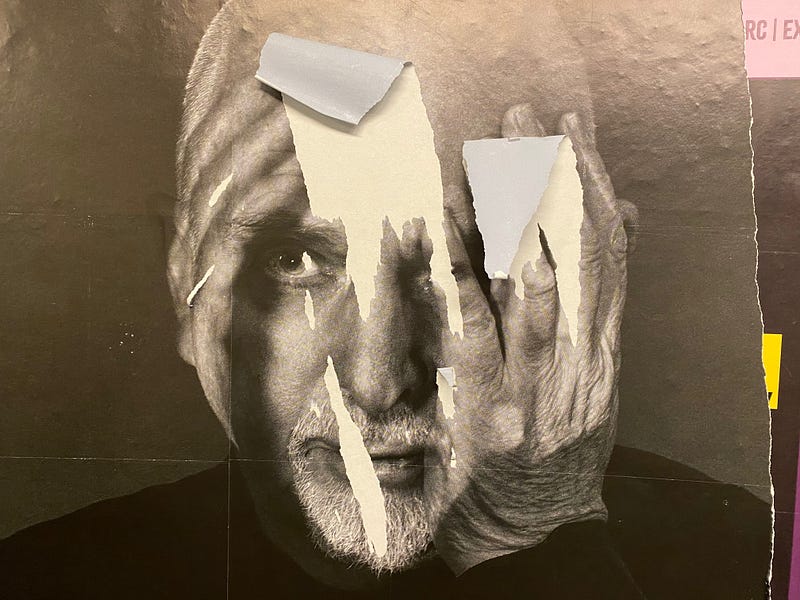

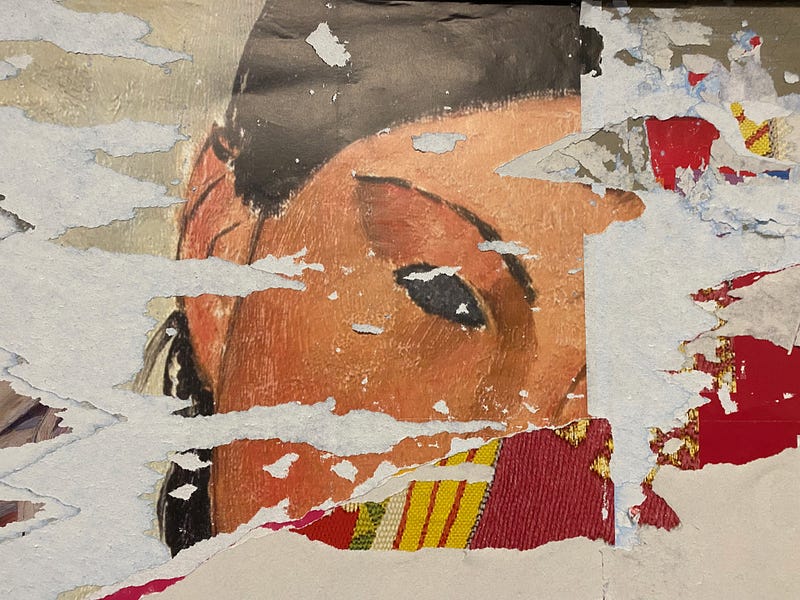

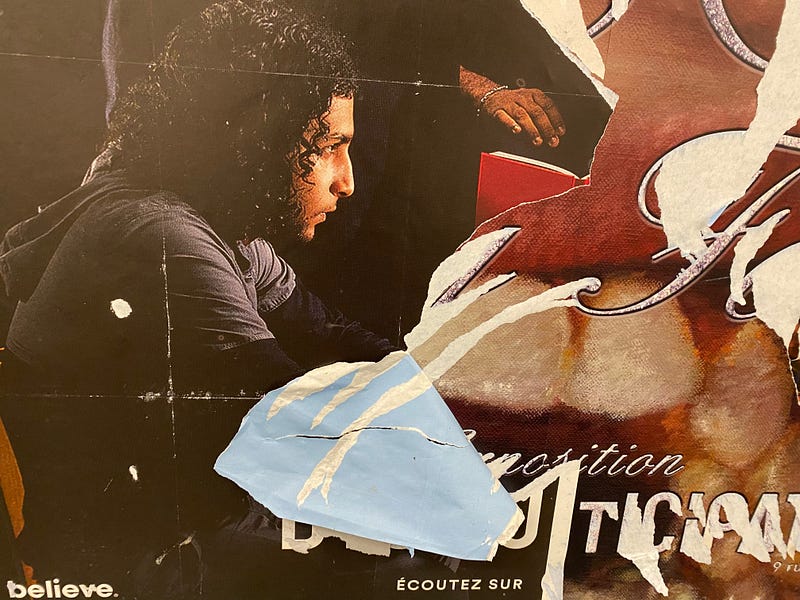
Whilst most days didn’t offer up a single poster, there were a couple of moments in January when most of the lacerations appeared at once.
On the 6th January 2024, I found a few ripped specimens in Lamarck-Caulaincourt, a metro station slightly to the north of Montmartre that has multiple staircases heading down into the underground.
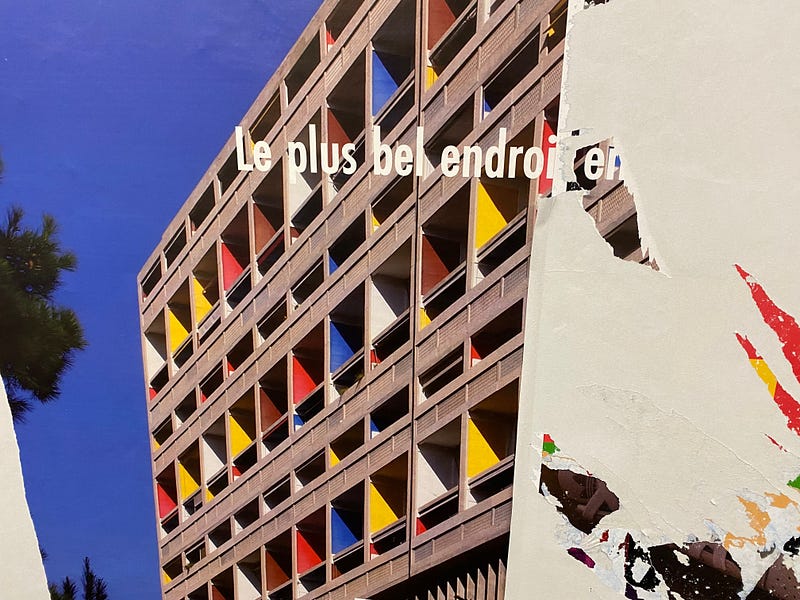
Then on 20th January 2024, I was transferring through Stalingrad when I came across an entire tunnel of torn posters. In this particular setting, not a single poster had been spared the wrath of a zealous vandal, who had seemingly lain waste to the entire area. The destruction not only left a whole series of white rips along the walls, but also the impression that if I wanted a quick dopamine boost, I could simply make a beeline to a station memorialising a Soviet dictator.



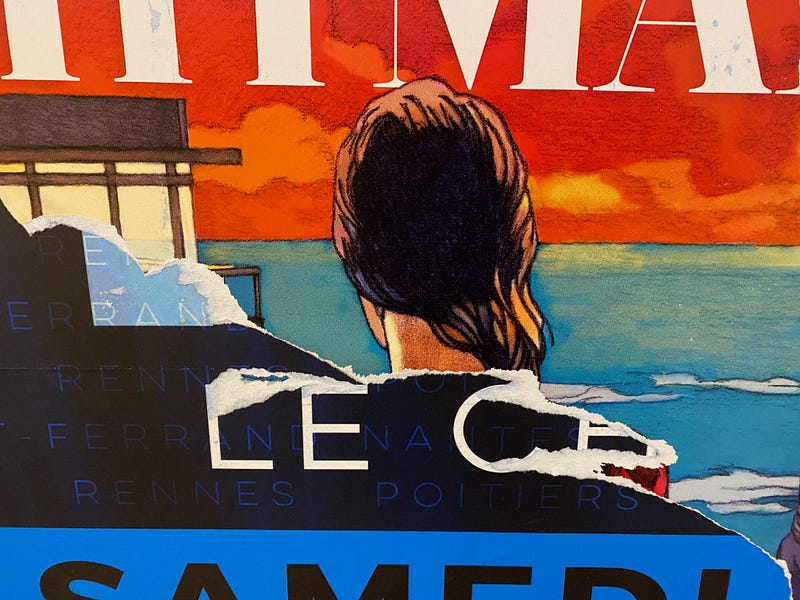
But perhaps that wouldn’t be such a great idea.
When I lived in the 19th arrondissement, where Stalingrad can be found, I never made a conscious effort to get off at that particular metro station. And for good reason: it’s in one of the least secure areas in Paris. The neighbourhood is close to where drug trafficking takes place, and there’s always an element of human misery around that can be depressing to witness. Simply put, it’s not a place you’d go out of your way to visit unless you had a solid reason to be there.
Besides the metro station’s location — or perhaps because of it — the images I found were surprisingly diverse in the styles of art and rips on offer. Taking photos of torn posters was like being a guest at a visual smörgåsbord — one where you could easily go back for seconds if you had the longing to do so. But, in all honesty, there are probably better ways to spend your weekend.
The reason I know Stalingrad is because I used to pass it on the way home from work. I would catch line 2 from the 17th arrondissement and then make my to the 19th in the north-east of the city, crossing over the infamous stretch of land between the Gare du Nord and the Gare de l'Est train stations that I had been advised not to linger around after dark.
I provide these anecdotes not to be judgemental about a broad geographical area but rather to provide some on-the-ground (or should that be underground?) insight into the Paris Métro that one might not otherwise be aware of. Whilst Paris is often caricatured in the public imagination as some kind of cultural Disneyland, the reality is a little bit more complicated. Of course, one could easily live the tourist fairy tale by keeping away from the sketchier parts of the capital. But even then, one would probably still avail oneself of the metro, which remains a public space where some of this sordid reality is inescapable — and where the tearing up of advertising posters can be read as a sort of low-stakes anarchy; a way for members of the public to breach rules and get away with it.
And weirdly enough, this low-flying chaos is one of the reasons I like Paris. The existence of individuals seemingly committed to vandalising advertisements underground forever reminds us that the city has a disruptive side to it, and it’s this sense of restlessness which ensures that Paris never stops feeling like a living, breathing city.