
19 341 Feet: Kilimanjaro Part XX
The Top of Kilimanjaro
You Keep Every Mountain You Climb
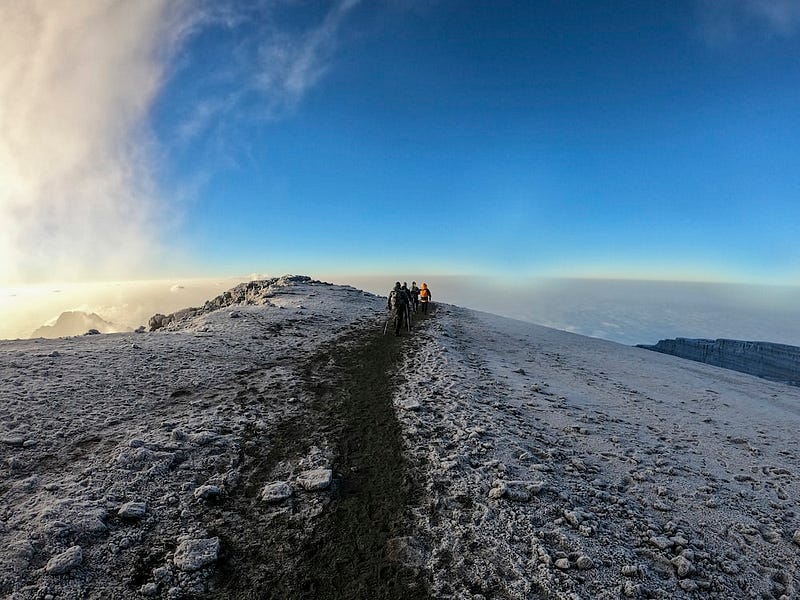
My heavy bag slithers off my shoulders. I am apathetic, lifeless. Let it fall. Let it slide down the mountainside. Who needs a frozen water bladder anyway?
My bag isn’t falling pray to gravity. It’s being taken: by Rumisha.
He never says a word — we both know what he’s up to. He’s going to carry my extra weight for me. I’ve closed my eyes too long; I’ve stumbled one too many times. Rumisha has seen me struggle, and he knows I have too much pride to say yes if he offers to carry my bag for me. So he doesn’t offer. He takes the straps and throws them over his own shoulders. Then he nods and points forward.
“Pole pole.” We keep going.
I am a toddler mounting the Burj Khalifa. Every step is its own herculean labor. If ever there was a time to break the glass in case of emergency, this is it.
I reach into my pocket and reveal a frozen Snickers Bar. The chocolate is frozen into a stone, but I can chip a morsel free with my teeth. I let the nibble of chocolate melt across my tongue until I can taste nougat and caramel.
The sugar runs through my blood and electrifies my brain. It makes me forget that my feet hurt. I dare to look up, and for the first time, I can see Gilman’s Point, the first of three markers at the top of Kilimanjaro. It’s right there. It’s possible.
I feel a ghost pushing me from behind as I scramble over boulders like a quadrupedal beast. Full of sugar and free of my heavy bag, I discover a brand new wind. I can hear Claire coming up behind me. In the dark all I can see is her shape: but I know that shape.
My voice, absent these last dark hours, comes back to me. “Claire! You’re almost there! We’re almost there! I can see Gilman’s Point! It’s so close Claire! We made it!”
At Gilman’s we are still cold, still exposed to the wind, still exhausted, still sick, still delusional. We stop just long enough to commiserate, to snap free another fragment of Snickers, to fist pump. “See you at Stella Point.”
Stella Point is the last stop before the top of Africa, the site where all roads up the mountain assemble. I can see climbers on the Lemosho route. They glow like caterpillars inching up the mountain, undulating in single file with their blue and white headlamps. Across the frozen air, I hear angels singing.
They aren’t singing in any language I have ever known. It’s as if an otherworldly choir has scaled Kilimanjaro as if they’ve come to announce our arrival. The sun is taking the black away from above us, but I can still see the stars in the sky and the glaciers below.
Whoever fashioned that old stereotype of heaven — full of clouds, harps, and angels — must have dreamed the very sight I now see. This feeling of deserved joy will be my moveable feast, the emotion I can conjure when the hackneyed rhythm of everyday life resumes. A memory to remind me that greatness belongs to this life.
You get to keep the mountains you climb. That is why you should suffer them.
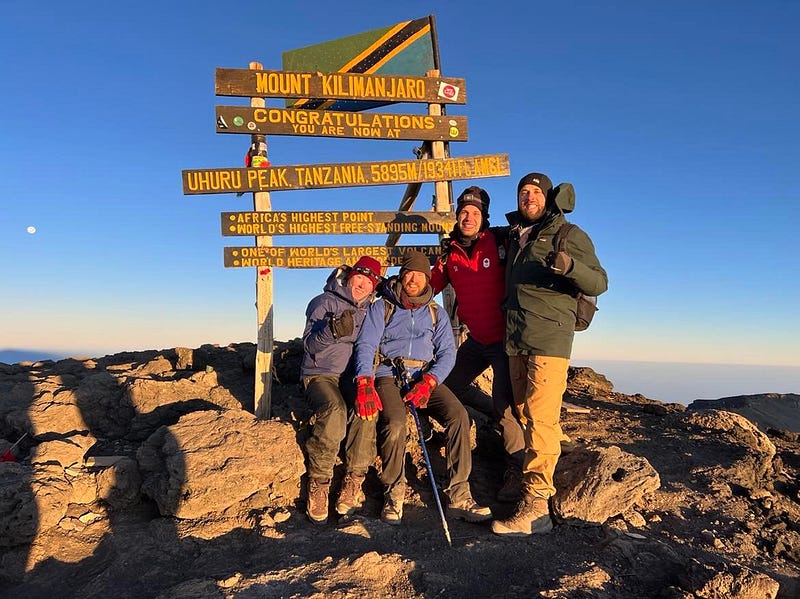
The true top, the wooden sign that announces Uhuru peak, is fine enough I suppose. The sun rises at Uhuru, but it rises below us. We stand at the sign so Ibrahim can take our picture. Then, ten seconds later, we are waved away. The next group is waiting.
I can see tears in the eyes of Stanley and Dr. Quinn. Claire is holding up beautifully. I’m sure I’ll catch her crying one day, but it’s not today. I am overjoyed, made dumb by happiness and oxygen deprivation, but there are no tears on my cheeks. Then, before we descend, I stumble upon a plaque.
“We: the people of Tanganyika, would like to light candle and put it on top of mount Kilimanjaro which would shine beyond our borders giving hope where there was despair, love where there was hate, and dignity where before there was only humiliation.”
And I cry.
Reading these very same words twelve hours later, I feel a perfect fool. Chalk my tears up to the thin air. Or maybe I needed an excuse, permission to release every emotion I’ve had since I first asked Claire if she’d like to climb Kilimanjaro. I let tears freeze into my beard, until altitude sickness gets the better of me, and I have to run to be sick behind the nearest rock.
Having vomited myself back into the emotional abyss of a mid-century man, I am ready to descend.
As we step back onto the face of the steep gradient past Gilman’s Point, the rising sun melts the scenery. The temperature soars by thirty degrees Celsius, and so the members of our expedition do what any sensible person would do with the onset of a sudden summer.
We strip.
Where just three hours before I was frozen in five layers, I am now too hot in a t-shirt. The volcanic ash that made our ascent so inconvenient is a perfect surface to slide down. I’m skiing, using my poles for support as I glide over the ash back to Kibo Hut, obscuring my own footsteps in a layer of silt.
Skating down the mountain in the sun is a wonderful feeling, until I lose my footing on a hidden rock, and tumble face-first into the mountain, slicing my arms before I can catch myself. I’m exhausted and embarrassed as Rumisha loops his arm in mine to help me descend.
“Most people, they fall on the way down,” Rumisha says. I still need my wits.
I am at Kibo Hut once again, collapsed in my bunk with the sun shining on my face through the open door. I am dehydrated, I am sore, and I am happy. They told us we have an hour to sleep. We petitioned for two.
So, two hours from now, I will wake up for the very first time as a man who once climbed to the top of Mount Kilimanjaro.
I can’t wait.
Catch the start of my Kilimanjaro series here:
And don’t miss this tour through Convergence Station courtesy of Kathryn Lee:


