The tomb of China’s First Emperor is still shrouded in mystery. It hides an extraordinary treasure
The tomb of China’s first emperor is considered one of the greatest archaeological discoveries in history. It contains extraordinary treasures that remain invisible to the eye to this day.
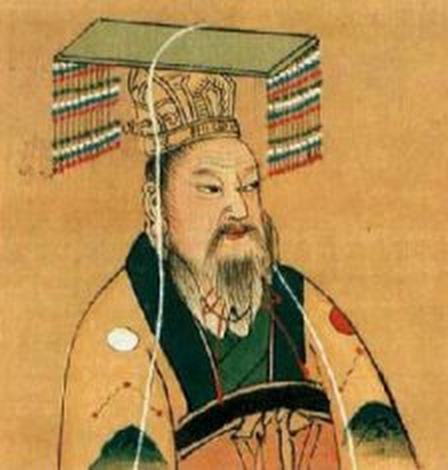
Shi Huangdi was the short-reigning emperor of China from 221–210 BC. Despite his short reign, he managed to introduce many reforms that helped unify the country. He built the Great Wall, laid out transportation routes, and carried out administrative reform of the country. Shi Huangdi took the title “huangdi,” which means “supreme ruler,” emperor.” However, despite his status, he knew he was just a mere mortal.
Unusual treasures in the tomb
In the 2nd century BC. Shi Huangdi had Mount Li drilled, where a sarcophagus filled with treasures was placed. Today, the tomb of China’s first emperor is one of the tourist attractions in Shaanxi province. However, although the Chinese know that the tomb contains extraordinary treasures, it has not yet been unearthed. The Chinese fear that too much curiosity could lead to the destruction of the items inside the tomb. In the past, during the opening of Emperor Wanli’s tomb, archaeologists noticed how the priceless silks lost their colors and disintegrated into tiny pieces when they came into contact with the air.
After the incident, Chinese authorities do not allow the opening of Shi Huangdi’s tomb. Archaeologists make regular requests to Beijing, but each time they receive an unequivocal answer:
“We are not ready yet, we are not in a hurry, let’s leave it for future generations.”
They know they cannot technically secure the treasures located there. Nevertheless, many tunnels leading to the interior of the mountain have been discovered on the mountain. Unfortunately, they are too short to reach the tomb chamber itself.
However, even if the appropriate techniques were available, it would not be easy to get inside the tomb. As Sima Qian noted:
“Craftsmen were ordered to make crossbows and arrows that would instantly shoot at whoever wanted to tunnel and approach the burial chamber.”
Secondly, the ancient Chinese coated bronze with a layer of chromates — salts of chromic acid, which could further protect ancient crossbows from corrosion. Daredevils who are the first to enter the emperor’s tomb may need more than the usual police shields.
Thanks to ancient records, non-invasive surveys of the hill, and comparisons with other imperial tombs, we can guess what hides the final resting place of the Lord of Heaven. Geomagnetic analyses prove that inside there is a hangt structure — ‘compacted earth’, something like a small pyramid. Inside it is another structure — wooden — with a hollow space inside.
“Since ancient times, no one has been buried in such a luxurious way as Shi Huangdi,” summed up the underground complex by chronicler Liu Xian in the first century BC.
De Luxe Burial
In ancient China, as in ancient Egypt, it was believed that after death a ruler needed the same things he enjoyed during his lifetime. The interior of the hill probably hides richly decorated silk robes, jewelry, pearls, jade objects highly prized by the Chinese, furniture, clay models of boats, imperial carts. — The emperor was a great fan of music, certainly all kinds of instruments were buried with him, Li Guo Zhikun said at the press conference. The tomb is also likely to contain representations of living beings, such as the emperor’s favorite horses, servants or concubines.
It’s possible that instead of clay statues, Shi Huangdi had his beloved ones buried with him, who allowed themselves to be killed. However, since the Han Dynasty, human sacrifice has faded away, and clay figurines are now found in graves. It is not known whether the emperor had living people put in his grave or made representations of them. Chinese people did not put as much foodstuffs in their graves as the Egyptians, but sometimes we find noodles, wine and peanuts there.
Chinese scholars are currently debating in what condition the body of the first Emperor might have been preserved. The ruler died in the summer during an inspection trip, and his body began to stink even before being brought to the capital. However, Guo Zhikun believes that the doctors accompanying the ruler did everything possible to prevent his remains from rotting. Chinese aristocrats usually put huge amounts of mercury in their graves to prevent corpses from decomposing. Historical records show that the ruler’s burial mountain was surrounded by a moat filled with mercury. On this basis, Guo Zhikun suggests that the body of the First Emperor survived in the form of a better or worse preserved mummy.
Not everything has been discovered yet
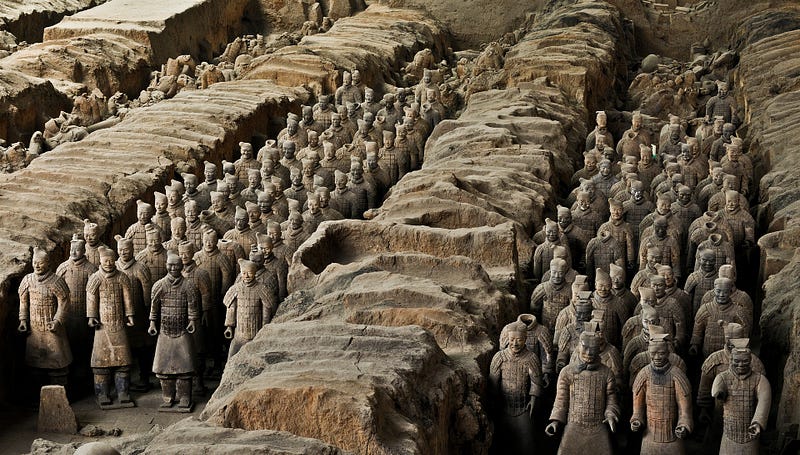
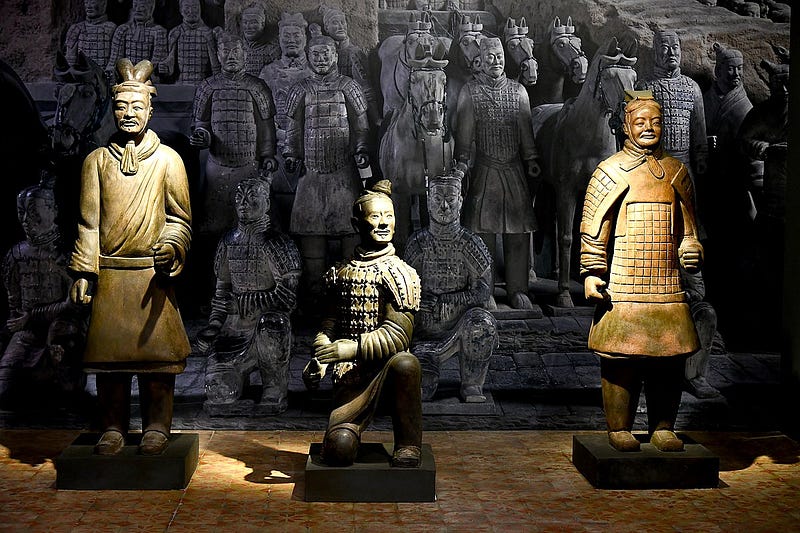
The Shi Huangdi Mausoleum is not only a hill with a palace and tomb, but also hundreds of smaller or larger earthen vaults in which things not fit for the palace were buried. These are located in the area surrounding the hill. The most famous find from the area is the Terracotta Army, discovered in 1974 by a farmer digging a well. Some 2,000 nearly 2-meter-high clay soldiers have been excavated to date, but there are four times as many. However, they are not reflections of real people, but embody the modularity of Chinese culture.
The clay soldiers were created from specific modules, which were duplicated and multiplied. The Terracotta Army is unfinished because during its construction the rebel army of Xiang Lu arrived and looted the treasures prepared to be buried in the ground, and burned the rest, including the surrounding buildings. A set of 87 stone plates forming armor and 43 stone helmets were unearthed recently about 200 meters from the hill. China’s CCTV reported the discovery in late December. Researchers suspect that several thousand armor and helmets lie underground — one set for each terracotta soldier. The production used techniques used to work precious jade. A craftsman working 8 hours a day made one armor set of 600 tiles in 340–440 days. Elsewhere, horse bridles and reins made using a similar technique were discovered 15 years earlier.
The pits that archaeologists are excavating around the hill with the First Emperor’s tomb always contain wonderful things, not just stone. For example, sets of bronze vessels, animal figures, carts. Not everything has been unearthed yet. A year and a half ago, the Chinese announced that somewhere near the tomb they had discovered the remains of a great palace, whose outer walls marked a rectangle 690 meters long and 250 meters wide. Inside there were 18 outer buildings and one centrally located building. For now, however, no details of the discovery are known.
The Chinese are very reticent to report on the research of the Shi Huangdi Mausoleum — what they are doing and what they intend to do there. This is understandable, as finding the right scale of reference is very difficult. With all due respect to our first historical ruler or Macedonian chieftain centuries ago — the magnitude of Shi Huangdi’s burial probably surpasses anything the scientific world has encountered so far. And perhaps this is what the Chinese fear most.
Shi Huangdi — creator of the centralized state
Shi Huangdi, who assumed the title of emperor, wanted to make China an efficiently run centralized state. To achieve this, he removed the aristocracy from power and based his rule on officials he personally elected. However, after his death in 210 BC, the aristocracy took advantage of a peasant uprising to regain their former privileges, leading to the doom of the Qin Ziyinga dynasty he founded.
Marcel Granet describes Shi Huangdi as a resolute man who valued technicians and professionals, was active and methodical, able to read reports and conduct interviews, and required strict discipline. The emperor did not regard his position as merely ritualistic and passive, but wanted to base loyalty to the monarchy on the cult of the imperial person. He was an energetic and stubborn individual.
However, among ancient historians, Shi Huangdi had many enemies who highlighted the cruelty of his rule. Unfortunately, such were the Chinese national heroes of the time.
How was the terracotta army created?
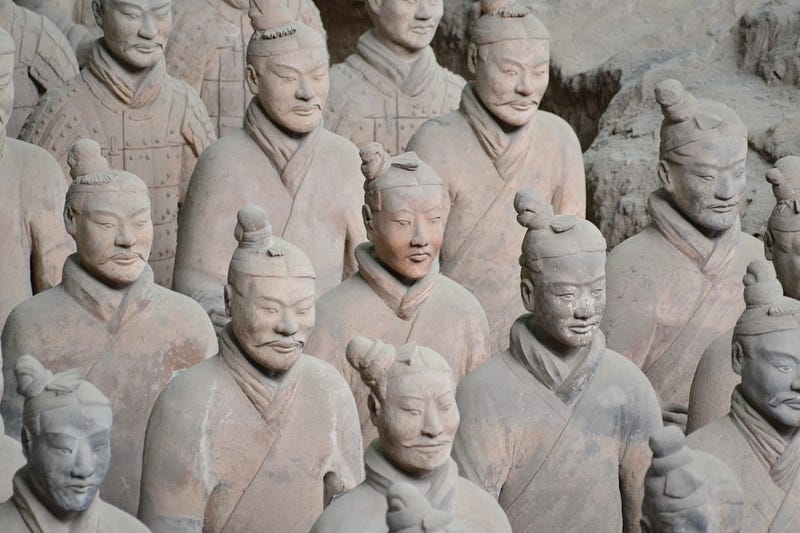
To create the terracotta army, craftsmen worked almost as if on an assembly line. First they prepared the pedestal, and then the individual parts of the warriors — clay legs, torsos, hands — which were created in special molds. The finished parts were joined together. The artisans had 8 molds for preparing heads, but the faces were given individual features. The finished sculpture went to the furnace, where it was covered with a layer of coal and then colored.
Ready for battle
Most of the terracotta warriors were found in the pit, where they were deployed in battle array. Generals and officers are found in strategic places. The main striking force was the infantry, with cavalry placed between its ranks. The Chinese army also included archers, whose figures were found in the cavity.
Thank you for reading! If you enjoyed this content, please consider giving it a clap, leaving a donation, or offering a tip to support my work. Your generosity helps me continue creating valuable content.