
Short Fiction Story, Chapter 1
The Time Traveler
All the signs are there, but we chose not to see them

“I am a time traveler.”
These were the first words professor Edmund West said to a filled auditorium at Oxford University. Everybody stood still and stared at the middle aged men at the podium. His trim mustache and combed hair complemented his three-piece dark grey woolen cloth suit and the new white shirt.
Professor West stood quietly, looking at the scholars, students, and other members of the London science community and listening to how a soft rumor grew. Some inquisitive and incredulous Oxford University council members smiled.
Before it got out of hand, the Professor continued his lecture, adding:
“Outrageous, ridiculous, the words of a lunatic. Don’t worry, I’ve heard them all, but before you discard my words and think of leaving the room, bear with me a moment as I explain.”
“Yes, I am a time traveler. But so are each and every one of you sitting in this room. The concept of time is wrong. For centuries, humankind thought we were only unwilling passengers watching time go by, but this is wrong. Time doesn’t go by; we travel through time.”
“Just as on a long stroll in the woods, as we walk, we are not only stepping away from our point of origin but also leaving our present behind, turning it into our past. A moment before, we were one meter behind and seconds away from where we had started.”
“Some of you might argue with why time goes by when we stay still. However, even in those moments, we are not completely still. Yes, we are not moving, but our hearts still beat, our lungs fill and empty with the air we need to live, and our brains still send electric charges through the neurons, keeping our thoughts and deciding what we should do next.”
“So imagine, just as we chose our path in the forest, we could choose the time we want to be in.”
At this moment, the crowd’s noise made Professor West stop and try to calm the audience as several hands appeared demanding time to question the Professor.
Using the podium microphone and gesturing with his hands to calm the audience, he said: “Please remain seated and use the notes in front of you to write your comments. We’ll be having a Q&A session in a moment; pass your notes to the staff so I can answer them.”
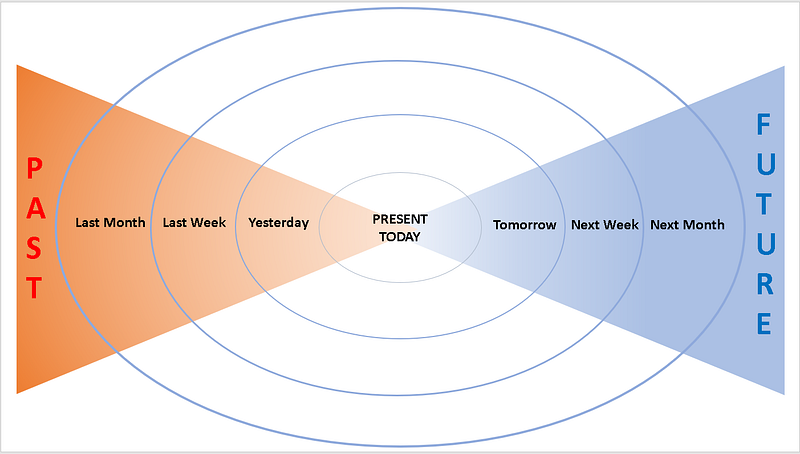
Professor West turned on the overhead projector, and a multicolor graphic showed two horizontal triangles connected by the vertex, where a “PRESENT / TODAY” label appeared in the center.
Using a laser pointer, Professor West continued:
“This graphic represents how we perceive time. We are in the center, where the “Present/Today” label shows how we travel through time. Our plans for today, tomorrow, next week, and next month are to the right. And to the left is what we did yesterday, last week, and last month. Further to each side lies our perception of the future and the past, growing darker since we don’t know what will happen and don’t remember what happened.”
“It is like traveling on a long road. You are in the driver’s seat and in command of the vehicle (this is the present). In front of you is the road where you want to go, from the near road and next exits to the faraway uncertain horizon (this is the future). On the mirror lies the road you’ve just gone through, and as the label says, objects are closer than they appear, but far events seem distorted and faded (this is the past).”
“Like on the car trip, you keep your eyes on the road ahead to avoid an accident while frequently checking the mirrors; your body, energy, experience, consciousness, and sub-consciousness are at the wheel, keeping you in command of the vehicle. Your presence in time is determined by where you decide to put all your attention.”
“If you focus just on the road ahead (the future), you might run out of gas or won’t notice if the car has some problem. However, if you always watch the mirror (the past), you will have an accident. The perfect mix is to be aware of what is happening ahead of the car while checking the mirrors and prevent something from hitting you from behind. This is when you are in the present, here and now.”
Once again, the audience murmured, moving in their seats, showing a clear sign of discomfort. A typical physical response when your brain doesn’t agree with what you’re listening to. Something every behavioral analysis expert will read as an involuntary reflex to get away from what is bothering you.
Professor West tapped the podium microphone with the tips of his fingers to catch the audience’s attention and said,
“Gentlemen, please remain seated so we can continue with the presentation, where you’ll find the answers to your questions.”
“As I was saying, let us consider for a moment the fact that your physical body is a representation of your thoughts. For years, scientists have studied where we reside in this world.”
Are we our physical bodies? Hardly, since when someone loses a limb, they still feel complete. That’s known as phantom limb sensation, so we can conclude that just like the car we’re driving, our body is only the vehicle we use for traveling in this world; therefore, we don’t reside in our bodies.
“Then, are we in our brains and thoughts? Well, neither; when people experience an accident or an illness and lose part of their brains or functioning, they still feel complete, perhaps losing some ability or forgetting some memories.”
“Religious people say we are our souls, but what about atheists? Just because they don’t believe in the soul, therefore, don’t exist? Once again, no, we don’t reside in our soul as many theologists claim, or at least as the simplistic idea of the soul, some religions argue, but let us keep this thought for a moment as we analyze the next slide.”
The projector displayed a page titled “Hypothesis Concerning Soul Substance Together with Experimental Evidence of The Existence of Such Substance,” by Duncan MacDougall, 1907 Haverhill, Massachusetts. It explained how this scientist conducted an experiment placing six dying patients on a special balance and concluded that when they died, humans lose up to three-fourths of an ounce upon death, or what we now know as the 21g experiment.
West continued: “For science’s sake and to avoid further philosophical and theological discussions, let’s call this phenomenon Living Energy instead of soul. I prefer to call it the physical measure of consciousness.” The projector changed the slide to one titled “‘Summary,’ on the top, and a bullet list with three empty points except for the first one, which displayed “1.- Soul = Living Energy = Consciousness.”
Using the remote control, West swiped the slide to a new one that read: “Consciousness alterations, from people with Alzheimer’s disease, Delusional Disorder, Altered States, and Hypnosis.” A bullet list showed the following:
1.- Memory Distortion 2.- Memory Loss 3.- Altered Consciousness 4.- Time Alteration
Professor West resumed, “Now let’s talk about consciousness alterations and how it affects our time perception. According to a study by the Alzheimer’s Association, patients suffering from this disease present memory distortion and loss, as well as distortion in consciousness and how they perceive time passing. Hence, sometimes they remember past events as if it was today. In other words, they are fully living in another time, and since they don’t understand what is happening today or how the future will be, they choose to go to the past.”
“We find similar effects in patients suffering from Delusional Disorder, or what we used to call paranoid disorder. During this state of mind, patients suffer from a serious psychotic disorder, and they can’t tell what’s real or imagined. They are convinced of their idea no matter what their family members or doctors tell them, so they try to alter their physical world according to their consciousness.”
“We also find these altered states of consciousness in people caused by trauma, an accident, induced through meditation, drugs, food poisoning, or by some device. During the 70's, the movie ‘Altered States’ made widespread use of an isolation tank, developed in 1954 by the practitioner and neuropsychiatrist John C. Lilly. This device, together with the use of psychedelic drugs like LSD, made some people experience stress reduction, easing muscle tension, reducing severe chronic pain, enhancing creativity, improving concentration, out-of-body, and time travel experiences.”
“The most outstanding example of consciousness alteration is hypnosis. Through some devices, Neuro-Linguistic Programming (NLP), Creative Visualization, or Cognitive Behaviour Therapy, the subject corrects some habits, phobias, and illnesses. But what is important to us at this point is that since our brain is like a recording machine, it stores events in a multi-layer form, which includes all of our seven senses.”
A young student in the audience interrupted Professor West arguing, “Come on. Surely you are not talking of the five human senses, plus women’s intuition and bullshit detection senses.” Causing the audience to laugh.
Professor West, smiling, gained control of the audience by saying on the microphone, “No, my young friend. I’m not talking about women’s intuition or bullshit detection senses, or in your case, your acute sense of humor and comedic timing, but the five basic senses of Sight, Hearing, Smell, Taste, and Touch, plus the Vestibular or movement and balance sense, and the Proprioception, or body position awareness sense. One helps us stay upright when we sit, stand, or walk, and the information about where we are and the other about how much force to use to hold an egg in our hands without crushing it.”
“Using hypnosis or NLP techniques, you can help people remember with extreme detail some events in their lives, like the moment they received their favorite toy or a gift from their loved one. They can recall what it looked like, the time of day, the season, the weather, what they were wearing, the smell, temperature, size, texture, and if they were standing or sitting, just as we in the audience could feel if this person told us in detail everything he remembered.”
Changing the slide on the screen, Professor West pointed to the “Summary” graphic, which now displayed “2.- Consciousness alterations = Selective memories = Time Alteration,” and continued, “Now we are going to talk about a new development in Mayan archeology deciphering. Please turn off the lights to see a short video.”
The Auditorium lights dimmed, and the image of a man holding a Mayan Codex appeared on the screen, explaining how the British researcher Eric Thompson’s 1930's interpretation of the Mayan glyph appeared to be wrong.
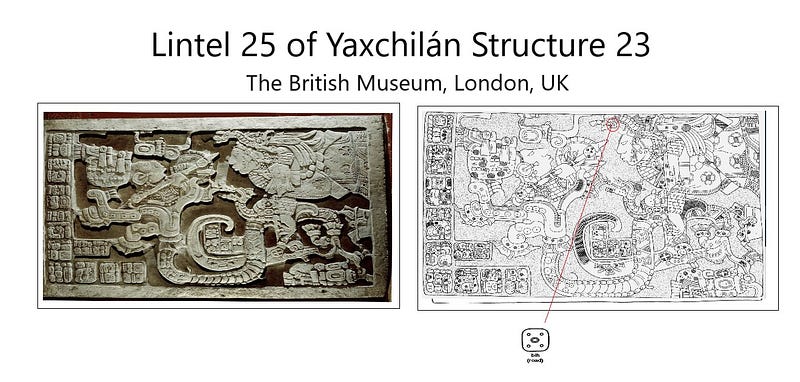
The man showed a photograph of an image of the limestone of the Yaxchilan lintels in the British Museum, depicting Lady K’ab’al Xook performing a ritual to stare at what looks like another representation of herself, which is known as Lady K’ab’al Xook staring at her ancestor. On the bottom of the detailed drawing, a Bih glyph which translates as road. Therefore, according to this researcher, the image represents Lady K’ab’al not looking at, but traveling to meet her ancestor. Concluding the Mayans, through some rituals, could travel in time.
Just as the audience once again murmured, raising their hands, professor West changed the image to the screen, and now the “Summary” graphic displayed:
1.- Soul = Living Energy = Consciousness 2.- Consciousness alterations = Selective memories = Time Alteration 3.- Time travel is possible via trance or ritual to create consciousness alterations
West said, “Considering the previous, we can conclude that we all can travel through time if we are willing to focus our living energy on another place in time. I will now answer your questions.”
One man in the first row asked, “Professor, so you assure anyone can time travel? Also, are you recommending people use drugs, rituals, or isolation tanks to do it?”
Professor West answered, “Yes and no. Yes, everybody can time travel, but only if the person is 100% convinced that he can do it. And no, I’m not recommending the use of drugs or another device, but just pure consciousness alteration. You can do it through NLP, hypnosis, deep meditation as the monks do, or by fiscally altering your brain by trauma, or Alzheimer’s, which in no way I would recommend. Next question.”
Someone else asked, “You say the Mayans time traveled, and maybe other people through history have done it, so why is there no evidence?”
Professor West, “First of all, I didn’t say the Mayans did. I just presented the research by archeologists, who translated the Mayan Codex, explaining what the glyphs say. I’m not trying to convince anyone to believe it or not. It is up to each one to decide if they think the Mayans could do it, as much as if feathered serpents, jaguar gods, or Kukulcan was an actual entity or just how they interpreted what they saw.”
“To the second part of your question, why do you say there is no evidence? People may have traveled in time before but couldn’t describe what they saw. That would explain Da Vinci’s futuristic inventions, Nostradamus predictions, Jules Verne’s novels, the Antikythera mechanism, or hundreds of other things we deem coincidences. I’m sorry, but we just have time for another question.”
A young man asked, “Professor, do you have traveled in time, or do you know someone who has?”
Professor West answered, “If I told you I have traveled in time or know someone who has, most of the audience would think I’m delusional, some conspiracy theorist, or crazy. Nevertheless, I can say that I’m convinced that if I decided to do it and put all my mind into it, I would travel in time, just as someone in my family did.”
On this note, the presentation ended, and the audience walked towards the exit after congratulating him or making some skeptical facial gestures. When the auditorium was empty, Professor West put away his things, took out his great-grandfather’s pocket watch, and looking at the inscription, which read “To my loving husband Herbert,” he said,
“Now I’m going home to get into my isolation tank because I’m absolutely convinced that I can travel through time, just as you did, grandpa. I’m going to go back in time and meet my famous great-grandfather, H. G. Wells.”
Jose Luis Ontanon Nunez, 2022