avatarSynthia Stark

Free AI web copilot to create summaries, insights and extended knowledge, download it at here

1845

Abstract

r everything. However, a person with good time management would be inclined to do something important ahead of time, regardless of the level of urgency, embodying Quadrant 2 (Q2). Thus, urgency is not the same as importance in this scenario.</p><p id="e77d">For example, working on a project at the last minute falls within Q1. By comparison, working on an essay ahead of time falls within Q2. In business, school, and even in life, it’s best to remind yourself that you’re doing something important because it has meaning to you and not necessarily because you must get it done right away.</p><p id="b0a7">That being said, items in Q1 should not be ignored. Emergencies and deadlines can arise from time to time, but with careful practice and pre-planning arrangements, steps can be made so that there are fewer crises to deal with in the future. If there are fewer crises, it’s easier to free up time for ourselves.</p><p id="7dc8">A good example of a pre-planning measure can include <a href="https://corporatefinanceinstitute.com/resources/knowledge/other/smart-goal/">S.M.A.R.T. goals</a> orientation. In this context, the letters can stand for items that are: specific, measurable, achievable/attainable, relevant/realistic, and time-bound. The image <a href="https://www.smartsheet.com/blog/essential-guide-writing-smart-goals">below</a> highlights a potential worksheet one could use:</p><figure id="cc7e"><img src="https://cdn-images-1.readmedium.com/v2/resize:fit:800/0*-gVC43v422FMrgeo.png"><figcaption>Photo by <a href="https://www.smartsheet.com/blog/essential-guide-writing-smart-goals">Smartsheet</a></figcaption></figure><p id="3e6c">Furthermore, a lot of us have the notorious habit of spending time in Quadrant 3 (Q3). While Q3 is a comforting place to be in, it is filled with lots of items that are very short-term and not as

Options

important, such as checking our email 1000 times or perusing through social media mindlessly.</p><p id="b224">There’s nothing wrong with taking a break once in a while, but if you find your time slipping by, perhaps you need to spend less time on those items, such as through various <a href="https://www.ventureharbour.com/best-productivity-apps/">productivity apps</a>. Otherwise, these items will eventually turn in the dreaded Quadrant 4 (Q4), where trivial pursuits are explored, such as exclusively mindless web surfing, gambling, and many more.</p><h2 id="13b3">Making The Most Out of Our Time</h2><p id="db90">When in doubt, it’s best to type out (or even write out) the various things that you regularly do, and to find a place to put them on your time management matrix. For those items in Quadrants 1 and 3 (Q1 and Q3), try to brainstorm or explore the ways that these items can be turned into Quadrant 2 (Q2) items.</p><p id="ab7e">If needed, you can set up specific appointments on your calendar, as if they are a physical meeting with someone. Instead, they’re meetings for you to commit to those items in Q2. Plus, breaking down overarching problems into smaller problems might make larger tasks easier to envision.</p><figure id="550d"><img src="https://cdn-images-1.readmedium.com/v2/resize:fit:800/0*h0LUYcbxLaMD6LQc"><figcaption>Photo by <a href="https://unsplash.com/@emmamatthews?utm_source=medium&amp;utm_medium=referral">Emma Matthews Digital Content Production</a> on <a href="https://unsplash.com?utm_source=medium&amp;utm_medium=referral">Unsplash</a></figcaption></figure><p id="df27">Overall, while time management is not an easy skill to master, the best way to make use of our time is to encourage, influence, and/or slowly modify our tasks so that they fall under Q2, for better or for worse.</p></article></body>

The Time Management Matrix

Pioneered by Stephen R. Covey in the critically-acclaimed The Seven Habits of Highly Effective People, the time management matrix is a proposed way to compartmentalize the various items in your life, based on its level of urgency and importance.
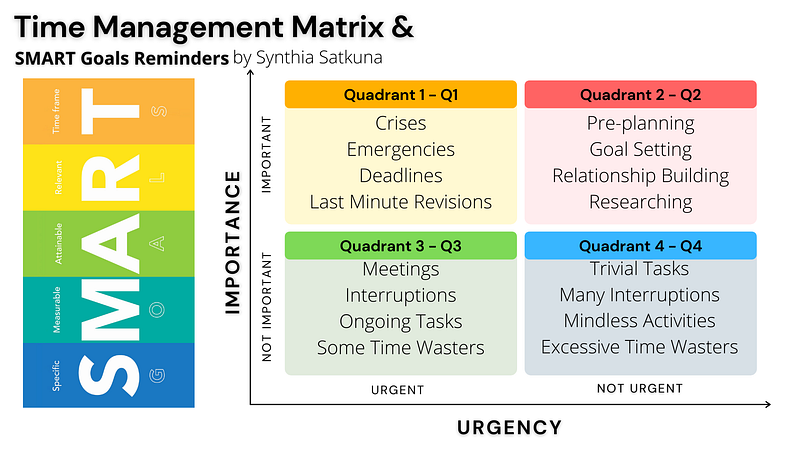
Image created by the author Synthia Satkuna on the design website Canva — image viewable from this link.

As seen above, the four quadrants are illustrated as follows:

  • Important and Urgent (Q1) — Tasks reserved for immediate crises and emergencies, such as deadlines.
  • Important but Not Urgent (Q2) — Items reserved for the pre-planning, improvement, and prevention of emerging problems and tasks.
  • Not Important but Urgent (Q3) — Includes ongoing and busy tasks that are filled with occasional interruptions.
  • Not Important and Not Urgent (G2) — Exclusively filled with time wasters.

As cognitive misers, it can be incredibly challenging to always prioritize the best use of our time. However, we often fall into the fallacy of living within the parameters of Quadrant 1 (Q1), where urgency takes precedence over everything. However, a person with good time management would be inclined to do something important ahead of time, regardless of the level of urgency, embodying Quadrant 2 (Q2). Thus, urgency is not the same as importance in this scenario.

For example, working on a project at the last minute falls within Q1. By comparison, working on an essay ahead of time falls within Q2. In business, school, and even in life, it’s best to remind yourself that you’re doing something important because it has meaning to you and not necessarily because you must get it done right away.

That being said, items in Q1 should not be ignored. Emergencies and deadlines can arise from time to time, but with careful practice and pre-planning arrangements, steps can be made so that there are fewer crises to deal with in the future. If there are fewer crises, it’s easier to free up time for ourselves.

A good example of a pre-planning measure can include S.M.A.R.T. goals orientation. In this context, the letters can stand for items that are: specific, measurable, achievable/attainable, relevant/realistic, and time-bound. The image below highlights a potential worksheet one could use:
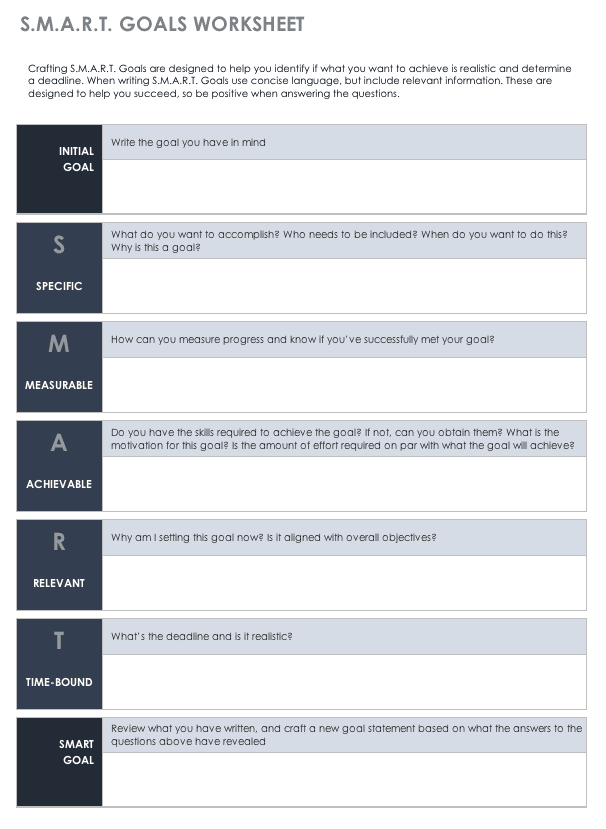
Photo by Smartsheet

Furthermore, a lot of us have the notorious habit of spending time in Quadrant 3 (Q3). While Q3 is a comforting place to be in, it is filled with lots of items that are very short-term and not as important, such as checking our email 1000 times or perusing through social media mindlessly.

There’s nothing wrong with taking a break once in a while, but if you find your time slipping by, perhaps you need to spend less time on those items, such as through various productivity apps. Otherwise, these items will eventually turn in the dreaded Quadrant 4 (Q4), where trivial pursuits are explored, such as exclusively mindless web surfing, gambling, and many more.

Making The Most Out of Our Time

When in doubt, it’s best to type out (or even write out) the various things that you regularly do, and to find a place to put them on your time management matrix. For those items in Quadrants 1 and 3 (Q1 and Q3), try to brainstorm or explore the ways that these items can be turned into Quadrant 2 (Q2) items.

If needed, you can set up specific appointments on your calendar, as if they are a physical meeting with someone. Instead, they’re meetings for you to commit to those items in Q2. Plus, breaking down overarching problems into smaller problems might make larger tasks easier to envision.

Photo by Emma Matthews Digital Content Production on Unsplash

Overall, while time management is not an easy skill to master, the best way to make use of our time is to encourage, influence, and/or slowly modify our tasks so that they fall under Q2, for better or for worse.

Time Management Matrix
Smart Goals Orientation
Organizational Psychology
Deadlines
Projects
Recommended from ReadMedium