
The time it takes for Voices in my head to flow to words on paper.
Billion years is an understatement.

Aaaah!!!! I can hear my grey matter scream at me. It keeps throwing down ideas at me, but the minute I sit down to convert those to decent articles, I am at a loss for words.
In the last 3 days alone, I have a total of 50 posts drafted with a title, and some of them a sub-title and an image.

But not a whole lot of them have made it from mere drafts to articles published on my profile. I am frustrated, irritated and disappointed. My goal was to write at least 3 articles a week. I keep thinking of following the 30-day writing challenge by Dr. Mehmet Yildiz. But I have thought of at least 5 different 30-day ideas, and I am yet to bring life to those mere ideas because I feel like a rudderless ship. Needing a gentle waft of wind to help me sail in the right direction. It is high time I learned, that gentle waft of wind needs to come from within me.
This article by Kimi Cerdon, which echoes exactly what I feel came at the right time to me, it taught me that everyone goes through that feeling of frustration. Ideas are plenty, but it takes time and effort to bring an idea to life, to put it down in words, phrases that resonate with everybody takes some time to finetune and it is a gradual process, and I need to train my mind to accept that and not fight it.
The only way I can manage my frustration is to keep writing. I cannot keep shouting at my mind or micro-managing it, to work better at converting those beautiful ideas to readable posts. Gulping down mugs of coffee does not help. I need to take a break, breathe a little, give my wonderful mind a little break and then provide it with all the love and nourishment so that it can go and translate those ideas. I need to be patient with my mind. I need to encourage it. I need to help silence the whirring sounds that go on in the deepest regions of my brain. Need to calm it down so that I can hear the beautiful sound of an idea forming, the different words, and phrases arranging themselves neatly forming a picture, beginning to stand in a line, and gently flow from the depths of the mind to the keyboard and thereby to the page.
I also need to look out of my kitchen window at the trees, at the birds chirping, play with my dog, feel the wind gently blowing outside, in short, to live a little.
That very wind will also help move the dust that has clouded my grey matter, and provide the gentle push needed to bring ideas to fruition.
Writing does not happen when I create a traffic jam inside my head with thoughts coming along in multiple different directions. There needs to be a structure, a plan, a process in place for different thoughts to exit without colliding with each other. They may carpool, but not collide. Collision is dangerous and leads only to the death of thoughts and ideas.
I came up with the below plan for my disorganized brain city. 10 important points to serve as a daily reminder:
- Keep it simple, the more complicated systems become, the more we tend to not enjoy them.
- Set aside a dedicated time each day to write.
- Pick one or two writing tips that you have learned and incorporate them fully before picking others. This leads to not experimenting with a bunch of stuff at once.
- Write from what motivates you. The minute you make it someone else’s game, you lose interest.
- Read more, understand more, give it time to create a clear picture in your head.
- Focus on consistency first, then quality. Quantity will be a by-product of this. Don’t go after quantity in the beginning.
- Then draw a blueprint, finally, build the system up.
- Improvise wherever needed.
- Enjoy cruising through. Go full-throttle, without the fear of collision :)
- Be aware and follow the rules, and be mindful of other drivers on the road.

One of the things that helped me organize my thoughts better and provide structure was to take a brain dump. This site that was mentioned in Marta Brozosko’s post was super helpful in getting my thoughts organized and straight.
What is essentially a brain dump? Let me explain with a comparison, our intestine which is 25 feet long holds up stuff that we need to get out of our system every day. If we don’t get it out even for one day, we feel bloated and heavy.
Think of the brain, the blood vessels in the brain, if they were stretched out, extend for 100,000 miles or so. Just imagine the stuff that is occupied in our grey matter, thoughts — useless and useful, ideas, concepts, beliefs, learnings, memories, dreams, the list is endless. And do we expel it at all? We only keep adding to it.
We need to dump out all that is there, to take a measure of what all needs to be held onto, and what all we can let go of. Sorry for the gross analogy, but we need to understand the term dump in terms of relativity to get a clear picture of the scale we are talking about.
Essentially a Marie Kondo technique for the brain is what is a brain dump.
So coming back to the brain dump, I first dumped everything out of my mind onto pieces of paper. On post-it notes, writing everything and anything coming to my mind. People in my house were surprised that I had like a thousand different thoughts going on at once. Most of them said they have a thought or two, but they mostly have some background singing happening in their heads.
“the nagging in your mind of undone things pulls you out of the present — tethers you to a mindset of the future so that you’re never fully in the moment and enjoying what’s now.” — Daniel J. Levitin
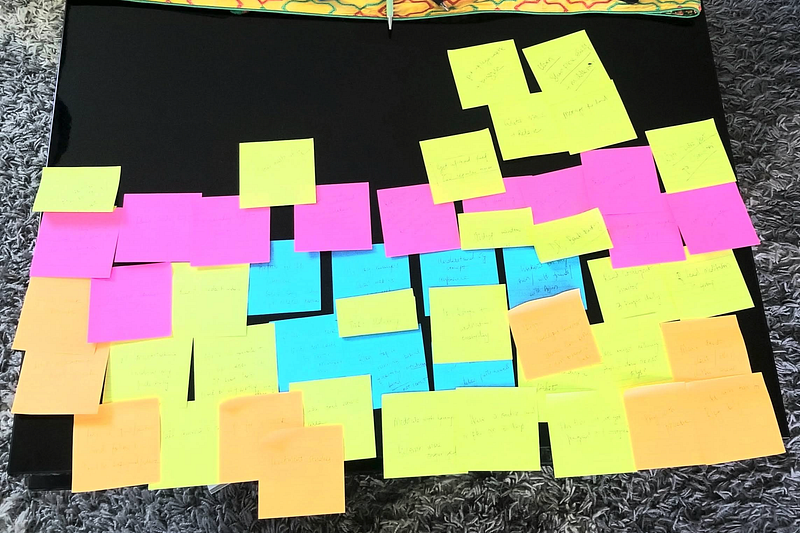
Once I dumped everything out, I saw the patterns in my thoughts. Make sure to cover all aspects —ideas and thoughts, work, health and fitness, relationships, career, recreation, hobbies, spirituality, music, books to read, chores and other responsibilities (like paying the bill, filing taxes, etc). Even write down all the worries, fears, demons holding one back.
I kept writing for a good 30 minutes, anything that came out was on a piece of paper. The different pieces of notes were things that fit into one of the 4 quadrants as explained by Eisenhower in the Eisenhower Matrix. I learned about this matrix in Stephen R Covey’s popular book — The 7 habits of Highly Effective People.
The 4 quadrants of time management:
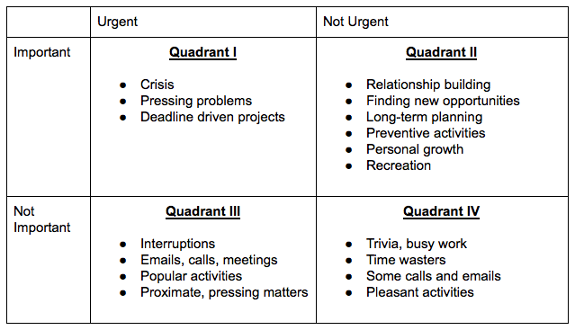
All our thoughts fit into one of the above quadrants. The idea is to sort them into the 4 quadrants above and sieve out the ones that are in quadrant III and quadrant IV to leave us to deal with those tasks in I and II effectively.
Once I finished taking a dump and sorting and writing down the different ideas in my mind, things became much much clearer in my head. This was the gentle breeze that I was looking for.
After sorting, I categorized them into different projects and quadrant mapping (mostly 1 to 1 mapping, except if I had broken down projects into small pieces, then it became 1 to many). It became immensely clear to me on what needed to be acted on first, and form a rough plan needed to sail through my day and week effectively.
The dumping doesn’t end here. Once everything is neatly organized, make sure to act on the first one — the one with utmost priority on your list immediately. The mind likes symbolism, and the sooner you act on it, the faster it realizes how serious you are. And trust me, it will take you much less time to finish it than it would have taken you before taking the dump.
And then continue the momentum. Build upon your previous action, lay the foundation for the next immediate piece of the action. You can create a new to-do list (or like I did, a rough outline of things to do), one that is modifiable in each step but is clear and specific enough to guide on what needs to be done and when.
Taking a brain dump once in a while is highly effective, especially when there are just too many voices in your head or when you are confused and unclear or when you are inspired and have a surge of ideas that need to be acted on, like when I did — the beginning of a month :)
What better time to organize thoughts and ideas than the first of a month.
At the end of the day, it is achieving the below that makes the whole journey fruitful.
“After you have prioritized and you start working, knowing that what you are doing is the most important thing for you to be doing at that moment is surprisingly powerful.” — Daniel J. Levitin
What are some of the other ways that help you clear your head? Please share in comments below.