
Bird Photography
The Thrill of New Birds
A birding story
On St. Patrick’s Day, my friend Gina and I went birding at one of my favorite local parks — Sweetwater Wetlands Park.
We always find lots of wildlife there, but Thursday was a stellar birding day! Not only did we see some of my favorite birds, including the elusive Limpkin, but we saw two birds that neither of us had seen before.
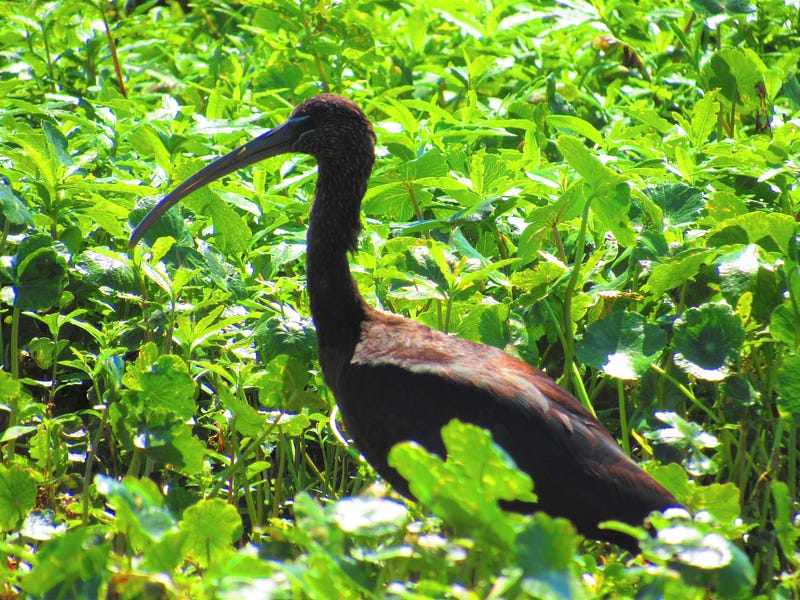
One was a Glossy Ibis. His sable-brown feathers were striking against the sunlit greenery of the wetlands.
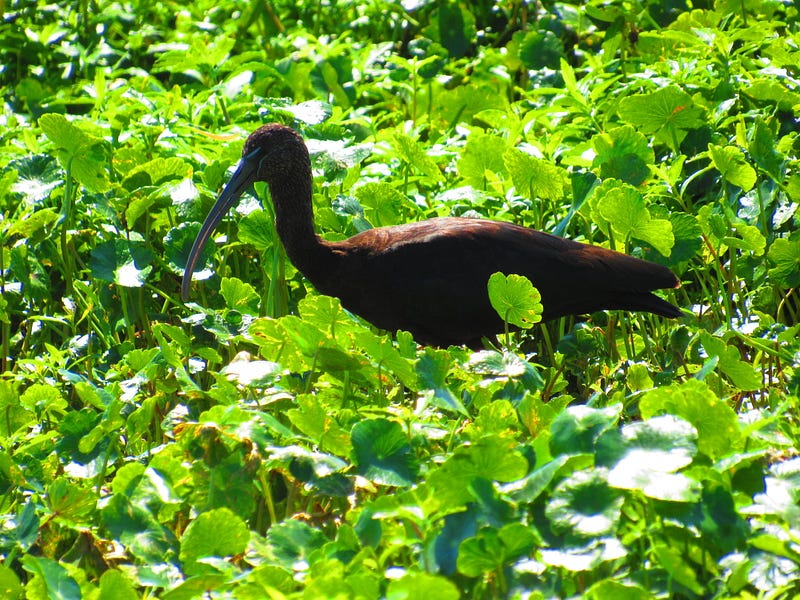
There are three types of ibis in Florida: the very common American White Ibis and the less common White-Faced Ibis and Glossy Ibis. I still haven’t seen a White-Faced but I can now check off Glossy Ibis from my Birds to See list.
Based on the Cornell Lab’s All About Birds website, this Glossy is probably a non-breeding male. The breeding males are more colorful. But, if you look carefully, you can see touches of maroon, green, bronze, and even a little violet in this guy’s feathers.
Like all ibises, the Glossy is a wading bird that frequents shallow waters and muddy ponds and wetlands. They can also occasionally be found on damp farmland.
Glossies are year-round residents in Florida and along the Gulf and Atlantic Coasts of the United States, as well as in the Caribbean islands. They can also be found in isolated places in Central and South America and in parts of Asia, Africa, Europe, and Australia.
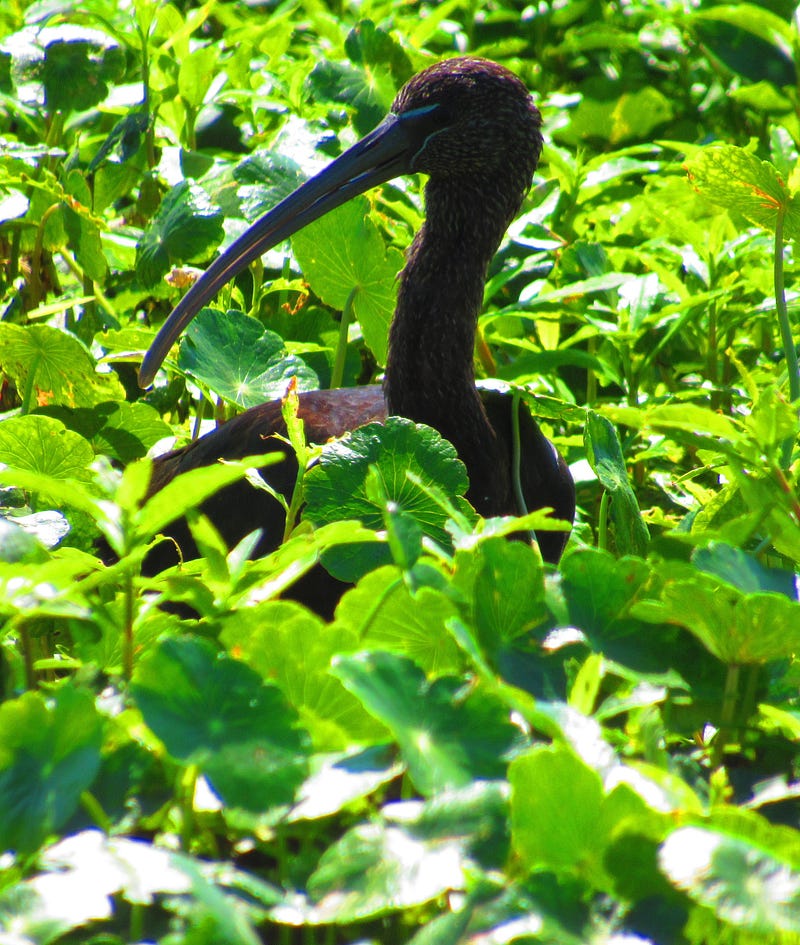
This Glossy, neck-deep in vegetation and muck, was constantly turning his head from one side to the other and peering down into the jungle of water hyacinths, duckweed, water lilies, and pennywort.
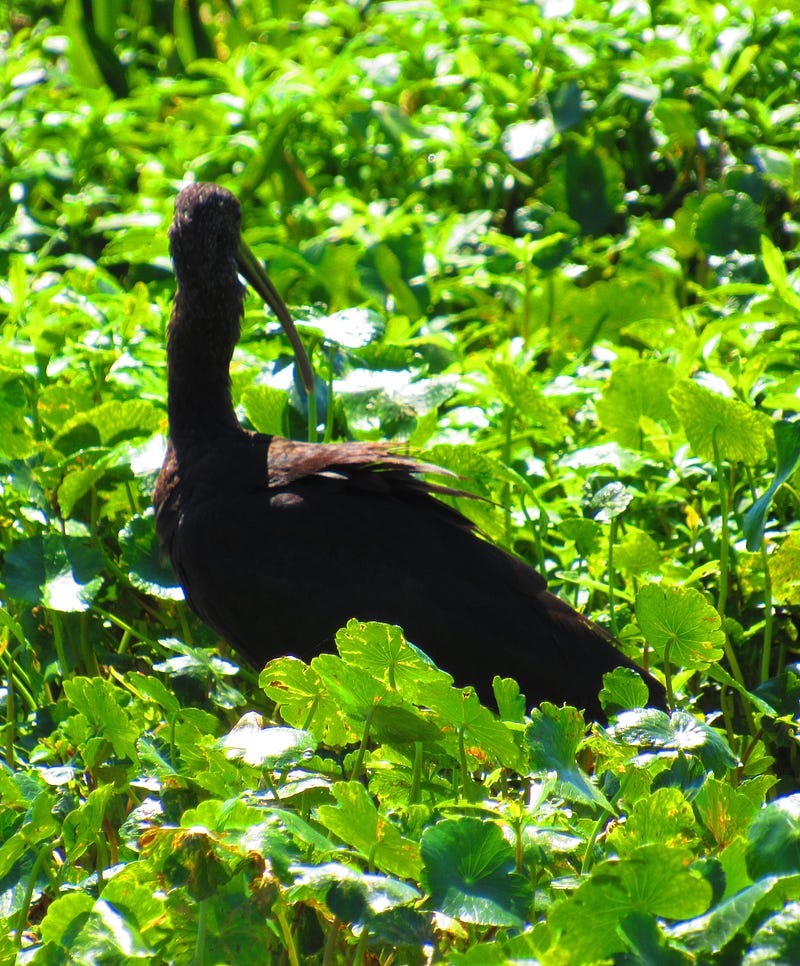
Glossies use their thick beaks as probes, shoveling them through the mud to feel for fish, crabs, crayfish, water insects, frogs, toads, snails, mollusks, snakes, snails, and other marine life.
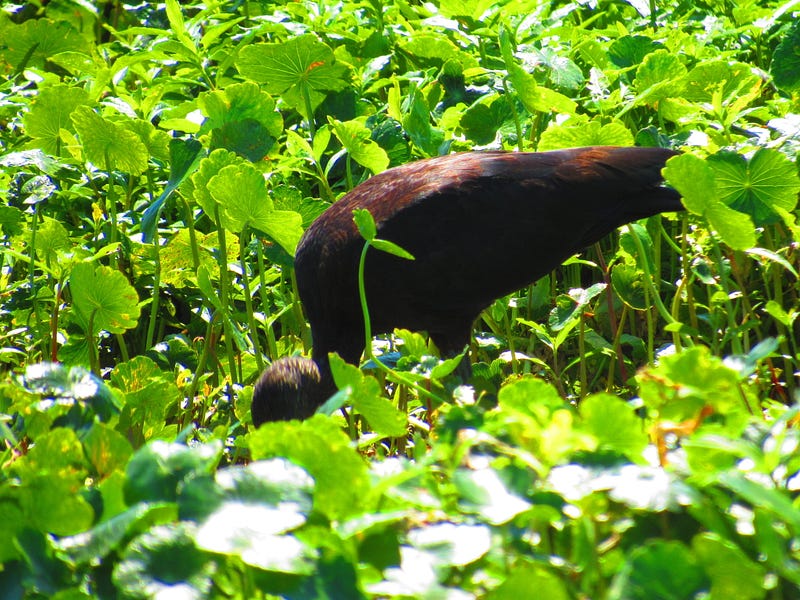
Spying a potential snack, the Glossy would plunge its long beak and neck into the vegetation, sometimes going deep enough that only his butt was visible.
But, Glossies are also known to hunt in rice fields and wet farmland where they dine on insects, rice, sorghum, insects, worms, crickets, and grasshoppers.
The other bird surprise of the day was actually a duck and a very common one but still, a new sighting for Gina and me.
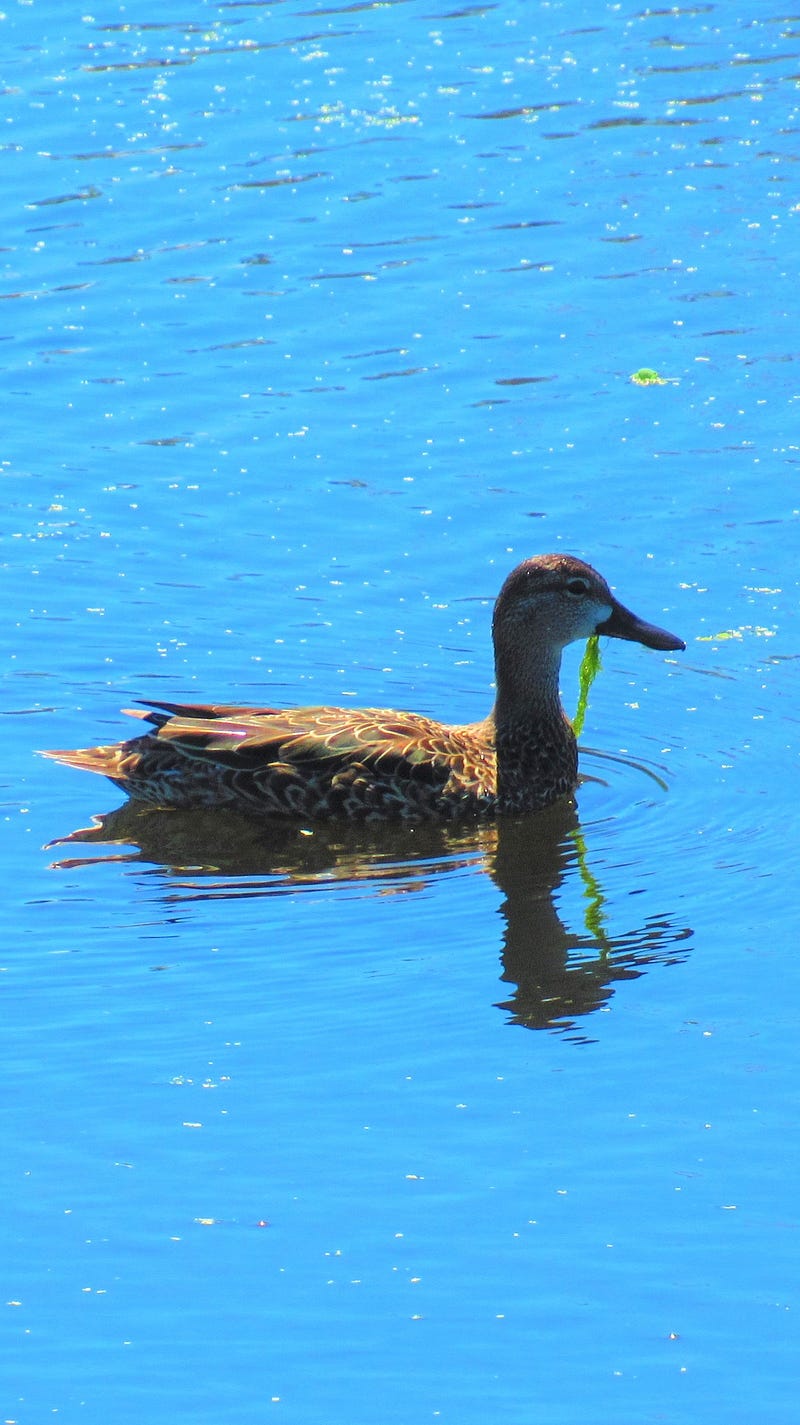
We tried unsuccessfully to identify it using our phone bird apps. At home, I searched online and decided it was a female Blue-winged Teal, which was a little odd since the duck had no blue and no teal! Gina conducted her own research and came up with the same conclusion.
Like many birds, the male Blue-winged Teal is blessed with all the brilliant colors while the female is dressed modestly in brown and white.
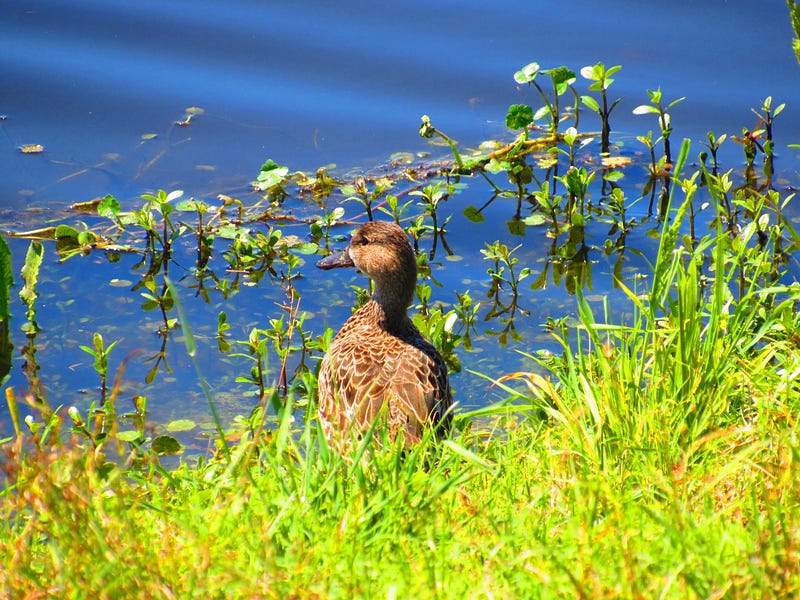
Teals are dabbling ducks. What’s the difference between dabbling and diving ducks? Diving ducks go completely under the water’s surface and swim submerged to capture fish and other aquatic treats. Dabblers “dab” their heads and the upper parts of their bodies underwater but a portion, usually their tails, remain in the air. Since dabblers often eat from the floor of a body of water, they are typically found in shallow wetlands, lakes, and marshes.
The Blue-winged Teal can only be found in the Americas. Although they spend warm breeding months in the Northern U.S., Canada, and even, Alaska, they migrate south in late fall, spending their winters in Florida and along the Gulf and Atlantic shores, as well as Mexico, Central America, the Caribbean islands, and the upper portion of South America.
Although Gina and I were fortunate to photograph the elusive Limpkin on a previous visit to Sweetwater Wetlands Park and at the La Chua Trail, it was still a thrill to be close enough to another Limpkin to get pictures.
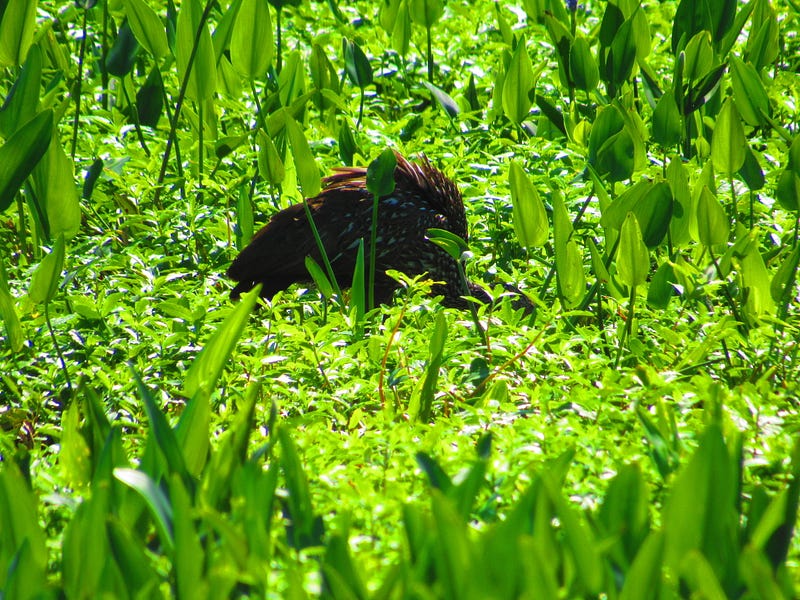
First, we heard two Limpkins. For very shy birds, they have a loud and distinctive call that is rather unnerving — a grating screech rather than a pleasant bird song. We often hear them but rarely see them.
This one was well-hidden in the thick, swampy vegetation.
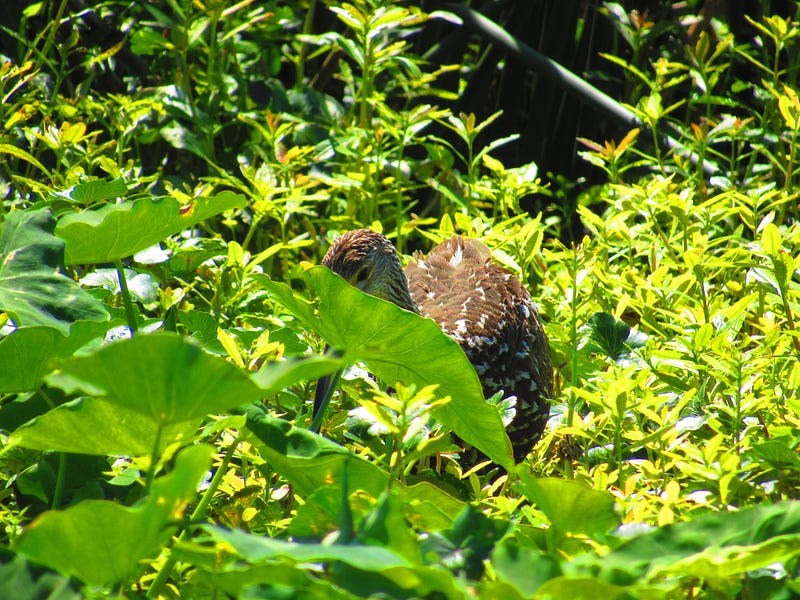
Limpkins are tropical wetlands birds, only found in the U.S. in Florida, the very southern part of Georgia, and around a sliver of the Gulf Coast. Mostly, they occupy parts of the Caribbean, southern Mexico, Central America, and parts of Northern Argentina.
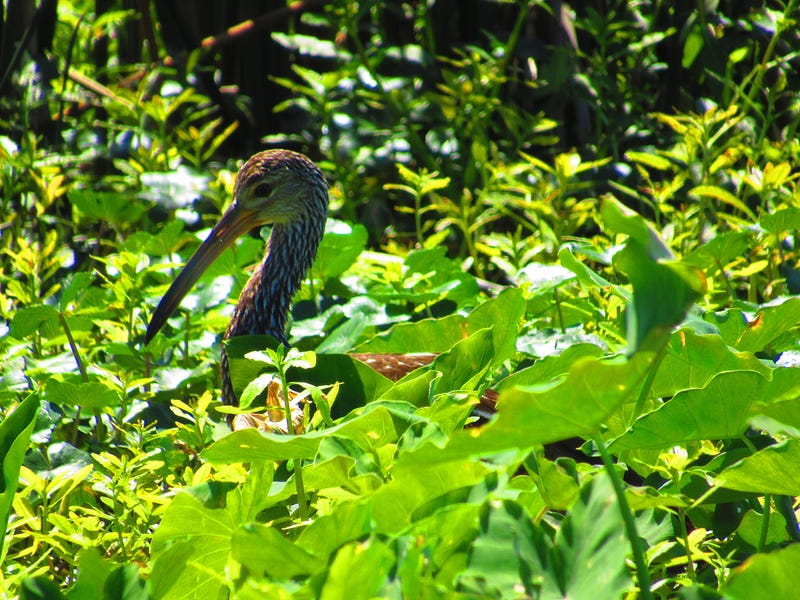
Limpkins have long, thick beaks with a twist at the end, used to open their favorite food, apple snails, and to extract the snail from its shell.
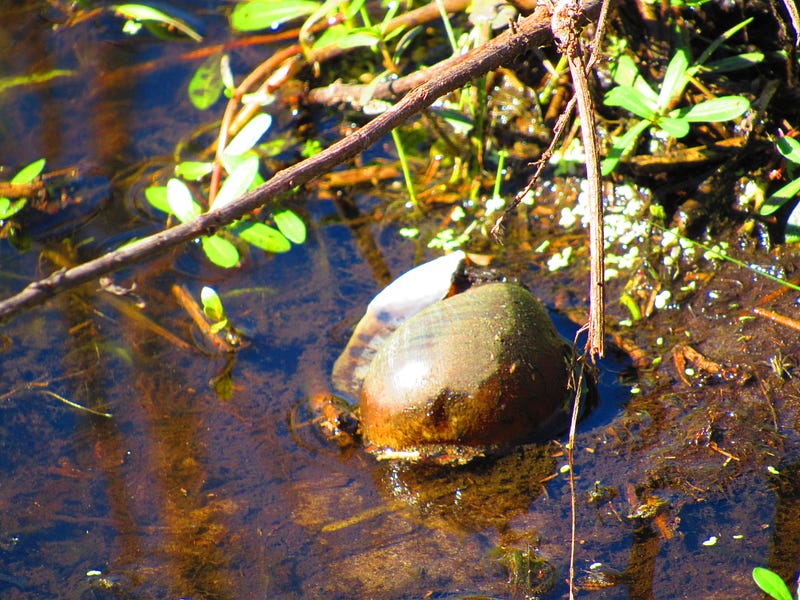
Where did this wading bird get its unusual name? Researchers believe early European settlers thought the bird’s gangly gait looked like a limp.
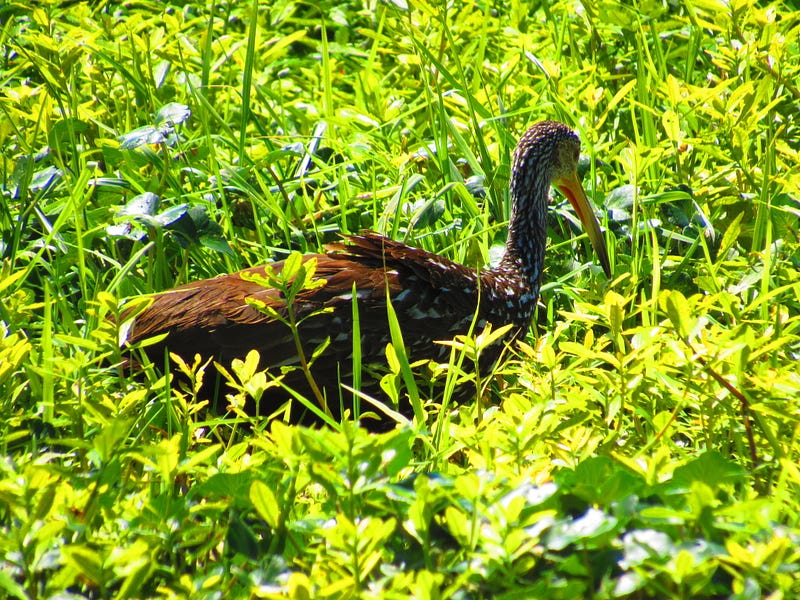
Interestingly, although they resemble herons and ibises, Limpkins are the sole members of a taxonomic family known as Aramidae and are more closely related to cranes and rails.
There were many other surprises and thrills on this St. Patrick’s Day birding trip that I will share in other posts.
Thanks, as always, to Randy Runtsch for this publication dedicated to wildlife.
© Dennett 2022
Dedicated to James Knight who was once, and still is, a Florida Gator, and to James Finn who shares his Yankee bird and duck photos with me.


