
The Three Most Promising Longevity Drugs Don’t Play Nice With Exercise
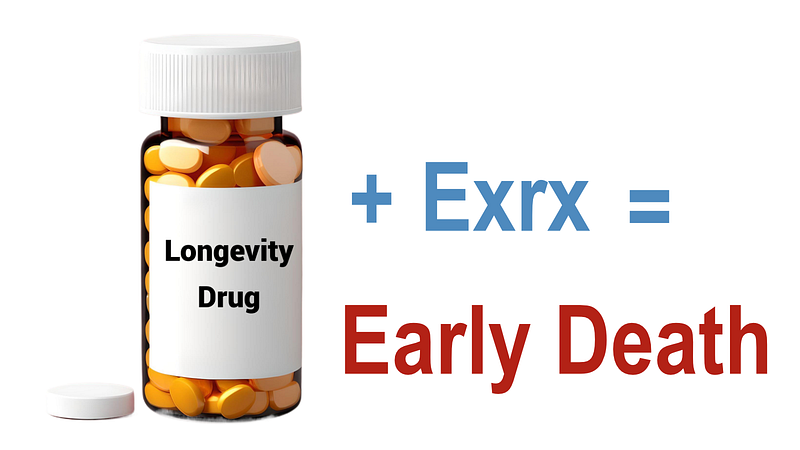
With the discovery that certain drugs may extend life expectancy, these so-called geroprotectors have become a hot item in research and development.
I am not talking about new drugs, but old ones that have been around for decades and other purposes.
- Metformin, a first-line anti-diabetic agent, has been used since 1957
- Rapamycin (now Sirolimus), an immunosuppressant, has been used for almost 30 years
- SGLT2 inhibitor, an antidiabetic drug
Then, of course, there is the most mundane anti-aging “medicine” of all: exercise. Lifelong exercisers live substantially longer in good health than couch potatoes.
Now a group of researchers has asked the question: What if you combine exercise with any of those drugs [1]?
The surprising answer is that you are playing with fire—the “backfire” version, to be precise.
Metformin
This godsend for patients with type-2 diabetes mellitus (T2DM) helps favorably regulate their glucose metabolism. Taken in the pre-diabetic state, metformin may prevent or at least significantly delay the onset of full-blown diabetes. While some studies suggest that metformin may extend health- and lifespan, the initial enthusiasm has faded.
In young, middle-aged, and/or older adults without T2DM, metformin turned out to inhibit the improvement in cardiovascular risk factors, insulin sensitivity, cardiorespiratory fitness, and skeletal muscle size, strength, and power.
In other words, metformin may well annihilate all the benefits you get from exercise. It also seems to increase heart rate and ratings of perceived exertion (RPE) during exercise. The mechanisms behind this are unclear, but metformin may throw a monkey wrench into the expression of genes that drive your body’s adaptation to the exercise stimulus. The net result is a type of cellular stress that may shorten health- and lifespan.
So if you don’t have T2DM, combining exercise with metformin is potentially counterproductive.
Rapamycin
You know that penicillin is an antibiotic molecule. Fungi produce it to ward off bacteria (which is how researchers discovered penicillin in the first place).
What you may not know is that bacteria have an answer to that: anti-fungal molecules. The most prominent of which is rapamycin.
Mankind has greatly benefited from this micro-scale arms race between the two species.
Rapamycin, now called Sirolimus, is an immunosuppressant that prevents the rejection of organ transplants. And it coats nearly every coronary stent, for the same reason.
It also extends the lifespan of mice. So, why not try it on humans? Such trials are on the drawing board, but there are already some indications that rapamycin and exercise may not play nicely together. The reason is mTORC (mechanistic target of the rapamycin complex). mTORC is a protein complex that controls, among other things, protein synthesis. The latter is what happens when you train your muscles. No net-protein synthesis, no muscle growth. Inhibiting mTORC with rapamycin may not be a good idea for promoting healthy longevity because it negatively affects the buildup and maintenance of muscle mass. It also seems to derail glucose tolerance.
SGLT2 inhibitors
They have recently gotten a lot of good press as an off-label solution to obesity. They inhibit glucose reabsorption in the kidneys, which makes you simply pee away excess sugar calories.
SGLT2 inhibitors do a lot of good for T2DM patients, regulating their blood glucose levels and adding to the favorable effects of exercise.
Adding to their impressive array of positive effects, SGLT2 inhibitors have been shown in animal experiments to also extend lifespan.
Unfortunately, in overweight and obese individuals who are free from diabetes, glucose metabolism seems to get worse when SGLT2 inhibitors are paired with exercise. The data are still too limited to draw any definite conclusions.
In Conclusion
Taking any of the leading geroprotector drugs on the same day as exercise may limit the healthspan-extending effects of the latter. However, the authors also highlight that future research needs to assess alternative dosing schemes. It might well turn out that geroprotector drugs and exercise can be combined to extend health- and lifespan beyond what you can achieve with exercise alone.
Until then, you are well advised to stick to exercise alone.
Cited Reference
[1] Elliehausen CJ, Anderson RM, Diffee GM, Rhoads TW, Lamming DW, Hornberger TA, et al. Geroprotector drugs and exercise: friends or foes on healthy longevity? BMC Biol 2023;21:1–15. doi:10.1186/s12915–023–01779–9.


