avatarHelen Fu Thomas

Free AI web copilot to create summaries, insights and extended knowledge, download it at here

5018

Abstract

ce's attention. In the context of the digital data explosion, which leads to information overload, it is increasingly challenging for individuals and content creators to stand out. Therefore, the battle to get the one breakthrough is not from zero but from the humongous number of trials to cut through the noise.</p><blockquote id="9cce"><p>“The biggest risk is not taking any risk. In a world that is changing quickly, the only strategy that is guaranteed to fail is not taking risks.” — Facebook founder Mark Zuckerberg, in an interview with Y Combinator President and OpenAI Co-founder and CEO Sam Altman, 2016</p></blockquote><p id="4c1a">We are at the next frontier of human history with artificial intelligence. AI-powered systems, like search engines, chatbots, and recommendation algorithms, have transformed how we discover and interact with content.</p><ul><li>AI-Powered Recommendations</li></ul><p id="c4a2">All social, content, and eCommerce platforms, such as LinkedIn, Spotify, Netflix, and Amazon, leverage AI to tailor user recommendations, driving engagement, conversion, and customer satisfaction.</p><ul><li>From Natural Language Processing (NLP) to Multi-modal AI Assistants</li></ul><p id="caf7">NLP, a subset of AI, has enabled more efficient and accessible information retrieval. Virtual assistants like Siri, Alexa, and Google Assistant use NLP to answer questions, perform tasks, and provide information. This technology has made information accessible to people of varying technological literacy levels, leveling the playing field. We are all excited to see how multi-modal generative AI will transform how we live, work, and learn.</p><blockquote id="22ad"><p>“We are moving from a mobile-first to an AI-first world,” says CEO of Google, Sundar Pichai.</p></blockquote><p id="3bed">This shift emphasizes the growing role of AI in delivering personalized information and how businesses can harness the power of today’s Generative AI to empower their workforce and improve the workflows with automation.</p><blockquote id="4352"><p>“Artificial intelligence will drastically change the business landscape, and those who don’t adapt will be left behind,” says Ginni Rometty, former CEO of IBM.</p></blockquote><p id="ed81">AI’s ability to process and interpret data at scale is reshaping industries, including marketing, healthcare, and finance, making it essential for organizations to harness its potential for exponential growth.</p><p id="40af">What’s missing in this hurray of AI push are the users in the drivers’ seats to navigate the cognitive applications, which are more complex than prompt engineering and even retrieval augmented generation (RAG). This is why my co-founder, Dmitri Tcherevik, and I introduced <a href="https://www.businesswire.com/news/home/20231206364076/en/AnyQuest-Improves-Citizen-Developer-Productivity-by-Launching-Low-code-Platform-for-Generative-AI">AnyQuest PyAQ</a>, an open-source, low-code platform for citizen developers to explore and deploy generative AI at work. This is to put users first and enable enterprises to add AI to their workforce.</p><figure id="273f"><img src="https://cdn-images-1.readmedium.com/v2/resize:fit:800/1*0rrSXB5E3LcGwoYutzMYtA.png"><figcaption>Image Credit: Author, Founder of <a href="https://www.anyquest.ai/">AnyQuest</a></figcaption></figure><p id="140a">Any Python developer in the world can now install our platform: <a href="https://pypi.org/project/pyaq/">https://pypi.org/project/pyaq/</a></p><p id="4f61"><b>№2 DATA: efficiency</b></p><p id="c8e4">Security aside, the current AI and Machine Learning (ML) practices are heavily dependent on and tangled in exponential amounts of data dominated by BIG TECH companies. AI is the new electricity. The power generators and grids are operated by giants with tremendous capital resources.</p><p id="06a9">While LLMs are becoming the new buzzword, it’s a misrepresentation of the AI operating systems that require electricity but thrive with safety, efficiency, and usability. In other words, not every commercial building or residential house needs its own power generator.</p><p id="6f83">Looking at the Generative AI Infrastructure Stack, multiple players are categorized in each specialty beyond the Foundation Models.</p><figure id="f700"><img src="https://cdn-images-1.readmedium.com/v2/resize:fit:800/1*91VdxtfoOoTqJeXhi0oXcQ.png"><figcaption>Image Credit: <a href="https://readmedium.com/the-new-infra-stack-for-generative-ai-9db8f294dc3f">Cowboy Ventures</a></figcaption></figure><p id="46a6">AnyQuest provides the Application Frameworks to enterprises with integration, security, and control for better data efficiency.</p><ul><li>Dynamic Knowledge Management:</li></ul><p id="f4ec">For any knowledge worker, an AI assistant can only be effective with specific knowledge in a digital workspace associated with the worker’s persona. The better we set up these workspaces and allow interactive collaboration among them, the better outputs we can deliver to assis

Options

t the knowledge work on the tasks. Ad hoc inputs and outputs are wasteful and poisonous.</p><figure id="7fed"><img src="https://cdn-images-1.readmedium.com/v2/resize:fit:800/1*h_w91qUUuKwgEEftBhLFVQ.png"><figcaption>Image Credit: Author, Founder of <a href="https://www.anyquest.ai/">AnyQuest</a></figcaption></figure><ul><li>Long-term Memory:</li></ul><p id="2296">It’s essential for generative AI to perform reliably within a specific framework of memory. It’d be inefficient to rely on impulsive prompts without continuity or reinforcement learning.</p><figure id="8fe5"><img src="https://cdn-images-1.readmedium.com/v2/resize:fit:800/1*ctD7sIbR-f7UcNSSuPlszA.png"><figcaption>Image Credit: Author, Founder of <a href="https://www.anyquest.ai/">AnyQuest</a></figcaption></figure><ul><li>Dynamic Middleware for Enterprise AI</li></ul><p id="85e5">To make AI relevant, efficient, and reliable, we provide an architectural framework for data orchestration and scheduling with the support of memory management, task primitives, model management and tool management.</p><figure id="20ba"><img src="https://cdn-images-1.readmedium.com/v2/resize:fit:800/1*aaCY-5zOPOMTYbTKxXUT2w.png"><figcaption>Image Credit: Author, Founder of <a href="https://www.anyquest.ai/">AnyQuest</a></figcaption></figure><p id="b079"><b>№3 RULES</b></p><p id="c4e3">There is so much fear of AI that organizations’ first steps towards deployments should come with explicit rules that reflect responsibility and accountability. This requires transparency and a systematic audit of the ins and outs of generative AI applications. While LLMs are black boxes at large, their purpose is generic under the governance of the global industry and national security. With semantic brokers, organizations can document and control how their own specific data are orchestrated and cognitive applications deployed.</p><p id="7de3">Today, most organizations adopt generative AI bottom-up at the level of individual employees or departments.</p><p id="ec5c">ChatGPT is a popular tool for drafting emails and website copy. Many online services provided by one- or two-year-old startups help automate work in sales, marketing, customer support, product development, and other areas.</p><p id="8346">Such democratization of AI adoption presents many opportunities to improve job satisfaction and productivity. It is also rife with security, privacy, and compliance challenges.</p><p id="347b">In most cases, the user must prompt AI with proprietary information. As a result, organizations risk losing control of their data and exposing their customers’ personal information.</p><p id="a31f">Banning AI is not an option. ChatGPT and similar apps are readily available on personal mobile devices.</p><p id="5620">Organizations must proactively control and manage security, privacy, intellectual property, and compliance risks associated with generative AI. Empowering people with knowledge and a no-code platform while implementing enterprise-grade middleware, as we described above, are the responsible approaches for managing and controlling these risks.</p><p id="4911">I am passionate about the future of this AI revolution because humanity will thrive and win after all is worked out. My advice is to <a href="https://readmedium.com/train-your-own-dragon-a432eaa0e773">Train Your Own Dragon</a> and embrace <a href="https://readmedium.com/human-2-0-thriving-as-machines-take-on-the-grind-22372ca81435">Human2.0</a>.</p><blockquote id="ed18"><p><i>For additional tools and resource ➡️ Visit <a href="http://www.startupstash.com/"><b>StartupStash</b></a> Zendesk is giving $75,000 in credits and perks for startups! ➡️ <a href="https://tinyurl.com/4ta2c8j6"><b>Apply Now!</b></a></i></p></blockquote><p id="fa1b">Read More:</p><div id="3b2f" class="link-block"> <a href="https://readmedium.com/train-your-own-dragon-a432eaa0e773"> <div> <div> <h2>Train Your Own Dragon</h2> <div><h3>My Optimistic View on AI as a Contrarian and Entrepreneur</h3></div> <div><p>medium.com</p></div> </div> <div> <div style="background-image: url(https://miro.readmedium.com/v2/resize:fit:320/1*xShRpeCNPp3YjG9Cg9ayXQ.jpeg)"></div> </div> </div> </a> </div><div id="3d1c" class="link-block"> <a href="https://readmedium.com/human-2-0-thriving-as-machines-take-on-the-grind-22372ca81435"> <div> <div> <h2>Human 2.0: Thriving as Machines Take on the Grind</h2> <div><h3>How AI Helps Us Reconnect with What Matters and Be Happier</h3></div> <div><p>medium.com</p></div> </div> <div> <div style="background-image: url(https://miro.readmedium.com/v2/resize:fit:320/1*DmZx3edla-nrWhDPMNawjw.png)"></div> </div> </div> </a> </div></article></body>

The Three Biggest Barriers And Opportunities For Enterprise AI
Image: iStock Credits and Author

Yes, you already know it. They are PEOPLE, DATA, and RULES. But, it is not what you think it is.

Many compare the most recent artificial intelligence boom to the Gold Rush. The pioneers got on their wagons and traveled far for their dreams. Many couldn’t survive the journey. Lots sold them food, tools, livestock, weapons, and gunpowder. Decades later, many tales would be told about the turmoils, victories, and fortunes made.

A year after the ChatGPT launch, we celebrated the unprecedented record-setting, earth-shattering numbers, for example:

Harvey, a one-year-old startup that sells artificial intelligence-powered legal software, is in talks to raise between $70 million and $80 million in a round that would value it at $700 million including the investment, two people familiar with financing said. The funding more than quadruples its valuation announced in April, indicating investors are still hungry for AI startups that can show revenue growth.

Venture firm Kleiner Perkins and solo investor Elad Gil, who previously invested in the company’s seed and Series A rounds, are set to co-lead the round, the people familiar said. Existing investors Sequoia Capital and OpenAI Startup Fund will participate as well, these people said. (Source: The Information)

As a founder in this space, I reflect on the challenges and opportunities ahead.

№1 PEOPLE: putting users first

Let’s face it. OpenAI has grown a record number of active users really fast.

ChatGPT now has 100 million weekly active users, OpenAI CEO Sam Altman announced on Monday at the company’s first developer conference in San Francisco. The service released nearly a year ago and garnered an estimated 100 million monthly users within just two months of launching and set a record for fastest-growing user base.

Altman also shared today that over two million developers use the platform, including more than 92% of Fortune 500 companies. (Source: TechCrunch)

Many startups have joined the generative AI race to launch the next killer app.
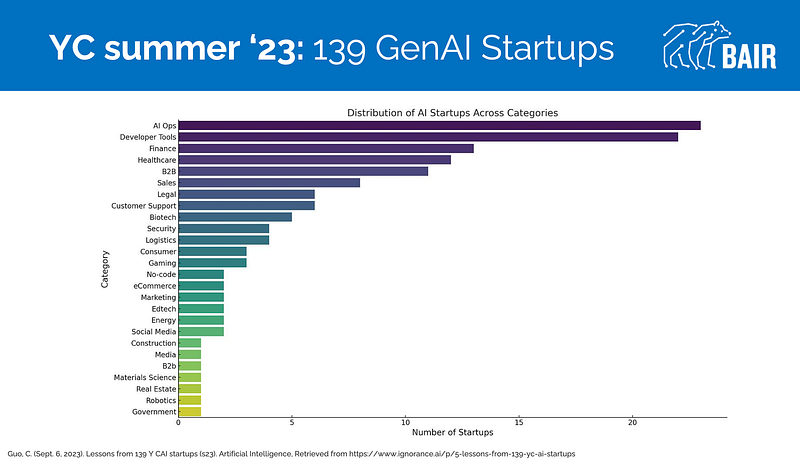
Dr. Mark Nitzberg Keynote as Part of My AI Panel during APEC 2023

The internet has been a game-changer in the democratization of information. This exponential growth in internet access has bridged information gaps, enabling people to learn, communicate, and engage online in a global network of interconnected computers.

“The web is more a social creation than a technical one. I designed it for a social effect — to help people work together — and not as a technical toy.” — the inventor of the World Wide Web, Tim Berners-Lee Weaving the Web, 1999.

Then, it’s followed by the mobile boom, which enables information at your fingertips anywhere, anytime. Mobile apps have revolutionized how individuals consume content. With personalized recommendations and user-friendly interfaces, apps like Google, Facebook, and Netflix have tailored information to individual preferences. Together with cloud technology, we are creating and consuming data at an explosive speed.

According to IDC, the global datasphere is projected to reach 175 zettabytes by 2025, with data creation doubling every two years. In this sea of data, standing out and achieving significant milestones have become more challenging.

“The best way to sell something: don’t sell anything. Earn the awareness, respect, and trust of those who might buy.” Author and digital strategist Rand Fishkin

In the age of information overload, businesses and individuals must focus on building meaningful connections and delivering valuable content to capture their audience's attention. In the context of the digital data explosion, which leads to information overload, it is increasingly challenging for individuals and content creators to stand out. Therefore, the battle to get the one breakthrough is not from zero but from the humongous number of trials to cut through the noise.

“The biggest risk is not taking any risk. In a world that is changing quickly, the only strategy that is guaranteed to fail is not taking risks.” — Facebook founder Mark Zuckerberg, in an interview with Y Combinator President and OpenAI Co-founder and CEO Sam Altman, 2016

We are at the next frontier of human history with artificial intelligence. AI-powered systems, like search engines, chatbots, and recommendation algorithms, have transformed how we discover and interact with content.

  • AI-Powered Recommendations

All social, content, and eCommerce platforms, such as LinkedIn, Spotify, Netflix, and Amazon, leverage AI to tailor user recommendations, driving engagement, conversion, and customer satisfaction.

  • From Natural Language Processing (NLP) to Multi-modal AI Assistants

NLP, a subset of AI, has enabled more efficient and accessible information retrieval. Virtual assistants like Siri, Alexa, and Google Assistant use NLP to answer questions, perform tasks, and provide information. This technology has made information accessible to people of varying technological literacy levels, leveling the playing field. We are all excited to see how multi-modal generative AI will transform how we live, work, and learn.

“We are moving from a mobile-first to an AI-first world,” says CEO of Google, Sundar Pichai.

This shift emphasizes the growing role of AI in delivering personalized information and how businesses can harness the power of today’s Generative AI to empower their workforce and improve the workflows with automation.

“Artificial intelligence will drastically change the business landscape, and those who don’t adapt will be left behind,” says Ginni Rometty, former CEO of IBM.

AI’s ability to process and interpret data at scale is reshaping industries, including marketing, healthcare, and finance, making it essential for organizations to harness its potential for exponential growth.

What’s missing in this hurray of AI push are the users in the drivers’ seats to navigate the cognitive applications, which are more complex than prompt engineering and even retrieval augmented generation (RAG). This is why my co-founder, Dmitri Tcherevik, and I introduced AnyQuest PyAQ, an open-source, low-code platform for citizen developers to explore and deploy generative AI at work. This is to put users first and enable enterprises to add AI to their workforce.
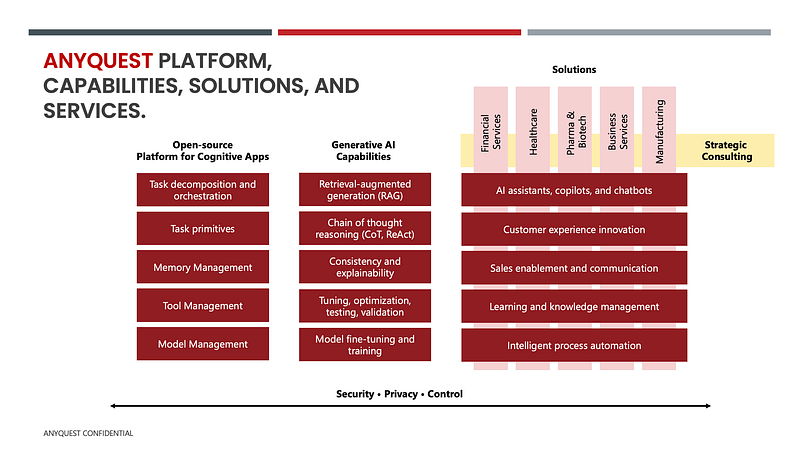
Image Credit: Author, Founder of AnyQuest

Any Python developer in the world can now install our platform: https://pypi.org/project/pyaq/

№2 DATA: efficiency

Security aside, the current AI and Machine Learning (ML) practices are heavily dependent on and tangled in exponential amounts of data dominated by BIG TECH companies. AI is the new electricity. The power generators and grids are operated by giants with tremendous capital resources.

While LLMs are becoming the new buzzword, it’s a misrepresentation of the AI operating systems that require electricity but thrive with safety, efficiency, and usability. In other words, not every commercial building or residential house needs its own power generator.

Looking at the Generative AI Infrastructure Stack, multiple players are categorized in each specialty beyond the Foundation Models.
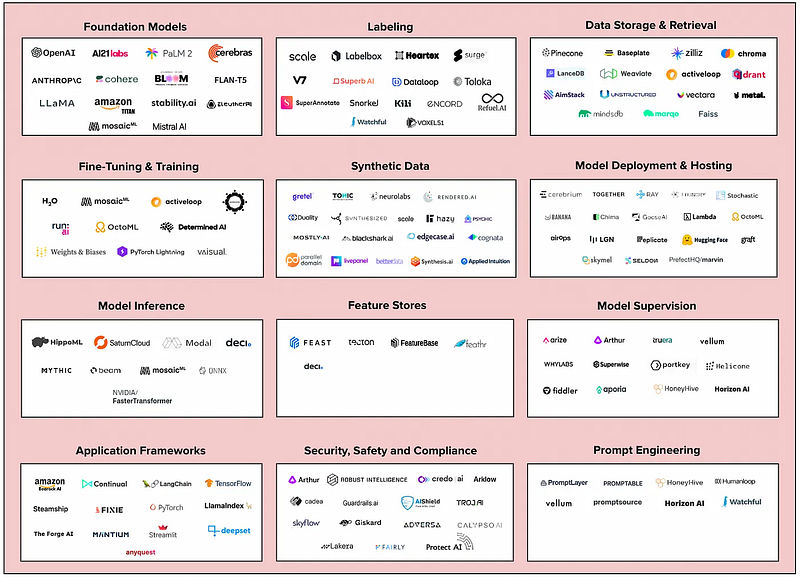
Image Credit: Cowboy Ventures

AnyQuest provides the Application Frameworks to enterprises with integration, security, and control for better data efficiency.

  • Dynamic Knowledge Management:

For any knowledge worker, an AI assistant can only be effective with specific knowledge in a digital workspace associated with the worker’s persona. The better we set up these workspaces and allow interactive collaboration among them, the better outputs we can deliver to assist the knowledge work on the tasks. Ad hoc inputs and outputs are wasteful and poisonous.
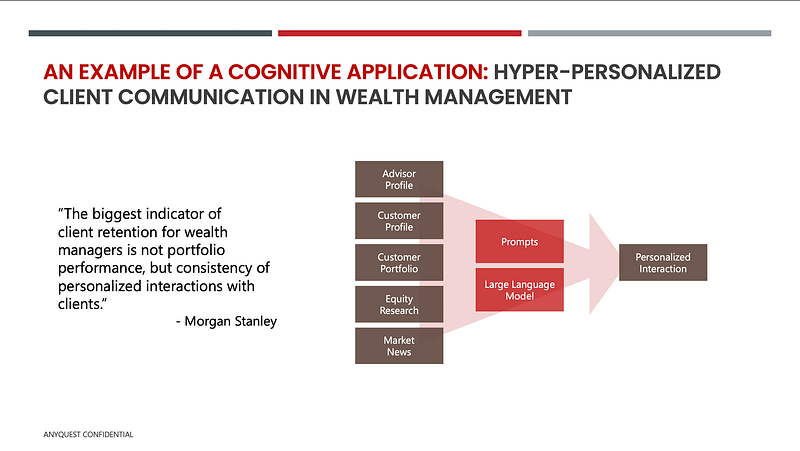
Image Credit: Author, Founder of AnyQuest
  • Long-term Memory:

It’s essential for generative AI to perform reliably within a specific framework of memory. It’d be inefficient to rely on impulsive prompts without continuity or reinforcement learning.
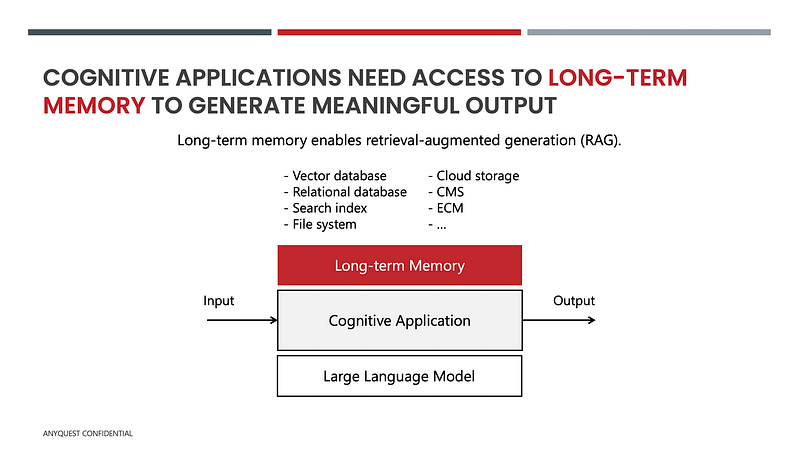
Image Credit: Author, Founder of AnyQuest
  • Dynamic Middleware for Enterprise AI

To make AI relevant, efficient, and reliable, we provide an architectural framework for data orchestration and scheduling with the support of memory management, task primitives, model management and tool management.
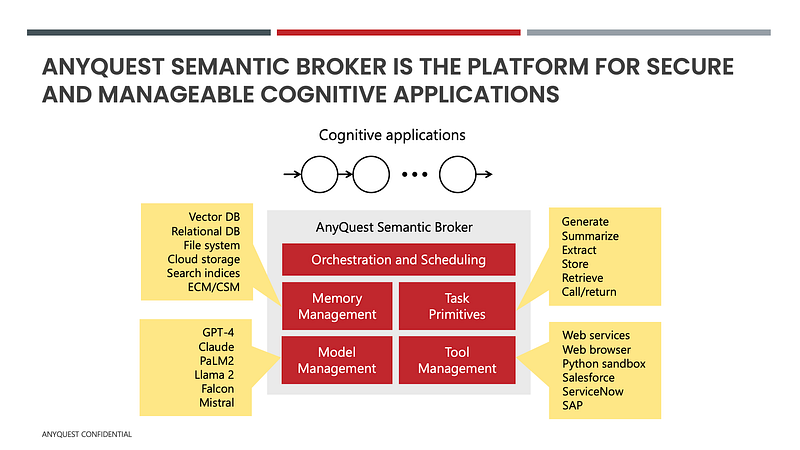
Image Credit: Author, Founder of AnyQuest

№3 RULES

There is so much fear of AI that organizations’ first steps towards deployments should come with explicit rules that reflect responsibility and accountability. This requires transparency and a systematic audit of the ins and outs of generative AI applications. While LLMs are black boxes at large, their purpose is generic under the governance of the global industry and national security. With semantic brokers, organizations can document and control how their own specific data are orchestrated and cognitive applications deployed.

Today, most organizations adopt generative AI bottom-up at the level of individual employees or departments.

ChatGPT is a popular tool for drafting emails and website copy. Many online services provided by one- or two-year-old startups help automate work in sales, marketing, customer support, product development, and other areas.

Such democratization of AI adoption presents many opportunities to improve job satisfaction and productivity. It is also rife with security, privacy, and compliance challenges.

In most cases, the user must prompt AI with proprietary information. As a result, organizations risk losing control of their data and exposing their customers’ personal information.

Banning AI is not an option. ChatGPT and similar apps are readily available on personal mobile devices.

Organizations must proactively control and manage security, privacy, intellectual property, and compliance risks associated with generative AI. Empowering people with knowledge and a no-code platform while implementing enterprise-grade middleware, as we described above, are the responsible approaches for managing and controlling these risks.

I am passionate about the future of this AI revolution because humanity will thrive and win after all is worked out. My advice is to Train Your Own Dragon and embrace Human2.0.

For additional tools and resource ➡️ Visit StartupStash Zendesk is giving $75,000 in credits and perks for startups! ➡️ Apply Now!

Read More:

Artificial Intelligence
Enterprise Technology
Enterprise Software
Data
Generative Ai Tools
Recommended from ReadMedium