
The Three Best Content Marketing Strategies for May 2021 and Beyond to Increase Your Reach and Earning Potential
May is a great month to revamp your content promotion strategies to increase your readership and following into the next year.

When you’ve been writing for a while, it can be difficult to come up with new ideas to keep your work fresh. This is important not only to maintain your readers’ attention, but also to keep your own interest high.
If it gets to the point that writing feels like dragging through the mud to get something, anything, out, this will be reflected in what you publish. Your readers will feel the difference, your numbers will start dropping and this will put more obstacles in your way as you try to write each day.
The key to staying interested and positive about your writing is to shake things up every so often, to try something different. When I first considered some of these ideas, I wrote them off. I’m not a photographer, I don’t draw, I don’t think in frames and I like flying by the seat of my pants determining what I’ll write about each morning from what strikes me in the news or in my life.
Yet I’ve committed to trying out the strategies listed here or at least fully researching them to see how I personally can apply them. I’ve already learned some new skills which are extremely easy to use. I’ve also discovered that there are an abundance of tools available online to help those with a lack of talent or ability in different areas so there’s no excuse not to up my game anymore.
Create Photo Essays
May is National Photography Month in the U.S. It’s the perfect opportunity to develop skills shooting your own photos or if not, learning how to find gorgeous free photos online to use creating a photo story.
From a promotional perspective you can use photography to tell a story and capture your readers’ attention. Good photo essays will also help you to attract a new audience. For writer’s sometimes this idea is a bit off putting since we use words to tell our stories. But this type of content doesn’t mean the absence of words. If you’ve read National Geographic you are familiar with photo essays.
In a photo essay you use a series of ordered photographs to affect the readers thoughts and emotions. Photo essays are great for travel articles to make the reader feel like they are really there. It’s one thing to describe the aquamarine waters of Lake Baikal in Russia but quite another to actually show what it looks like.

You can talk about the landscape, local culture, events, and people who live there. (Remember to get permission before posting photos of individuals).
You don’t have to go far to gather photos for a photo essay. Walk around your town or neighborhood and look for different ways to show the mood and energy of the location. Take wide shots of streets, close-ups of interesting details on buildings, street signs, and candid shots of people. Talk to the people you photograph and find out something unique facts about them or aspects of their lives. Look for small details that give the area character and life. Take photos at different times of the day and in different weather conditions.
Other ideas for photo essays are behind the scenes where you photograph what’s going on in the background of an even or the preparations, an account of architecture, water features specific to a location, or showing aspects of a unique occupation or craft.
Create Your Own Comics Even if You Can’t Draw
May 1st has also traditionally been Free Comic Book Day in the U.S. when the comic book industry gave away free comic books to attract attention and raise awareness. But due to the pandemic for 2021, they had to push the date off to August 14th. It’s still a great time to try to challenge yourself with a new content type.
In addition to their entertainment value, comics as a content type can be used to write satire, to comment on the culture or politics of the times and to inform, persuade and inspire readers to gain more knowledge about different topics. They can be used as stand-alone pieces, or to introduce an article in a fun way. Comics are also idea for those who don’t want to struggle through the pages of text in an article, but just want to get to the main point.
When I first saw an article about using comics as a different content form to provide diversity in your content writing, I didn’t consider it. This was because I have no drawing skill at all. It took more than half a year of friends’ encouraging me, before I returned to the idea. I realized that there are programs and apps that you can use to create comics even if you can’t draw.
Doing I search, I could tell than many of them were fairly complex and more appropriate for people writing Manga. Others were expensive with no free trial. But there were several that seemed simple enough for the comic neophyte to use.
I found a few free ones that I tried out. Generally, they didn’t have as many options for backgrounds, characters and objects as I would have liked. But they provided enough to at least give comic creation a try.
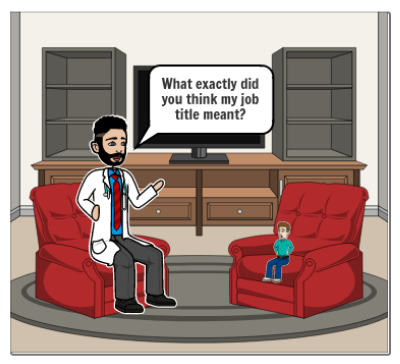
I first tried Storyboard That which is pretty simple to figure out. There is a free version that lets you create two storyboards a week. The program gives you settings, characters, speech bubbles and individual objects all of which you can edit to fit your needs. You do have to be careful with rights, as you can’t earn by selling the comics you create, However, as long as you’re not making over $5000 off of the comic they’ll let it slide if you want to include in in a blog or article. I made just a single panel comic since it was my first time creating this kind of content. Here is my first ever attempt at creating a comic:
Due Diligence
Not thrilled with the results, (admittedly I’m sure a more professional looking comic could be created if you took the time to learn how all the features work), I then tried Make Beliefs Comix which is a program for children. I figured if children could manage the program, then so could I.
Make Beliefs Comix also has a free program but to be able to use your comic commercially you have to obtain permission from the site creator and link back to the program (a good practice to get in the habit of even when using programs, photos or illustrations that are under creative commons licensing).
Make Beliefs Comix has a wider variety of character types than Storyboard That, but each character only has three possible poses to use. It took some work to adapt two of the characters to my idea. Make Beliefs Comix also has a wider variety of different backgrounds to use and both speech and thought bubbles.
Here’s my second attempt at making my own comic. This time I created a strip with three panels.
Therapy Gone Awry
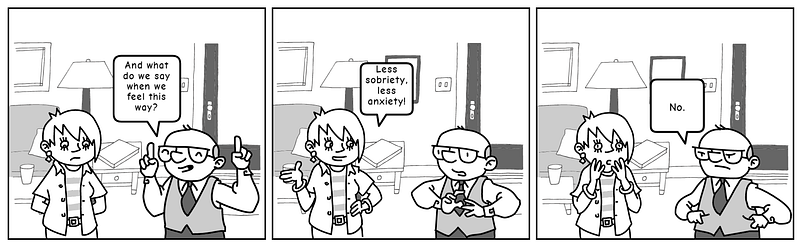
This seemed better and looked more like what comes to mind when I think of comics. There are a number of other programs available for those who are a bit more tech savvy or used to working with graphics. Some have a free version or trial and several have paid options that are under 10 dollars.
Create a Topic Cluster
This strategy is one that we all should have been exercising before now but is easy to forget or just not plan out. Topic clusters are internal linking systems linking related articles together.
Often, writers will include links to individual stories that are tangentially related to the current story. Sometimes we might also add links to other stories that have little or nothing to do with the article they’ve been embedded in. This might get us a few new views on older articles but it isn’t likely to create a lot of new interest or engage readers with our content.
When you created a topic cluster, you plan out the topics you’ll write about and the order in which you’ll present them. They help readers and search engines identify your site or collection so that you are recognized as an authority for a specific topic.
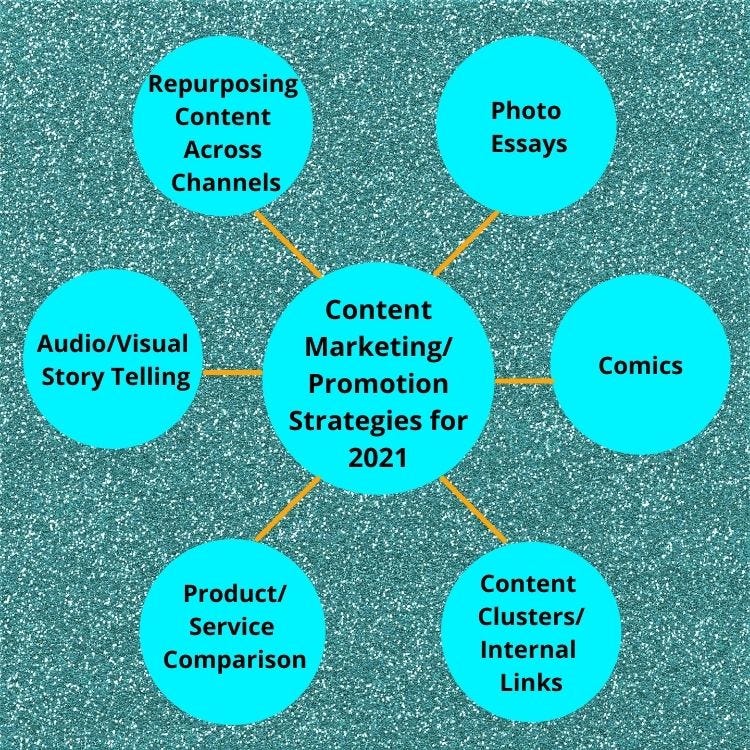
For example, if I was to create a topic cluster for content marketing and promotional strategies for 2021, it might look like this:
Final Thoughts
The focus of search engines in the coming year will be user experience. The factors that go into this were determined by analyzing search queries and user behavior in response to results.
With the continued growth of technology, many content consumers want to have different accessibility options in addition to long text articles. Variety is key to attracting followers in the coming year, so including forms such as photo essays and comics will provide diversity that readers are looking for.
Making sure that your content is cohesive and not every article you produce is a one off but that there are definite topics with subtopics explored in linked articles will help your reputation as an authority. For writers who are independent publishers to be able to compete with large, established content sites, readers don’t only want credentials, they want to see that you have expertise in one or two areas.

If you enjoyed reading this article you might also like these:
You can find links to my other work on Medium and follow me here. Thanks for reading!