
The “Thousands, Not Millions” Law of Content Quality
Unless you’ve been living under a rock, you’ve probably noticed that the world of media — both social and broadcast — is undergoing a massive disruption. The old guard has become wobbly and new upstarts, in terms of content platforms as well as content creators, are rising all over the place.
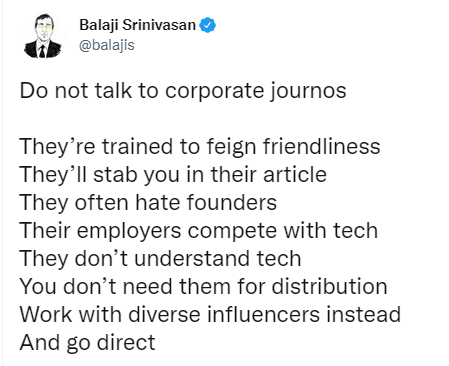
A recent tweet by Balaji Srinivasan captures this quite well, if a bit dramatically.
To emphasize the point just a little further, let me give just one example of this phenomenon:
Lex Fridman, an emerging (or shall I say “emerged” by this point?) podcaster, recently interviewed Elon Musk — possibly the one of the most coveted guest for any interviewer at this point. Imagine talking one on one with the richest and most sought after man in the world for 2.5 hours! I’m pretty sure every major journalist as well as media outlet is jealous of Lex! He is getting what they are not able to get in spite of being a lot more popular and powerful.
What’s Going on Here? And Why is it Happening?
It is tempting to look at this phenomenon from a political point of view (and that’s always a popular way to look at it), but that wouldn’t be very honest on my part frankly. I am more interested in looking at it analytically and from first principles.
Hopefully such an approach will actually lead to a way of moving forward, rather than just going round and round (as it seems happen a lot these days when you look at anything politically).
So, what’s going on? Why is it happening? Is this a long lasting change or just another fad? What can we do about it?
It’s time we (as in content creators as well as content consumers) took a hard look at this phenomenon. To do this, let us go back to first principles and follow the journey of a typical content creator to see what insights one can glean from it.
The Journey Begins

The creative journey a typical content creator progresses as follows:
- They create an account on some portal, like Medium or YouTube or Instagram etc. depending upon what type of content they’re planning to produce. They invite some of their friends to follow them, and start producing content.
- If they create something good and keep a consistent cadence, they start to generate some interaction and sharing among their friends. This typically leads to attracting a few other followers.
- This also attracts other content creators who are basically in the same boat (in terms of followers or reach). This typically leads to mutual following of each other in the hopes of helping each other increase their reach.
Finding Your Voice
- This process continues gradually for a while. At some point during this long and tedious process, through constant experimentation and a few false starts, the content creator eventually finds their “voice”.
- This “voice” is basically just a combination of what the content creator is good at producing and what seems to be working for their audience.
- This is akin to a tree root growing in various directions until, at some point, it finds a damp patch of soil, indicating a source of water nearby.
- At this point, the content creator may have a just few dozen to couple of hundred followers.
The Hard Slog
- This invigorates the content creator and they start producing better and better content in that direction. They hone their skill, they discover other creators in their niche and borrow ideas from them, they try to build relationships with their followers and so on.
- Their audience starts to grow, but it is still a slow and tedious slog of linear growth. From a couple of hundred, to many hundreds of followers. (YMMV of course.)
- At the same time, this is also the period when the content creator typically starts to produce their best content. It’s a weird situation where great content is being created, but it is not very well known yet.
The Magic Moment of Virality
- Then, at some point, they just happen produce something about something that is very timely and poignant in some way, the stars line up just right, someone with far more reach shares it, and the content goes viral. This is the magic moment that everyone hopes for!
- This leads to a sudden burst of followers who, for the first time, are complete strangers and are really interested in what the content creator is saying rather than having some other motivation like friendship / obligation or people in the same boat helping each other or just casual followership etc.
- This further invigorates the content creator and they really get into their A game. If they handle this transition from an obscure slogger to someone with a bit of recognition well, and keep producing great content and maintain their cadence, they start to get to thousands of followers.
- The community of followers they have attracted so far typically shares a common interest or niche. They share a lot of the context with the content creator and with each other, and thus are able to extract more and deeper meaning out of every post by the content creator than a casual consumer of their content.
- The comments and interaction in this range is also typically of high quality. There is a feeling of community. There are very few followers who are there just to ride on the content creator’s coattails as it happens with larger accounts.
- Now, if they keep at this level for a long time, and keep serving their niche well, that is great. You can expect a lot of very high quality content to come from such people for a long time. They might even start to make some money from their content.
Sliding From Thousands to Millions
- But this is a slippery slope. Everyone wants to continue to grow their audience. And the experience of going viral is so heady that one naturally wants to repeat it again and again.
- Now, typically, meaningful niches are not very large. (That’s pretty much the definition of a niche!) And the content creator is already pretty much serving their entire niche by this time. So how can they grow their audience?
- Well, the natural solution is to craft a message that spans multiple niches. Find some adjacent niches that they can grow into. How does that work?
- Each niche and each piece of content has a bunch of attributes that define it. These are things like the genre / topic / subtopic, presentation style, degree of difficulty, tone, length, and so on. A content creator that is filling its niche well is someone who is consistently producing content whose attributes align very well with their niche.
- So, in order to expand beyond their initial niche, the content creator has to produce content with attributes that apply to all those additional niches.
- Of course, this usually comes at the expense of some of the attributes that were specific just to their original niche.
From Fine Wine to Diluted Alcohol
- Unfortunately, this means their original followers from their original niche may start to discover that their message is getting “watered down” or becoming less authentic or organic to their niche. Some of the shared context they had built up, which was making their message more meaningful to them, starts to wither away.
- Also, in order to attract the uninitiated followers from the new niches they are trying to target, they typically have to dress up their content, to make it more attractive at first sight. This could be thought of as them “spiking” their message.
- Over time, as the content creator targets more and more niches, which implies focusing on fewer and fewer shared attributes among those niches, and having to attract more and more uninitiated followers, their message gets further and further watered down on the one hand, and more and more spiked on the other.
- As you might have guessed, eventually you are left with just a tasteless watered down moonshine bound to only give you a headache and nausea! The special flavors and colors and mouth feel and stories of the original fine wine are lost.
- It’s no wonder that this is commonly known as “catering to the lowest common denominator”. The common denominator here refers to the shared attributes of all those niches that the content is trying to target. And the “lowest” corresponds to the spiking using cheap quality alcohol. This appears to be the bane of most content creators who manage to get to many millions of followers.
Dead Man Writing
- In a good world, the journey would end there. Or reverse course back into the fine wine territory. Unfortunately, we don’t live in that world.
- Most content creators tend to keep going, adding more and more niches, watering their message down further and further, at the same time spiking it more and more.
- Eventually it feels like all life has been drained out of their message. The content creators themselves become like a ghost that’s still producing content.
- (As an aside, soon enough we may actually be able to do this using something like a GPT-n based text generator gone awry similar to the “paperclip maximizer”!)
- Maybe we can call such soulless content creators “Clickbait Maximizers”! 😊
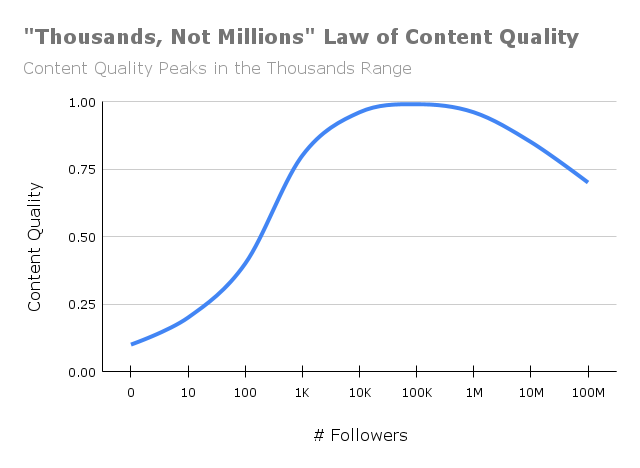
The “Thousands, Not Millions” Law of Content Quality, in Short
So, that’s the typical journey of a content creator. The actual numbers may vary somewhat here and there, but they are almost always in this ballpark.
To summarize, the interesting pattern to note above is:
- Content quality rises fast as the number of followers rises from zero to hundreds to thousands.
- It peaks somewhere in the thousands to hundreds of thousands of followers range.
- It starts its steady decline somewhere in the millions range.
It is amazing how common this story is. Just look at the people you follow on various media platforms and you will see this pattern. It may not fit exactly, but roughly.
That’s why I feel like there should be a law named for it. So I am calling it the “Thousands, Not Millions” law of content quality.
(I suppose this isn’t the best name for this law. I could have probably come up with a more authoritative / scientific sounding name, but that would miss the whole point, right?)
For those who like pictures and charts, here is a chart depicts this phenomenon:
Content Platforms
This phenomenon applies equally well for content platforms also. The stodgy old platforms that I mentioned earlier that are wobbling right now used to be young upstarts at some point. They basically went through the same process of evolution — probably over a longer period of time given that things used to be slower then.
And they have started wobbling now because they have gone over the peak and have started declining. Some would say they have been declining for a while. Of course, being platforms, which are agglomerations of many small niches, the numbers that apply to them are much larger.
Due to the larger numbers, maybe one can say that the content platforms follow the law of “Millions, not Billions”. It’s the same pattern though.
This basically brings us back to what I started with, the tweet by Balaji. These platforms have become wobbly because they are full of watered down and spiked content and people are starting to catch on to that.
You are probably seeing this pattern everywhere. You might have noticed that the people and platforms that used to be great when they were relatively new have become boring, too commercialized, too click-bait driven, and generally unappealing. They have become a spitting image of the old hegemonies they replaced — at least as far as the quality of their content, the meaning and value you were able to derive from them, the connection you felt with their community etc. are concerned.
A Call to Action

Given this phenomenon, what can we do to ensure that we end up with high quality content?
- As a content consumer, it is best to stick with creators who are catering to a single or just a couple of niches. Typically, they will have hundreds to thousands of followers, since that is typically how large a meaningful niche is.
- If you encounter a creator with millions of followers, your default assumption should be that you are getting watered down / spiked content.
- And, if you are a content creator, you should avoid the temptation to water down your message or spike it in order to appeal to a large number of niches. Avoiding this pitfall will, in the long run, ensure that your content quality remains high, keep your craft improving, and ultimately lead to a more long term sustainable activity or career for you.
- Also, it is best to stick with content platforms that specifically cater to the content creators in the hundreds to thousands followers range. This applies whether you are a content creator or consumer. (I believe Medium itself, as well as others such as Substack fall into this category.)
- If you are a software engineer, there may be an interesting opportunity here: a search engine for quality content, based on this law. Basically, you would rank content that is in the sweet spot of hundreds to thousands of followers higher than the more popular content. You may consider other features such as the level of engagement (i.e. number of comment threads etc.), consistency, cadence, stability of followership, etc. I think this will uncover many hidden gems.
I believe that as more and more content creators, consumers, platforms, and search engines come to realize this phenomenon and act on it as stated above, it will lead to the quality of content improving overall. This seems like the most interesting and promising solution to the current crisis in content quality.