
MEDIUM | AI | PLAGIARISM
The Thought Thinkers Stance on Artificial Intelligence
The modern age of plagiarism
Artificial intelligence is a subject I’ve addressed here at Thought Thinkers before, but in the recent weeks it’s grown apparent that more clarity may still be needed.
Artificial intelligence certainly has its uses, and there’s no denying the utility it can bring to the table throughout the editing process. It can catch mistakes, suggest adjustments to tone, and point you toward articles to support the arguments you’re attempting to make. It can serve as an advanced thesaurus that can refine results around the specific sentences at hand.
But it isn’t a writer, and its work isn’t your own.
Writing is about the creation of ideas. It’s about saying things that have never been said, and communicating them in a way that only you can. It’s about using the language skills you’ve spent your life developing to carry your ideas to beautiful places. It’s telling untold stories, providing novel wisdom, and finding ever-changing ways of communicating the thoughts dancing through your head.
AI-written content is the fundamental opposite. There is no creation of new ideas, and there’s no saying what’s never been said. These programs are built on a vast database of words already written and ideas already expressed. They don’t consider issues in new ways. They don’t consider.
If you’re using artificial intelligence as a means to get your ideas across, you’re taking information simultaneously from a thousand different sources — or many billion, as the case may be. It’s plagiarism of the modern age, and in the months and years to come governments will have no choice but to pass laws around it. But for now, the world of generative AI is a Wild West of artistic and intellectual dishonesty.
Artificial intelligence poses a serious threat to all creators. As these programs have begun “creating” artwork, writing and performing “new” music, and creating “original” novels, the threat posed here could hardly be clearer. The advent of AI is one of the primary reasons why Hollywood has been paralyzed by this writer’s strike.
While I’m not going to outright ban AI-generated imagery at this time, I can only caution that you consider the implications each time that you use its work to replace a real artist’s or photographer’s. While I can’t ban the overall use of AI as a tool in writing, I can do my best to make sure it’s not being abused.
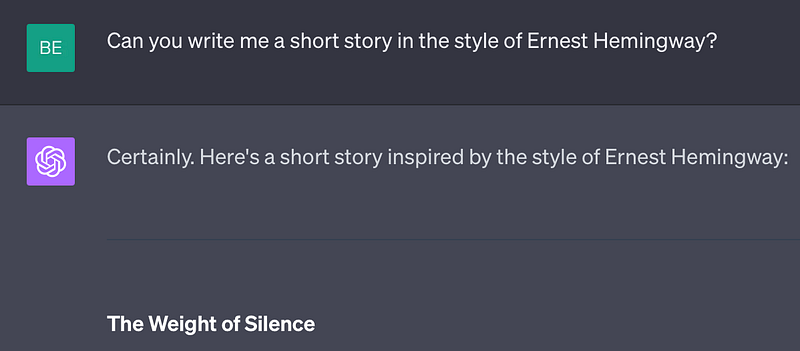
I’ve begun to develop an eye for the AI-written introduction. It’s stilted and discernible. And while my eye is far from perfect, with the help of a couple AI-detectors and some basic scientific method action, I can assess with reasonable accuracy whether you’re using AI as a practical tool or a cybernetic performance enhancer. These tools can be powerful means for refining a piece and assessing its grammatical accuracy, but when simply prompted to “Write a paper on the French Revolution,” the plagiarism at play could hardly be plainer.
Don’t submit AI-written content. Do your best to avoid AI-generated imagery. Take no credit for work that isn’t your own.
Remember we’re all a part of the fight for a world in which creators can continue to create.