
The Third Morning
Thirsty Work — Chapter 19: best laid plans
Two young women from California travel to New Orleans in search of redemption after the death of their mother. Carolee thinks she will show her little sister the world, but what they find in the barrooms of the French Quarter at Mardi Gras is more than she knows how to handle, or could have imagined back home. This is the nineteenth chapter of the novel Thirsty Work.
The next morning we got ready for our first Mardi Gras parade. Howard was slow getting up and out of our sleeping bag and I wondered if he was still angry with me for encouraging Terri in the kitchen. We’d made love the night before — after eating our dinner in separate corners of the living room, after passing the evening without exchanging two words. He had come into my bed and reached for me quietly in the darkness; I had welcomed him eagerly, comforted by his scent. But I knew that having sex didn’t mean I was forgiven.
“Forgiven for what?” I scolded myself in the mirror as I brushed out my hair. “For having sympathy for another person? For having an open mind?” I didn’t even know if I liked Howard. He’d shown the night before that he could be mean. Still, I looked at his sleeping figure with anxiety. I didn’t want him to reject me. Everything would be better if he’d just whisper my name.
Then he woke up and I saw that I’d been worrying needlessly. He smiled sleepily at me. I felt giddy and blessed. I watched with relief as he got out of bed and pulled on his soft, striped shirt; his old, baggy pants; his brown, scruffy shoes; and his thick, blue beret.
“Hurry up!” Tessa urged, running through the room between us. “It’s started!” Sharon and Doug followed her out the front door to join Peter and Stan on the stoop. Cathy and Carl came out of the kitchen together, arm in arm. I ignored the twinge of worry, the tiny voice in the back of my head. What’s happening to Cathy? What are you doing about it? Is everything going to be all right? Howard and I fell in behind them, and pulled the front door shut. We started off en masse down Rampart Street, in the direction of Canal.
It was a warm, bright day and our little band was full of silly, childish energy. I was glad to be part of the group, with Howard beside me, although I wasn’t looking forward to the parade. I didn’t like parades. The only one I remembered involved sleeping on the sidewalk with my cousins in order to get a good seat for the Rose Bowl in southern California. Mom had pitched it as a great adventure, but it was scary to stay out all night on a city street, where an old man in a lawn chair could eye me while grimly drinking his beer. And the event itself was an interminable stream of big, clumsy floats and too-loud bands passing by in the sweaty, relentless heat.
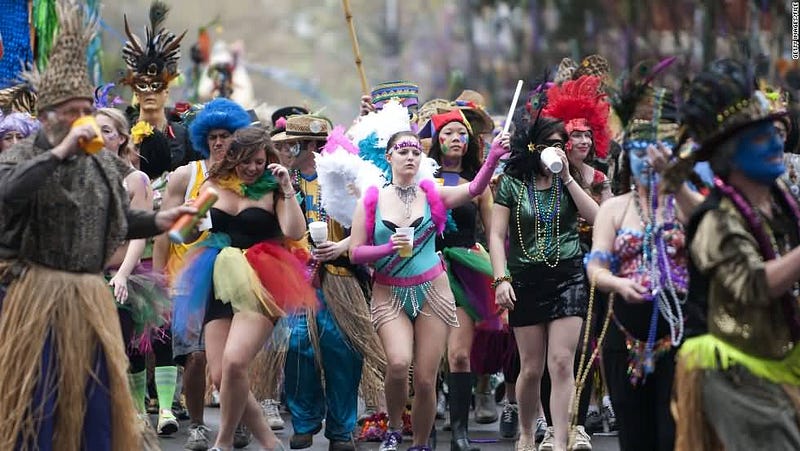
But a Rose Bowl parade in Anaheim is not a Mardi Gras parade in New Orleans. There would be no fat men on lawn chairs grimly sipping beer. No white women in pastel jumpsuits with stiff, sprayed hair. I noted the difference long before we got to the parade route on Canal Street. Walking down Rampart, we saw people in costume everywhere. There was a man dressed as a peacock with a huge circle of iridescent green and blue plumage framing his black-stockinged body. He had silver glitter on his eyelids. When he turned to beckon a friend, his pants were missing the seat. His bare butt stuck out in the warm New Orleans air, with a big, red pimple on the right cheek.
There was a family of lady bugs: mother and father and three little children, all wearing black tights and black caps with curving antennae and big, round red shells with little black dots.
There were pirates. There were gypsies. There were cowboys and gangsters. There were Zorros and Draculas and Marie Antoinettes. We saw one Cher, two Tin Men and a dozen Dorothys. There were paisley arms and fluorescent feet and metallic faces. Feathers and beads. Capes and boas. Sequins. Fishnet. Lipstick. Pearls.
As we got closer to Canal, we could hear the crowd cheer and see the tops of the floats passing by us. “Come on!” Howard said excitedly and grabbed my hand. We pressed into the crowd and pushed forward until we were right on the edge of the street, where we could see.
The next float approaching featured a huge pirate wielding a cutlass over a treasure chest of gold. Behind him, on the deck of his brown, paper ship, were dozens of eerie-looking men in sexless black pajamas and white, expressionless masks. They looked sinister to me, much more dangerous than pirates, like a secret club of criminals who performed acts so vile that they didn’t dare reveal their identities — even to themselves. They stared out at the crowd with cold, black eyes through tiny holes in their hard, white masks.
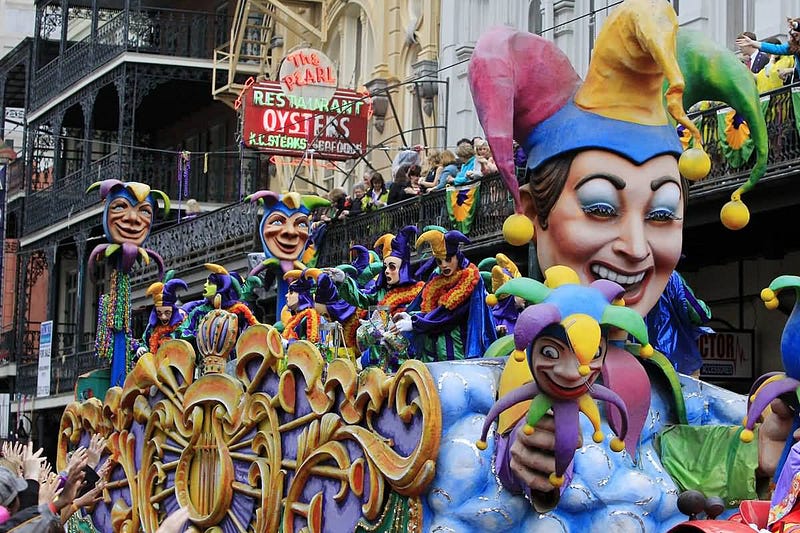
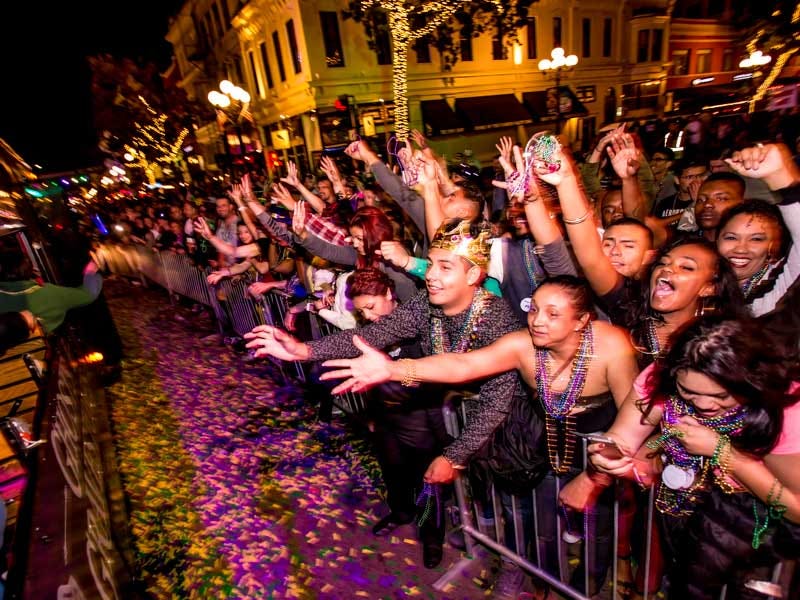
But as the float drew closer, I saw the sinister figures were throwing treasure to the delighted crowd. They dipped their hands in brimming bags and pulled out lush fistfuls of long necklaces and round, shiny doubloons. As they passed us, the trinkets rained down on our heads and I found myself scrambling with the others to scoop them up off the street. Howard came back with a particularly gaudy gold and purple necklace. “This is for you,” he said happily, stringing it over my head. I surged with silly pleasure just like the foolish crowd.
The next float had a giant moon and men in white pajamas. Then came a huge crawfish in a big, black pot. As the floats and hours passed, the string of necklaces around my neck grew thicker and heavier, the big plastic coins in my pocket drew the fabric taut.
Sometimes, when a float went by, the men in masks threw nothing, saving their treasures for the luckier people a little farther down the street. “Throw it to me, to ME,” the children clamored. “Throw me something!” called a woman beside me. She got no response. Then she opened her shirt and bared her breasts and was showered with treasure. I looked at Howard and laughed.
That first parade was followed the next day by another, and the next day by another, and the day after that by two more until we were tired of collecting plastic necklaces and phony gold pieces and decided to find other things to do. I hung out with Howard and Cathy stuck to Carl. Doug cleaved to Tessa and Sharon. Peter traveled with Stan. Sometimes, two or more groups would spend the day together. Every morning we were all together at the flat.
Howard took me to walk by the Mississippi or sit together on a bench in Jackson Square, where we would watch the world pass. He was delighted by almost everything he saw. “Listen to that,” he’s say of a saxophone player in the street, closing his eyes and tilting his head back, letting himself be transported by the melancholy tones. “Smell that jambalaya, it’s making my mouth water,” and I could see the saliva pooling at the corner of his lips.
It wasn’t only the world outside that moved him. I watched with delight as he let himself drown in his feelings for me. He often grabbed my hand and ran to show me something that pleased him. He brought me small gifts. He fed me. He kissed me unexpectedly. Once in a warm rain he pulled me into a doorway and kissed me so passionately that I felt myself floating outside my body, rendered weightless by the sudden swell of his love.
We strolled and window shopped and ate and drank and sang and talked. We moved with pure, fluid rapture on the dance floor. But mostly, we kissed. We kissed in the car, by the lake, alone under the moon and pressed in on all sides by huge crowds in the middle of the afternoon. We kissed on front stoops and park benches, barstools and pool tables, rocky riverbanks and grassy lawns. We kissed under magnolias and over frangipani and standing next to bamboo. We kissed quietly in the darkness in Howard’s sleeping bag, and in mine. But we were too shy to make love until the whole flat was snoring. The lack of opportunity only made our desire swell.
As the days passed my cache of love tokens grew larger. In addition to my magic juju bean necklace I had a small fish carved from ivory, a jangly silver bracelet, a leather belt woven with intricate beadwork, a tiny china cup. He derived pleasure from each piece, from each bit of art he bought or saw or found, and he transferred that pleasure to me along with each gift.
When we’d been in New Orleans two weeks I got sick with a fever and Howard nursed me tenderly back to health. He brought ice cream to my bedside and plumped my pillows and rubbed my feet. He sat beside me with his guitar and played soft, beautiful music, his fingers flying over the frets like bees collecting pollen — light and magical and impossibly sweet.
He read me poetry. No man had ever read me poetry. He kissed me gently on the neck.
The third morning of my illness Cathy came to talk to me. She looked at me awkwardly as she perched on the side of my bed. “How are you feeling?” she asked.
“Better, I think. I’ve got a good doctor,” I smiled in the direction of the front stoop, where Howard was having a cigarette with Doug and the others.
“He’s a nice guy,” said Cathy. “I can see you really like him.”
“I really do,” I smiled.
“I like Carl a lot too. In fact, I think I love him.”
That woke me up. I hadn’t been paying much attention to Cathy lately. I’d been too wrapped up in my own romance to care. In fact, I hadn’t paid her much attention since we’d arrived in New Orleans. I’d told myself I didn’t need to. Just seeing new places, meeting new people — that was the point, wasn’t it? That was the reason for the trip. That would open her eyes to a world of possibilities, help her break from the crowd of bad boys she hung out with back home. But was Carl any better? Not at all. He was worse. He was older and harder. He didn’t live in our town…
“Yeah, I do,” she smiled at me with a half-angelic, half drug-addled teenager’s grin. I waited for her to continue. But she didn’t. And I hesitated to probe. I was afraid to hear what she might say next.
“Well, that’s nice,” I said, finally. “I’m glad for you,” I forced a smile. “But is it going to be hard to say good-bye when this is all over?”
“Yes, it is, Carolee, and that’s what I wanted to talk to you about. I don’t want to say good-bye when this is over. I want to go with Carl.”
I felt like I had fallen from a tall tree. All the wind was knocked out of me. “GO with Carl!?!” I croaked. “What do you mean? Go where?”
Cathy grabbed my hand and tried to soothe me. “Just on a little trip,” she said. “He got a job driving a big truck up to Connecticut on the day after Mardi Gras. He says it will only take a week or maybe two to get there and back. I want to go with him.”
“But Cathy, how can you? What about me?” It didn’t seem right to show myself as vulnerable to my little sister. Wasn’t I the driver? Wasn’t I in charge of the trip? But I was frightened, and there it was.
“You’ll be all right, Carolee. You always are,” she held my hand tighter. “I thought you could wait here for me to come back; then we would drive home together. Or, if you don’t want to wait, you could go home without me and I’ll come back later on the bus.”
“On the bus?” I felt myself sinking deeper into already deep mud. “I can’t go home without you, Cathy. Dad would kill me if I left you out here. The sisters would never forgive me for letting you get away. I would never forgive myself.”
“I wouldn’t be ‘getting away,’” she laughed at the image. “Come on, Carolee, you’re not responsible for me any more. I’m out of high school, now. That makes me a grown up. I can make my own decisions. I can decide whether I want to go home or not.”
I started crying. “Cathy, please don’t do this. I’m afraid for you to go. I don’t want you to go anywhere without me. Couldn’t Carl come and visit us in Stockton instead?”
Cathy’s voice got sterner. “Listen, Carolee. Everything will be all right! Carl might come to Stockton. We’ve been talking about that. But first, he’s got to make this trip so he can save up some money. And I’m going with him. It’s all decided.” I groaned.
“You know I was thinking,” Cathy voice took on a softer tone. “Howard’s from Boston, and that’s not far from Connecticut. Maybe the two of you could go up there after Mardi Gras and me and Carl could meet you. Then we could drive home from there.”
I stared at my little sister. She’d come up with what sounded like a pretty good plan. Not only could I hold her to her commitment to drive home from Boston, if I drove all the way up there, but also I could stay close to Howard. We wouldn’t have to say good-bye for another week or two. Or maybe three. Or maybe never, I thought to myself. By that time, maybe he’ll be so much in love with me that he’ll follow me back to California.
“That might work…” I looked cautiously at Cathy. “I’d have to check with Howard.”
“Then it’s settled.” She gave me my hand a businesslike squeeze before leaving to join her lover outside.
That was also the morning that Aunt Viv came back for another visit, all dolled up in a black miniskirt and bright pink, plastic earrings and a tight pink top. “Carolee,” she said, walking into the big back room where Doug and Sharon and Tessa had given up the only bed in the apartment for the duration of my illness. “Get up out of that bed. It’s late! I’ve come to take you and your sister out to lunch.”
“Thanks, Aunt Viv, but I can’t go, and Cathy’s not here. I have a fever and a sore throat. That’s why I’m in bed. But it was nice of you to ask.”
“Oh pshaw,” Aunt Viv scolded. “You can’t rest in New Orleans! What’s a little sore throat to my favorite niece? There’s only two more days to Mardi Gras!! You can’t spend them in bed!” I could tell by the way her words blurred at the edges that she’d started lunch without us — or at least the liquid part.
“But if I rest, maybe I’ll be better in time for Mardi Gras,” I reasoned. “I don’t want to miss the big party,” I lied. In fact, I would be perfectly happy to miss the big party. In fact, I was enjoying laying about in bed.
The truth was, I loved Howard’s gentle ministrations far better than his excited ramblings in barrooms. The truth was, I was tired of drinking myself silly and walking down grimy streets that stank of piss and beer. In fact, I was tired of a lot of things.
Learning from Terri that we were living in a neighborhood of sex workers had sucked some of the romance out of our trip. I wasn’t trying to cook and clean and sprinkle fairy dust on the apartment anymore. Now I was tired of sharing a kitchen with cockroaches; I was tired of having to wear shoes to the bathroom because of the grime on the floor; and I was tired of sleeping in a room crowded with people who stank and sweat and farted and snored.
I was also tired of worrying about Cathy and wondering what nasty surprises might be in my future. And I was particularly tired of Aunt Viv standing at the foot of my bed in an outfit 20 years too young for her, pressuring me to get up out of bed. Just thinking of all the things I was tired of made me tireder still, so I lay my head back on the pillow and shut my eyes.
“How about you, Howie?” Aunt Viv said seductively, targeting my boyfriend. “You’ll come out for a free lunch with Carolee’s Aunt Viv, won’t you?”
“Not today, Viv, thank you.” Howard was polite, but loyal. My belly warmed, but I didn’t open my eyes.
“Well, what a bunch of tired old stick in the muds” Aunt Viv said haughtily. “I never saw a tireder bunch of so-called young people in my entire life!”
Viv clacked out of the room on her high heels and slammed the door behind her. Howard and I looked at each other and laughed. But despite her ruffled feathers, she was back the next morning to tell us our whole crew was invited to a party at her house on Mardi Gras. “We’ll watch the toast of Rex and Comus on television at midnight.”
“On television?” Doug was incredulous. “We’re going to watch television on Mardi Gras?”
“It’s traditional!” said Aunt Viv, laughing and batting her eyelashes. “Besides, it’s free food and booze. Norman is buying.”
“We’ll be there,” Doug said, giving her a winning smile.
Who appointed him chief party planner? I wondered sourly. But what was I going to do? Refuse Aunt Viv’s invitation? Not likely. So I smiled and nodded as she swept out the front door.
Follow the free chapter links above or buy a digital copy of the whole book:
Copyright © 2020 by Patsy Fergusson. All rights reserved.
My writing is always free to readers who follow my links from Twitter, Facebook, and LinkedIn, but if you’d like to browse more, click here to join Medium and help support my work at the same time. Want an email when I publish a new story? Click here. Find more of my fiction, including another novel, on this List. And for more of the good stuff, follow Fourth Wave, where we’re changing the world for the better, one story at a time. Got one of your own? Submit to the Wave!


