
‘The Third Door’ Book Will Take 15 Minutes To Change How You Think — Here’s Why.

I’ve never heard of Alex Banayan and you probably haven’t either. That doesn’t matter for now.
I found him because I was searching the internet for content to share with the world that’s inspiring. Looking for this content can sometimes make me look like a cocaine addict that is desperately searching for some of that white dust.
The search began, and then wham! There it was — some 5 minute Facebook video that I’d normally never watch but did for some reason. The video got my attention.
The book was about how Alex went on a five year quest to interview many thought leaders including Bill Gates, Mark Zuckerberg, Lady Gaga and Larry King in the pursuit to share their wisdom with a younger generation that would allow them to understand The Third Door methodology.
The book used one key analogy of a nightclub being like life. Having grown up as a DJ working in nightclubs, the idea spoke to me.
There’s one line to get into the nightclub that the majority enter through. There’s one line to get into the nightclub that is for the VIP and celebrities. Then, there’s one line that nobody tries.
That mystical line is the one that involves the following:
- Working your face off to find a way in
- Going through the back entrance
- Knocking on the door a hundred times until someone answers
- And using creativity to see an entrance no one else sees’s
This idea was enough to get me excited. I spent the $20 and bought the book even though I would normally never do that for an unknown author or a book that wasn’t recommended to me.
From the minute I opened it, it reminded me of some of the magic I saw when I first opened The 4 Hour Workweek. It was eye-opening and intriguing.
By the end of the book, I saw life and its struggles through a completely new lens. That lens was focused on this idea of a third door.
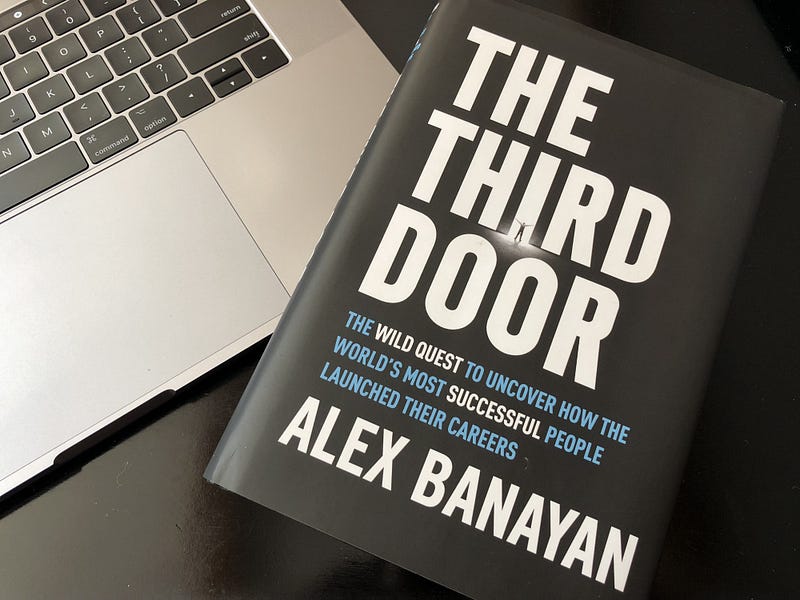
Here’s what you can learn from The Third Door Book:
Borrowed credibility.
If you’re like me, then you probably don’t have Google or Microsoft or some other brand name company on your resume.
For us normal folk, convincing mega influencers to help us with our mission is not easy. It’s this process that makes many people give up. Borrowed credibility is the simple idea that you can give something away for free — knowledge, ideas, tickets to an event, content — in return for the right to use someone else’s brand name to support your mission.
If I were to reach out to Bill Gates he’d be like “Who is this Aussie Clown that keeps saying mate?” and he’d probably ignore my request for a chat. If I contacted young Bill and said I wanted to chat with him about an event that Netflix was partnering with me on, he might at least consider it.
If you don’t have much credibility, then you can borrow it off someone who does. The key is to ask nicely.
There’s always another opportunity.
In the Lala Land of entrepreneurship, founders often think they have to catch their big break and ride off into the sunset.
That first well-known investor to contact them becomes an obsession when it should be nothing more than a conversation. I’ve had many opportunities in my career and burned lots of them. There’s always another one that seems to come past and the same is true for you.
The answer is not to jump at every opportunity that comes your way; the answer is to jump at the right opportunity when it makes sense to do so.
I want to add that often not being ready for an opportunity is the best time which can seem counter-intuitive. I find that if I wait to be ready, then I never am.
The push to be ready by tomorrow creates some magic in my brain that helps unlock a level of creativity that I only get when I’m in flow.

A quick hack for nerves.
Alex Banayan talks about dealing with nerves a lot in his book.
I too have the same issue and for years it crippled me from taking action. What works for Alex, and for me, is to take immediate action. When you feel nervous, transform the nerves into excitement and take action.
Nerves are normal and acting despite them is how you take the chance most people are not willing to take and enter via The Third Door.
It’s not the story but the way you tell it.
Putting my ego aside for a minute, a lesson I learned from the book was about storytelling.
I tell my story all the time about battling mental illness, leaving behind a business I loved and going on this crazy blogging journey that in some ways is similar to the story of The Third Door that Alex tells.
I figured out that when I tell my story, it’s not that different to any other story you’ve heard. I’m sure many of you reading this know someone who has suffered from mental illness, started a business or tried to be a blogger.
My story is not unique but how I tell it is. I’m obsessed with using my story to inspire others which is why I hate the conversation around the whole ‘personal brand’ thang that gurus preach about.
What draws people closer to you is how you articulate what you do not what you actually do.
The planets never align.
Alex teaches this in his book and I’m also obsessed with the idea. There are too many of you that are searching for the perfect time and overthinking your way to a place called regret.
Write this one your forearm and memorize it: there’s never a good time to do anything.

Now you’ve heard the news, quit waiting, or procrastinating and hoping — Just do!
Send the email. Ask the girl or guy out. Quit the job and find the right one now. Start the business.
Learn to skip a step.
I came from the corporate world which is full of process and red tape. Alex’s book opened my eyes to something I did without realizing.
I pissed people off because I always wanted to skip a step in the process. For the process hound dogs, this drove them insane. It was by skipping steps that I was able to get more done.
The same is true for you. You don’t need to follow all the steps. If you do, then you’ll fall for the false idea of waiting for permission and doing what everybody else does. That way pushes you through the first door that everybody else is trying to enter through.
The third door becomes available to you when you skip a step.
Ask yourself “How could I do what most people do in a year, in one month?”
The avoidance list.
Warren Buffet taught this one to Alex and he shares it in his book.
Focusing on twenty five things is like trying to be married to nine wives/husbands. No matter how hard you try, you’ll stuff it up.
Now I’m the crazy guy that wrote “The Power Of Doing Only One Thing,” and I wrote it for a reason — and it went viral for a reason. I wrote it because I’ve been on both sides of the fence: trying to juggle lots of priorities and trying to juggle one priority. One priority, for me, has worked well.
It’s very hard to crash and burn when you only have to think and focus on just one thing.
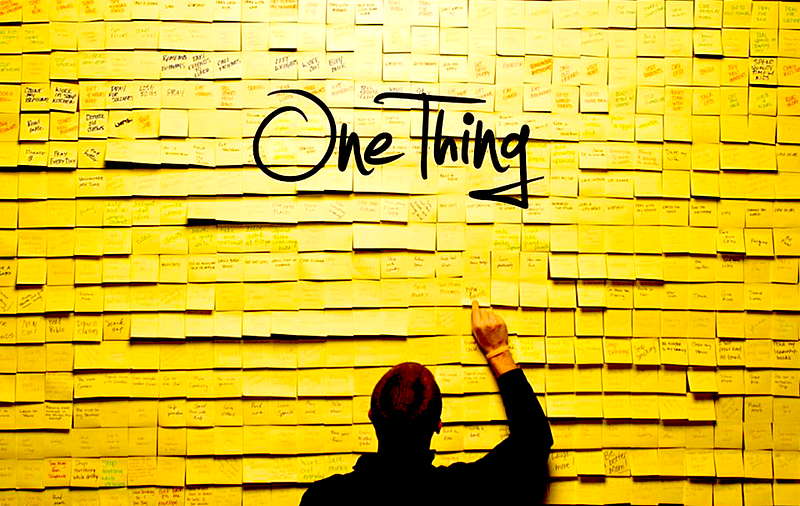
Alex’s advice in the book says to focus on five which is still doable. The aim is not to focus on twenty five things because you’ll become lost and do all of them poorly thus destroying whatever goal or life mission you’re chasing.
The idea of the avoidance list is to write down the things you want to do but have chosen not to. These things written on your avoidance list are like the candy-colored pokies machine that’s sitting in your pocket (aka the not-so-smartphone).
The items on your avoidance list are addictive and not your top priorities and that’s why you have to avoid them otherwise they’ll distract you from the five items (or in my case the one) that you truly want to focus on.
Just ask.
This lesson came from the Zappos CEO Tony Hsieh where in Alex’s book he asks why Tony won’t help his staff also spend a day in his life. Tony’s response is “No one has ever asked me.”
Finding the third door often involves nothing more than asking.
Sometimes you’ll have to knock on the door a hundred times and other times all you have to do is ask to go through the door.
Having the guts and embracing the nerves (like I said before) can be a fantastic strategy to getting people to help you with your mission.
If you don’t ask, you won’t get. You already knew that cliche before I wrote it so go act on it!
Focus on the why.
I’ve heard literally thousands of startup pitches in my career. The only ones I remember are the ones where the ‘why’ was powerful.
Alex learns the same lesson on his quest to interview Bill Gates when he tries to copy other people’s interview techniques like Cal Fussman’s and Larry King’s. He learns that why these famous interviewers ask questions the way they do is more important than what or how they’re doing it.
No one cares what you’re doing or how you’re doing it; all we want to know is why. When you’re pitching your idea or trying to influence people, focus on the why and make it deeply personal and relatable.
Communicating why you want to enter through the third door is as important as finding the door and having the courage to walk through it.
In person for the win.
Every salesperson knows this lesson from the book, but I’m going to assume you’re not all salespeople.
Here we go: influencing people is always best done in person, not via SMS, Group Chat, Instant Messaging or even a phone call.
If you’re always being a keyboard warrior, you’ll probably never find a way through the third door.
The third door is for people that show up and have the tough conversations face-to-face. Looking someone in the eye and letting them see who you are deep inside, will do far more than your words ever will.
It takes vulnerability and courage to influence in person, but the rewards are far greater, the strike rate is higher, and let’s face it, it’s more fun once you get over the nerves.
Drop the keyboard. Show up in person.
Name dropping vs. purpose.
There was a fundamental turning point in the book when Alex was pitching to Bill Gates’s Chief Of Staff and the focus of the conversation was on the list of names for people he’d already interviewed.
What changed in an instant was when Alex got frustrated and told the Microsoft Executive that what he was doing was far more important than a list of names. Alex had finally had enough.
He explained the purpose was to have these leaders he was chasing share their wisdom to help younger generations essentially get ahead in life by learning from them. This purpose, which Alex hadn’t ever put into words before, changed his approach.
He got many more yes’s when he communicated a purpose instead of a list of celebrities that he was ticking off one by one like a list of one night stands.

You don’t always have to negotiate.
You’d think business is all about negotiating.
Alex teaches in his book that when someone is a friend or a mentor or someone you have a relationship with, you will probably get to skip the step of negotiating.
Given that one of the key messages of the book is how you can skip steps by using the third door, I found this idea powerful. I knew relationships in life were important, but I’d never thought about them in the context of negotiation.
Strong relationships can allow you to skip the step of negotiation.
The same lesson will repeat itself until you learn.
I’ve always been impatient and I’ve had to learn this lesson many times until I finally decided not only to learn it but put it into practice.
This was the same for Alex. He had to learn the same lesson over and over during his quest to interview these highly influential people before he not only learned but used the lesson to help him secure an interview.
The one or two lessons you keep seeing are a result of the fact you haven’t got the message.
Having a pipeline.
Elliot Bisnow teaches Alex in the book that getting no’s is inevitable. Where Alex starts to shift his thinking is when he builds a pipeline.
He realizes that no’s are a given and so if he has a pipeline of people to ask for interviews, then when one says no, he can move onto the next one and then go back again later to try again for a yes.
Letting yourself be succumbed by emotional reactions that come from being told no a lot will never work.
Expecting no’s and having a strategy such as a pipeline in place is how you use the no’s as a stepping stone.
Think differently or think bigger.
There’s a ripping example in the book of where Alex’s friend Elliot talks about his Summit Series of events.
He explains how the Toms Shoes founder couldn’t attend and he had to find another keynote speaker. He decided to think bigger and put a plan in place to secure Bill Clinton. He then thought differently by setting up a fundraiser as part of the event so that Bill would have to attend.
There was also the battle of trying to get Blake Mycoskie to attend and Elliot thought differently by asking Blake to host a Q&A with one of his idols Ted Turner. Blake couldn’t say no because the offer was too good to refuse.
He summed it up by saying that when you think bigger and think differently, it allows you to pitch offers that are too good to refuse.
Your hidden biases are the most dangerous.
Alex realizes during his quest that everyone he’s trying to interview is mostly male. He realizes he has a hidden bias without even knowing it.

Once he understands his hidden bias, he does something about it and it changes the course of his journey.
We all have hidden biases. Knowing what they are is a major growth opportunity.
I realized I had a hidden bias for people that were also ‘Addicted 2 Success’ (the blog I write for) and that my obsession with chasing people who were successful was blinding me from the idea that my understanding of success was fundamentally flawed.
Uncover your hidden biases if you want to find real wisdom.
Attach yourself to growing.
A lot of what Alex does in the book fails. The realization he has, in the end, is that it’s not about whether you’re failing or succeeding; it’s about trying and growing.
When you try, you discover unlimited possibilities. When you grow, you feel fulfilled. When you grow, you end up succeeding in the long run by default.
Admiration for success vs. kindness.
The final lesson Alex learns is one I’ve recently learned myself hence my recent obsession with sharing stories of kindness.
When Alex started the journey, he admired the success and milestones that the list of people he sought to interview had achieved. By the end of the book, he realized that admiring people’s successes is not what we should obsess over. Admiring people for being kind was the wisdom this journey taught him.
Without kindness, he would never have been able to go on this five year journey or become the person he became. That was the real lesson.

*** My Third Door Realization ***
I reflected on what this book taught me and realized something truly profound: I’d already chosen the third door!
In 2014 I had a dream to become an influential blogger and had no resources to set up my own blog. I used the third door — in the form of a blog called Addicted2Success — to trail blaze my way there. I used platforms like LinkedIn instead of building a blog and this pathway to blogging was much less crowded.
While everyone was building their own Wordpress Blog, I decided to attach myself to one that already had millions of followers. By consciously choosing the third door to avoid all of the noise, I skipped many steps that other bloggers had to go through to reach the same outcome.
Once you understand the power of Alex’s idea about using the third door, how you think will be forever changed.
Use The Third Door.


