
Espionage
The Thing with Ears
No, not from the Addams family — The Thing was a highly sophisticated bug discovered in the U.S. Ambassador’s study in Moscow

I first came across this interesting tale of Russian espionage when researching a story about Peter Wright, an infamous (though not criminal) Principal Scientific Officer at the UK’s MI5 (FBI equivalent, approximately).
Wright was heavily engaged in counter-espionage during the Cold War. After retirement he co-authored ‘Spycatcher’, the 1987 book which was highly critical of UK intelligence activities.
Banned by the UK Government, the book caused a political furore and as late as 2021, the UK’s Cabinet Office was still rejecting freedom of information requests for files on the Spycatcher affair despite the mandate that documents should be released after 30 years. It’s a quirk of UK law that the book could not be banned in Scotland.
It’s a damned good read and the relevance to this story of a sophisticated Soviet bug is that Wright was the scientist who carried out the technical investigation into the Soviet bugging device after the US asked the UK for assistance. Or so Wright claims.
Discovery of the bugging device
The Great Seal was a gift from the Soviet Union’s Young Pioneers to Averell Harriman, the U.S. Ambassador in Moscow, t in August 1945. It was hung in the Ambassador’s residential study.
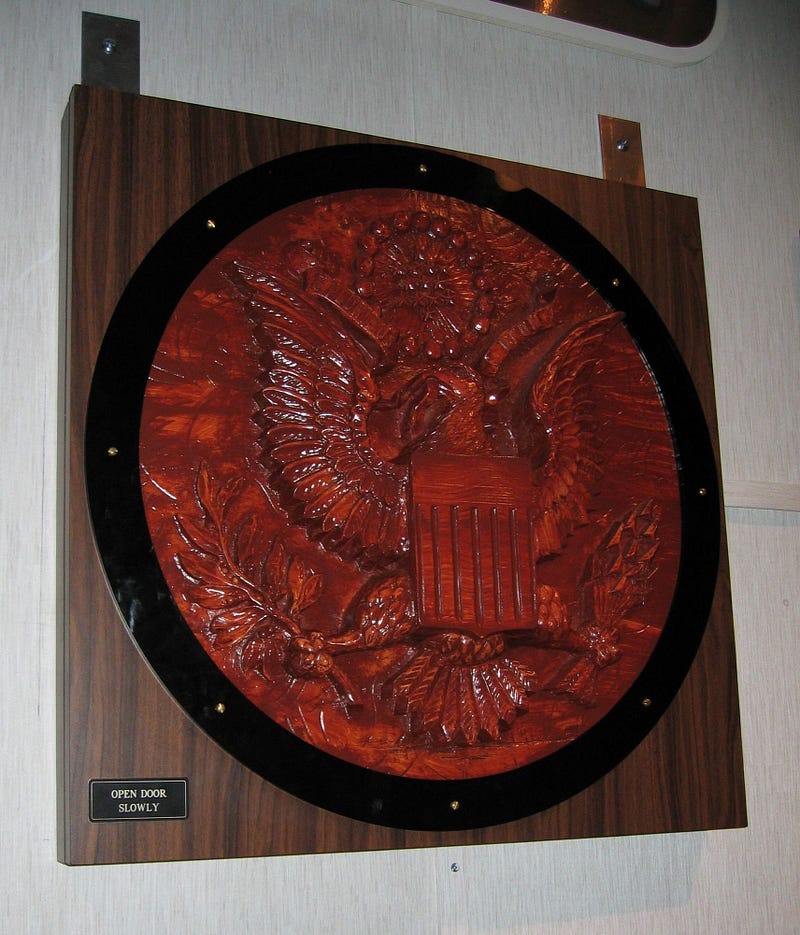
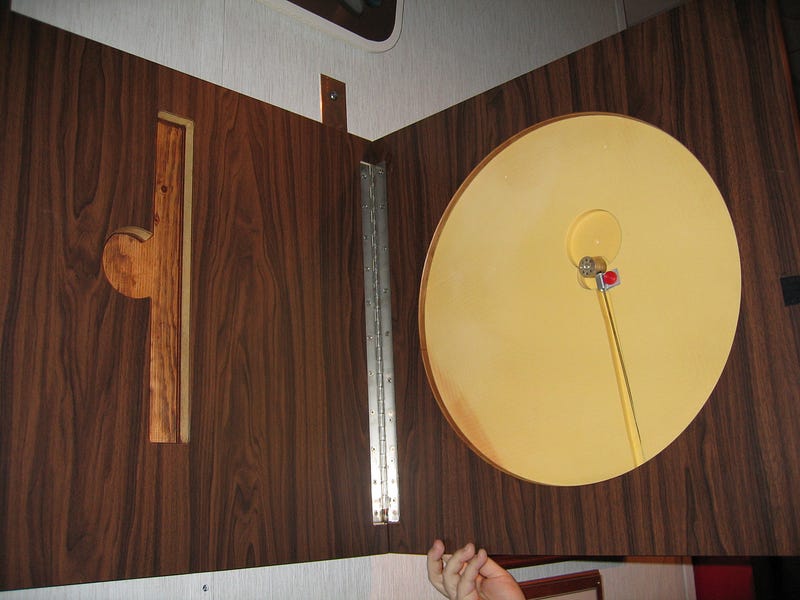
The bug was ingeniously concealed inside the seal and practically undetectable by visual inspection.
The existence of the bug was discovered accidentally in 1951 by a British radio operator at the British Embassy who overheard American conversations on an open Soviet Air Force radio channel as the Soviets were beaming radio waves at the ambassador’s office. An American State Department employee was then able to reproduce the results using an untuned wideband receiver with a simple diode detector/demodulator, similar to some field strength meters. (Wikipedia)
The investigation
Once the bug was discovered, a discreet investigation was launched by U.S. authorities.
According to his own account, Wright’s work for MI5, initially part-time, started in the spring of 1949 when he was given a job as a Navy Scientist attached to the Marconi Company. According to Spycatcher, during his stint there, Wright was instrumental in resolving a difficult technical problem when the CIA asked the UK (Marconi) for help in the technical investigation.
Technical details
The device inside the seal was a tunable passive membrane capacitor. When an external microwave beam was directed at the unit it became active as a microphone (it had a diameter of about 3/4"). Ambient soundwaves (as in the Ambassador’s speech) vibrated the microphone and caused it to modulate the incoming signal and re-radiate it. The outgoing signal could be picked up by a receiver outside the premises and de-modulated, as your home radio set would do.
Accounts differ as to the precise microwave frequencies on which it could operate, from 330 MHz to 1800 MHz.
The device was designed by Soviet-Russian inventor Leon Theremin, who was best known for his invention of the ‘theremin’, an electronic musical instrument.
From a design perspective The Thing is a very elegant device and the beauty of it is that it does not require a local power source. It acts like a ‘radio mirror’, just adding the sound image to what comes in and sending it out again.
My understanding of 1950 era (valves, pre-transistor) technology is that the microwave transmitting unit would be at least the size of a suitcase and I think would need to be located in a truck or nearby apartment with a suitable power supply.
The consequences
It could be that the device was used by the U.S. for dis-information purposes, but I think that unlikely given the circumstances of its discovery and investigation. The Soviets would know they’d been rumbled. Its discovery led to investigations at the Moscow embassies of the UK and Canada.
Wright’s technical investigation led to development of a similar British system codenamed SATYR, used for a decade by the British, Americans, Canadians and Australians — and the start of a new industry. Today we can buy micro-sized bugs off the shelf.
Suspicion naturally fell on the Soviet Union who vehemently denied any involvement, but the evidence pointed strongly in their direction.
Intel value?
It was almost six years between the time Harriman was given the Seal and its discovery. Could the Soviets have gained any useful information in that time? Did the Ambassador’s residential study have a scrambler phone? Perhaps, and if so then there would clearly have been a vulnerability.
The discovery of the bug led to increased tensions between the United States, its Allies and the Soviet Union. It highlighted the extent of Soviet espionage operations and the audacity with which they targeted sensitive locations. The technical inventiveness did not go unnoticed either, and even today it is wise not to underestimate Russia’s capabilities in this regard.
In response to the incident, security measures were significantly heightened at U.S. and Allied diplomatic facilities worldwide.
And there is an ironic twist to this story.
At the United Nations
In May 1960, The Thing was mentioned on the fourth day of meetings in the United Nations Security Council, convened by the Soviet Union over the 1960 U-2 incident where a U.S. spy plane had entered their territory and been shot down.
The U.S. ambassador Henry Cabot Lodge Jr. showed off the bugging device in the Great Seal to illustrate that spying incidents between the two nations were mutual and to allege that Nikita Khrushchev had magnified this particular incident as a pretext to abort the 1960 Paris Summit. (Wikipedia ibid.)
The moral of this story
You’ve probably already guessed the moral of this story:
Beware Russians bearing gifts.
If you follow me I guarantee variety in your inbox with some unusual perspectives! I write on a wide range of topics that interest me including humour, tech, space, geopolitics and travel. I also write about…
…pesky bugs
If you appreciate stories like these and want to support me and other writers, please consider signing up to become a Medium member. It’s only $5 a month, giving you unlimited access to incredible stories on Medium. If you sign up using my link, I’ll earn a small commission at no extra cost to you.

My novels are available at my Gumroad bookstore. Also at Amazon and Apple
Or maybe just buy me a coffee? and tell me what you liked reading (or not)…