
The Theology of ‘Ready Player One’
Is Ernest Cline in search of God?
A Sci-Fi novel in 2011 seems anti-Christian. Ernest Cline’s narrator says: “The whole God thing is actually an ancient fairy tale that people have been telling one another for thousands of years.”
But as I read Ready Player One, it could seem to contain very different tendencies. It seemed even a work of theology, heavily influenced by the Bible. I looked up Cline’s life. He was raised hard-core Evangelical.

He recalls his family was “very religious”
He doesn’t specify what religion it was, but the details are unmistakable. He recalls his mother forbade the fantasy role-playing game Dungeons & Dragons, and gave him an Evangelical book about the subject.
In the 1980s, of course, the religion was gripped by panic about demonism manifesting in rock music and fantasy. Never in history had fantasy fictions seemed more powerful! A religion had said they were ‘real’.
The key narrative was the tragic tale of Patricia Pulling, whose son Irving killed himself — as she blamed Dungeons and Dragons. It ended at the great battle of Harry Potter, where Evangelicals launched at a Scottish children’s author, saying her books opened the door to Hell.
“I think those people need psychiatric help,” J.K. Rowling says in 2000.
The religion actually loved the fantasy genre
These were people who loved the Bible. Fantasy was kind of their thing? The supposedly evil Dungeons and Dragons was heavily influenced by the work of J.R.R. Tolkien, who was Christian!—as C.S. Lewis, and J.K. Rowling herself, were Christian as well.
The anti-fantasy crusade was, as usual, just Christians fighting Christians.
Cline rejected Evangelicalism, and turned to Pop Culture fantasy fiction. He became obsessed with Star Wars. He recalls being excited for the Star Wars prequels: “For me it was like a new chapter of the Bible had been discovered.”
He scripted the story into the 2009 comedy Fanboys. But this was a religious quest! Star Wars is another re-write of Christianity—a John the Baptist and Jesus story.
And all Pop Culture is religious!
Contrary to any official messaging, America never much liked the Bible, a book more looked at than read. As the Bible scholar John Wiley Nelson argues in his classic 1976 study, Your God is Alive and Well and Appearing in Popular Culture, the sacred texts of America were T.V. shows, country music songs, movie westerns, and women’s magazines.
Then Sci-Fi came along, becoming by the early 1980s a body of texts with quasi-mystical appeal. And Ernest Cline began to dreams of his own next chapter. When he dreams up the idea of people pursuing clues left by and eccentric inventor of the OASIS, James Halladay, his hero Wade says that organized religion was “exactly what the Hunt was for me.”
Wade dismisses Heaven as “total bullshit,” but the OASIS virtual environment where he lives much of his life looks rather like Heaven.
Even Wade Watt’s dismissal of religion — is religious?
If he had seemed a full-on-atheist in his anti-religion rant, I read through it again, realizing there’s more texture:
“So I swallowed all of the dark ages nonsense they fed me. Some time passed. I grew up a little, and I gradually began to figure out that pretty much everyone had been lying to me about pretty much everything since the moment I emerged from my mother’s womb.
This was an alarming revelation.”
It was a “revelation” — and a prompt to develop his own understanding of the meaning of life, and death, via an epic narrative. His largest aim is always clear: finding a new, higher community of people — via the OASIS.
There’s loads of Bible references along the way
James Halliday is said to be an atheist—but it’s more like he’d cleared out one deity to become one over his own created world. He left riddles and narratives for followers to come and find him. That’s called “religion.”
As Wade notes, Halliday’s Almanac “had become my bible.”
The Pop Culture texts which matter are called “canon”—with a range of 1980s-era movies and video games becoming, essentially, a Bible.
The riddles are approached like biblical study with lots of religious language. Hearing a puzzling phrase, he has “no immediate revelation as to its meaning…”
The Bible itself is there too. No planet seems to be a virtual re-enactment of the Bible, but a verse, 1 Corinthians 13:13, becomes involved in solving the Hunt. The Jesus teachings illuminate the way: “faith, hope and love…”
The Satan figure is ‘Sorrento’, as his enemy team, the ‘Sixers’, might suggest the dreaded ‘666’.
The whole plot is framed, really, by Evangelical apocalyptic imagination. The virtual cosmos OASIS is in the shape of a cube. Wade notes the general assumption is that it was inspired by Rubik’s Cube.
Another guess might be, as in Revelation 21:16, the ‘New Jerusalem’ — the new Temple hovering above the earth where believers dwell. It’s also a cube.


Wade has an elderly woman neighbor, Mrs. Gilmore, who is a kindly Christian.
Wade says: “She was always praying for me too. Trying her hardest to save my soul.” And wasn’t Mrs. Gilmore’s intervention a key to Wade’s success? She was also a living link to the 1980s and communicates to Wade a sense of what it was ‘really like’.
On every level she can help Wade, she does — and in a terrible world, she becomes Wade’s mentor and guardian angel.
It would be very like Jesus to point to ‘simple’ woman as a true beacon of the faith, active even in a dying world. ‘Mrs. G’ is a portrait of a Christian woman who changes the world. I can’t help but think she’s Mrs. God.
The plot of the novels is a messianic quest
And here we see young Ernest Cline was actually paying attention in church. The Bible is a succession story, in which the messiah becomes a king.
The story of the gospels is Jesus inheriting the power over the whole earth from his father, Yahweh, who is suggested to be a very old deity. Succession of a son from a very old father is a regular Old Testament narrative.
Near the end of his story, Jesus says: “All authority in heaven and on earth has been given to me” (Mt 28:18). He essentially wins his own ‘Hunt’.
You could read about the political succession drama in a scholarly study like Scot McNight’s 2017 book The King Jesus Gospel.
Or you could read Ready Player One.
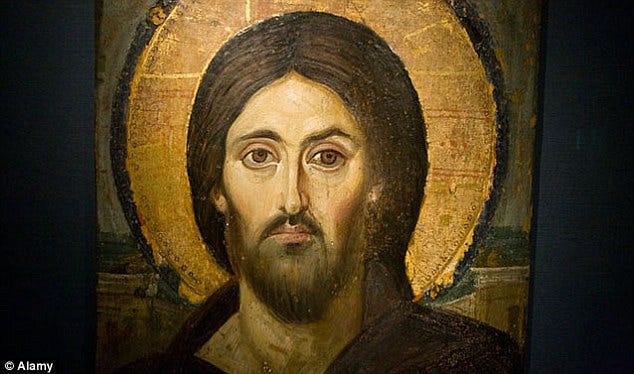
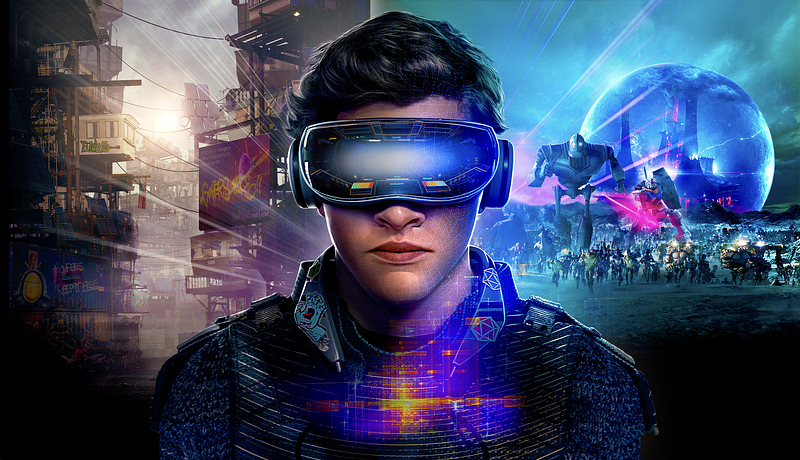
The idea becomes that you’re larger than your body.
Cline’s plot is really the most Christian thing ever. The mind is sort of released from the body to become a citizen of another world. As there’s an odd feeling in Chrisitan feeling of the soul being sexless, Wade’s journey takes him through a lot of LGBT territory, like inhabiting the body of women for a time in both Ready Player One and Two.
Everyone find spiritual freedom in a disembodied state, their minds roaming the OASIS as their bodies lie entombed.
The plot of Ready Player Two suggests a possible state in which humans live free of physical bodies, as programs. Like the Bible, the plot hurtles toward the ‘Resurrection’—in which the physical body is left completely.
The key spiritual practice might be telling stories?
As often as Christians have tried to formulate some specific religious practices, the real suggestion of the Bible might be that telling stories is the divine activity.
For God, the ‘Beginning’ was only a marker for starting a new work, and there was no “The End” in sight. 🔶


