
The Terrible Lives of Ancient Greek Women
Women in ancient Greece — at the brink of insanity.
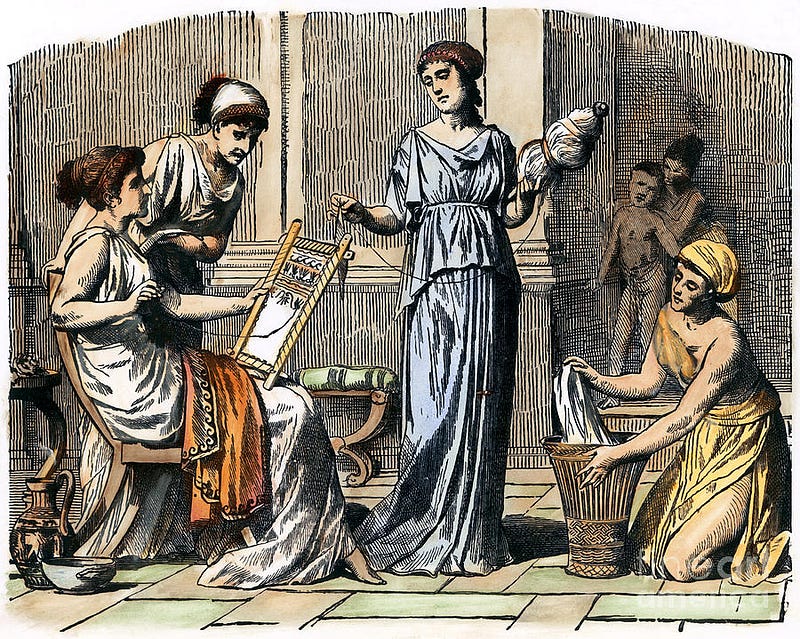

No word in the English language could sum up what life was like for women in Ancient Greece. As the tides of unrelenting blue water, their reality was a wave of which city they called home, what period they lived in, and how rich their husbands were; they were the tides, crashing against challenging waters.
There was no idea of an ideal woman. Pandora’s curse was basically animals. Maybe one was ideal if they were the physical embodiment of Penelope, wife of Odysseus, peacefully and faithfully, waiting 20 years, confined to her home, sewing, awaiting her husband, away from the advances of indigenous males.
So, boredom, servitude, and isolation were the way to go in Ancient Greece.
Rights! Sounds lovely, doesn’t it?
Ancient Greece really is a tell-all tale of democracy; however, the women would beg to differ. That acclaimed institution overtly outcast them outside of Sparta. The word rights, for women, itself felt wrong. It was perhaps the fear that women would flee their oppression and truly live the moment they escaped. Or maybe, it was just the excitement of marrying husbands twice their age, at the ripe age of 13! A woman governing herself; that would be preposterous.
Every stage of life was fixated by the men in their lives. Even after the passing of their male companion, they were under the charge of another male relative — so much for respect for the dead. Instead, in most states, you were lucky enough to receive some form of informal education at home. The schools, of course, were vehemently reserved for the superior gender.
Do not even begin to talk about expressing your opinions in public or owning property. Thomas R. Martin’s, Ancient Greece reports tell us that an heiress with no alive male relative, neither a father nor a husband, was legally forced to marry her late father’s closest living male relative to bear a son, who would be the one to inherit.
Did you not also picture Greece as the hub of Philosophy? Some wine maybe, drinking parties? Maybe the Olympic Games? Well, all of it was there, indeed. Just crop out females from the picture.
Poor Women and The Slave Prostitutes
Today, social mobility is directly linked with economic mobility and how much money you had; in Ancient Greece, this concept did not exist. Wealth equated to lesser freedom. Naturally, the poorer women left the house more often. Yes, to fetch water, visit the marketplace, and maybe even work in bakeries or servants to the higher elite.
Was it worth it? Probably yes.
Contrary to beliefs that these women lived their lives hidden away, slave prostitutes are the community of ancient Greek women who are a bit more on the front line. From Hetairai, the higher-class prostitutes, and bearers of the symposium (a private drinking party for male guests) to attending school to become a master of the art of music, these women kindled a love for philosophy and literature and married men who enjoyed their company and likewise.
Where are the Stoic women?
The school of philosophy called Stoicism, where women of ancient Greece practiced Zeno of Citium founded philosophy in Athens during the early 3rd century BC. Contrary to the rights women had in Athens, the philosophy ejected from personal ethics cemented by a system of logic and views on the world outside. The path to eudaimonia (happiness or blessedness) is achieved by accepting the moment itself, not allowing oneself to be controlled by the desire for pleasure or by the fear of pain.
Indeed, this philosophy does not exist for men only.
“Women are pleased no less than men by the noble and just deeds and reject the opposite of such action. Why is it appropriate of men to seek out and examine how they might live well, that is, to practice philosophy, but not women?”
These words of Musonius Rufus, the Epictetus teacher, bring light to some of the most powerful Stoic women, Porcia Catonis, Annia Cornificia Faustina Minor, and Fannia. They live in gratitude to stories recorded by those who had the thirst and courage to do so.
The Lady Olympics in Ancient Greece
Name something, anything in the world, something from your daily routine, and Ancient Greek men probably had a vengeance against it when it came to women. Working? Nope. Politics? Not a chance. Walking around the market? Frowned upon. It was the same with the Olympic games. While it was not a complete ban, Adolescent single girls were allowed to watch the naked men exuding prowess; how exciting! No way a married woman dared to sneak a peek unless she fancied getting thrown off a mountain into the lovely wilderness.
However, as we come to know, women have always been a force to be reckoned with. Even in Ancient Greece, they broke through the norm of subjugation and gatekeeping. They started Herren Games, an Olympic game created by women, for women specifically. Being held every four years, a total of 16 women from many city-states challenged each other in footraces. Wearing tunics, which covered only half their chests (breaking the stereotype then too!), winners were awarded olive branch headdresses, and sometimes if you were lucky, part of a dead cow. The Spartan women usually came out on top though so maybe it wasn’t that fair!
Sparta: Heaven on Earth?
While life in Athens, along with most city-states, was almost comparable to women under the Taliban today, there was one sanctuary in Greece, with a brink of freedom and some relief.
This. Was. Sparta.
You were most likely God’s most gifted, handcrafted individual if you were a woman born in Sparta. The ideology behind it was that since the men were always away fighting, they needed their women to take charge of things around. While they received the same amount of food as boys, they were also regularly forced to exercise. Inherently though, it was only so they could birth strong boys who would be the greatest fighters.
Marriage was also not enforceable on all. It was more customary to wait until they found pleasure in interacting with the males in their lives. Outspoken, funny, landowners, warriors were the ladies of Sparta. Still, however, in Ancient Greece’s eyes, treating their women like humans would be the reason for their demise, and if it weren’t for their utility for birthing strong children, they would suffer the same fate as the rest of the women in Greece.
The women of Greece were never born there. Simply put, Greece was born in them.
Sources
“https://www.ancient.eu/article/927/women-in-ancient-greece/”
“https://www.greekboston.com/culture/ancient-history/life-of-women/”
“https://www.ancient-origins.net/history-ancient-traditions/greek-women-0013292”