The Telos Archipelago
How life (and free will) emerged from matter
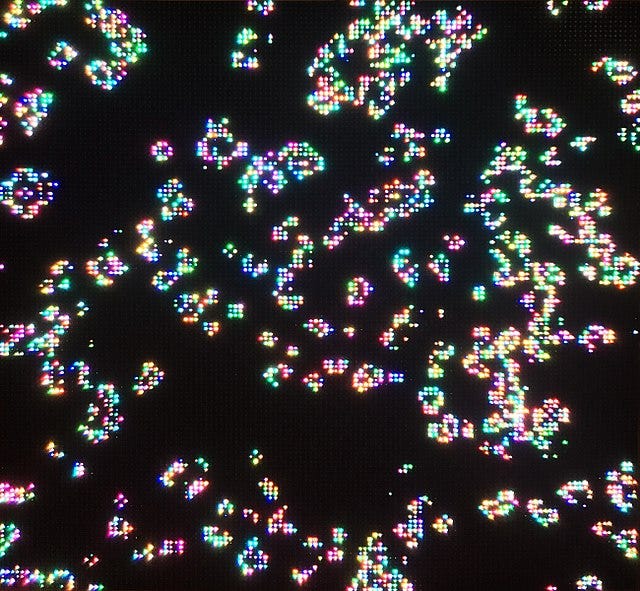
In his seminal paper, “The Nature of the Firm,” Nobel Prize-winning economist Ronald Coase compared firms in a market economy to islands of consciousness surrounded by an ocean of unconscious forces. He wanted to know, if the market really is efficient, then why should these islands of directed economic activity exist at all? Why shouldn’t the market just be one vast sea of undirected exchanges?
Coase’s answer was that since all market transactions entail various kinds of costs — information costs, the costs of policing agreements, bargaining costs, and many more — there may come a point at which these market costs exceed the value that can be created solely by transactions with external actors. At that point, it becomes more efficient to internalize these costs by organizing production from the top down. Moreover, this process of internalization will continue to create efficiency until the costs of decoupling intra-firm transactions from the price mechanism exceed the savings from reduced transaction costs. (Contrary to the claims of Marxists, this point arrives long before the entire economy has become one big firm.)
I think there is an interesting analogy to be drawn between the emergence of firms in a market, on the one hand, and the emergence of organic life forms from inorganic matter, on the other. Living things are like little islands of teleology in a sea of mechanism. And if instead of transaction costs, we talk of the cost of capturing energy and converting it to heat, then the emergence of this Telos Archipelago may be just as easy to understand as the emergence of firms in a marketplace:
“From the standpoint of physics, there is one essential difference between living things and inanimate clumps of carbon atoms: The former tend to be much better at capturing energy from their environment and dissipating that energy as heat. Jeremy England, a 31-year-old assistant professor at the Massachusetts Institute of Technology, has derived a mathematical formula that he believes explains this capacity. The formula, based on established physics, indicates that when a group of atoms is driven by an external source of energy (like the sun or chemical fuel) and surrounded by a heat bath (like the ocean or atmosphere), it will often gradually restructure itself in order to dissipate increasingly more energy. This could mean that under certain conditions, matter inexorably acquires the key physical attribute associated with life.”*
In addition to understanding how and why life exists, this view of life offers a third way between the claim that the universe is purely mechanical, on the one hand, and the claim that it expresses a Design, on the other. The latter view is suggested by analogy with our own experience as (seemingly) goal-directed agents, while the former appeals to the amazing success of mechanistic views in other fields of science, especially physics and astronomy. But at least since Spinoza, and probably before, philosophers have noted that from the perspective of an observer standing outside of space and time, there really is no difference between a purely mechanistic universe, and a universe organized entirely by divine diktat. The appearance of a difference between them is only due to our perspective as time-bound observers with limited knowledge.
In other words, a purely mechanical universe and a universe designed entirely by God are both alike in that they leave no room for the choices of individual actors within the universe to bring about alternative possible futures. By contrast, if teleology emerges in localized clusters from otherwise blind, mechanical forces, and if these localized clusters possess properties, such as an internal logic, that cannot be reduced to purely mechanical descriptions (as the behavior of firms cannot be reduced to, or predicted by, individual market transactions), then the possibility arises for what Daniel Dennett calls “evitability”, or the capacity to act differently than one otherwise would.
In his book, “Freedom Evolves,” Dennett shows how even with a relatively simple mechanical system such as Conway’s game of life (see illustration above), basic rules and structures can give rise to new structures and new behaviors, essentially to new phenomena that require a new vocabulary to explain them, a vocabulary that is not reducible to the game’s fundamental units and rules of action. Or, as the great scientist J.B.S. Haldane once wrote: “Life is from its very nature incapable of being described or understood in terms of mere physical conceptions. It is not biology, but physics, that from the biological standpoint is an ‘inexact’ science.”