
SCRUM TOOLBOX | TEAM CULTURE
The “Team Happiness Index”
A tool supporting the Agile Manifesto and People-Centric Cultures
“A high-performing team is a happy and motivated team.”
That’s what he said when we introduced this Team Happiness Index Survey to Team Alpha (not their real team name).
We’ll do this every Friday just to get a sense of what occupies you and what puts you in a bad mood.
He continued nonverbatim.
He was on his first week as our Product Owner in the team, and me as the Scrum Master on my third, when he suggested having some sort of a regular team health check. He wanted to see the state of the team’s morale and look for areas where we can improve. He is quite a Product Owner who will most likely be able to support both the product goals and people-centric culture.
Bringing Technology, Agility, and Humanity together
We do have the Agile manifesto influencing the majority of the IT industry, and some groups of Human Resources, Marketing, and Sales among others. We also have Scrum, Kanban, and Lean frameworks. And we will not discount their benefits.
What I would propose to you, if I may, is to supplement these Agile Frameworks with People-Centric Leadership, wherever in the leadership or managerial role you may be.
People-Centric Leadership is basically treating employees “not as assets that can be bought, sold, or traded” (Gaurdie Banister) but as humans. We will not focus on the idea, but if you are interested to learn more about People-Centric Leadership, the Youtube video that follows is a good start.
Company executives sharing their insights on People-Centric Leadership
For a people-centric culture to thrive, the key is to understand where people are coming from — what upsets them? what energizes them? what makes them feel valued? From there, we as Scrum Masters, or managers, or leaders, can make decisions and actions that can help them stay motivated and/or boost their morale. Remember the fifth of the 12 Agile Principles?
“Build projects around motivated individuals. Give them the environment and support they need, and trust them to get the job done.” -Agile Manifesto
Assuming we followed Jim Collins’ advice to “get the right people on the bus” (Good To Great), it is our responsibility as leaders to let them experience the enjoyment and the thrill of the ride, no matter how rough and rocky… and look forward to the next one. To reiterate,
“A high-performing team is a happy and motivated team.”
which probably means that:
- When a team performs more than what is expected of them, they become happy and motivated; and
- When a team is happy and motivated, they perform more than what is expected of them.
If this is the case, then we need to start listening, really listening, to the voice of the teams and individuals we are working with, whether our subordinates or peers — to understand them better.
We will need a reasonable balance between the product goals and the people’s personal and team-level goals. The business grows as its people glow.
What follows is a brief on a tool I prototyped from the idea of our Product Owner in the story and inspired by this Happiness Index.
More Than Words
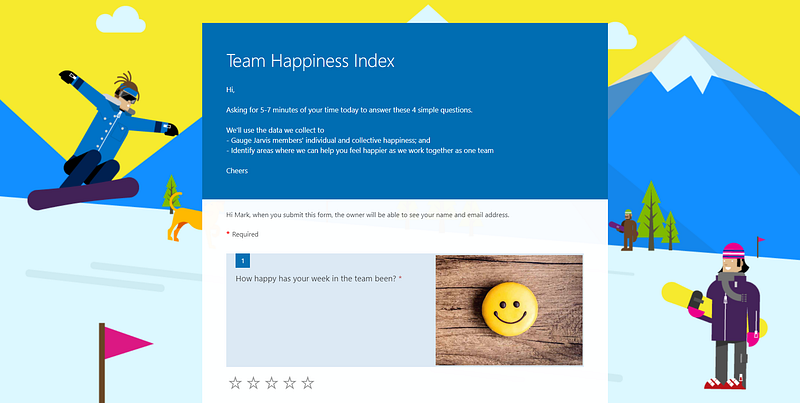
The form asks for these questions:
1. How happy has your week in the team been? 2. What situations, activities, or events put you into a good mood? 3. What situations, activities, or events put you into a bad mood? 4. What do you think will make you feel happier?
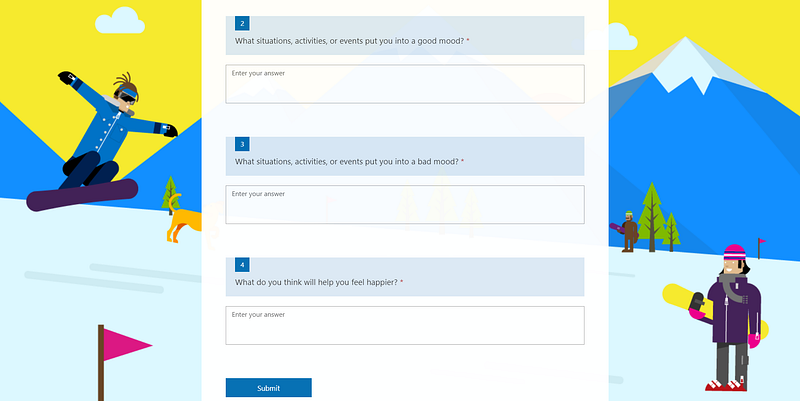
The first one as the quantitative component, something more measurable, which we would want to see when we step back after, say, 3 months.
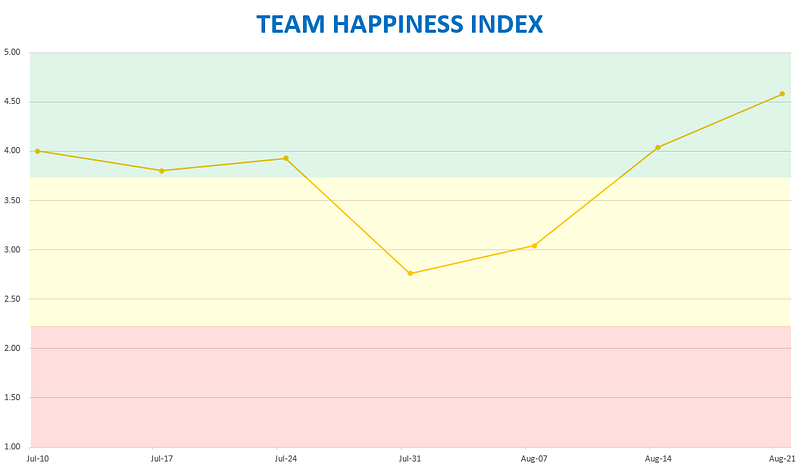
For instance, if we want to look at how the team generally viewed their happiness in the past 4–6 weeks, we can look at the Team Happiness Index Report. What does the trend say? Are there any patterns showing (if using for a longer period)?
In the following image, if we are not able to address the prevailing concern on Jul-31, the team would have had lower morale for the next couple of days or so. Please remember that these are dummy data and that the tool is still in its early life.
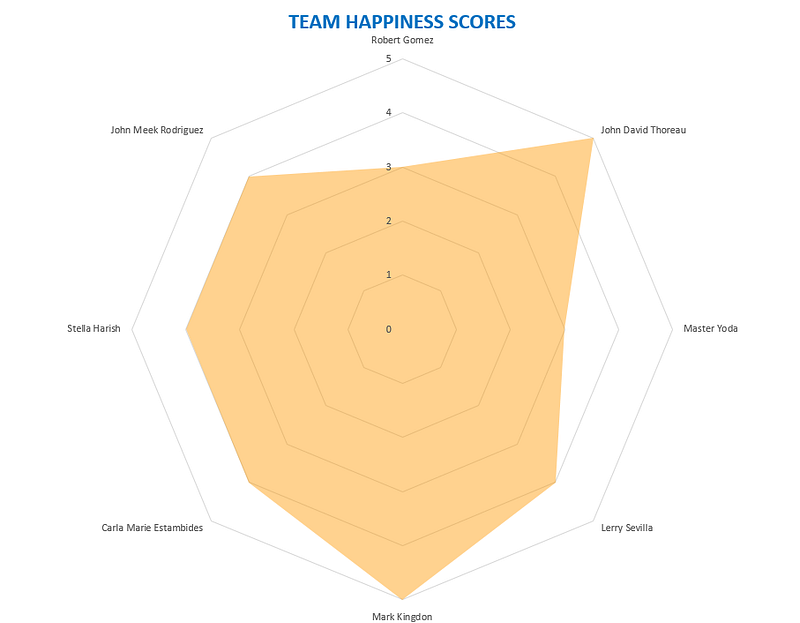
Closing in on a particular day, we can also look into individual members’ happiness relative to the rest of the team. A radar chart readily exposes the extremes and those developers who may need the most urgent attention.
The rest of the questions look for more descriptive answers and they give us a glimpse into the day (or the week) of the individual members. What gives a score of 4 to their happiness level for the week? These more descriptive ones allow us to see through their lenses — how are they really doing?
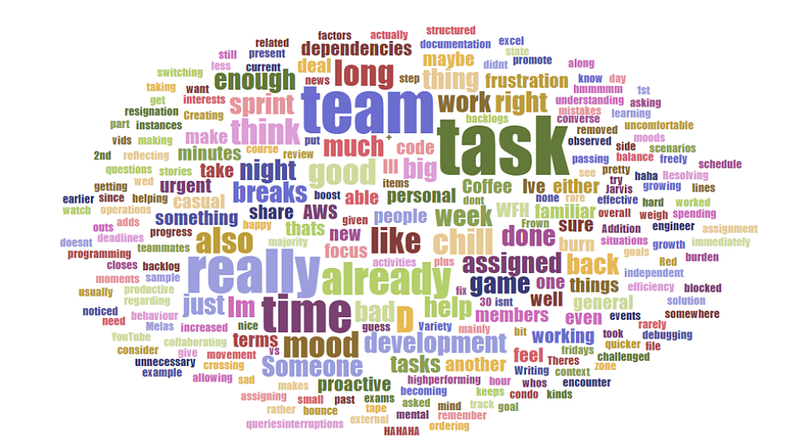
Most of us would try to find that out by a manual assessment of individual sentiments in raw words. There are contexts and emotions that only humans can capture anyway. However, nothing stops us from further supplementing our analysis with a word cloud. Only copy all the text responses from your survey into a word cloud generator and it will visualize the results for you.
And What Happened To Our Prototype?
Well, the Product Owner and I have identified burnout and lack of focused time as the primary culprits chipping away from the team’s happiness.
We will then be looking into our team’s time logs to see where the bulk of the work may be and recalibrate the tasks based on what we find out. We also came up with the idea of blocking off a time window where the team can focus on individual work. We will come up with brighter solutions and improvements as we move along and utilize the tool. By the way, it has turned 7 days old as of this article’s writing.
These 4 questions and 5–7 minutes of each individual’s time will help us understand the team better and remind ourselves that we are working with humans. They perform, they produce output, they think, and they feel.
So what do you think about this tool? You can try it out and implement a similar idea or you can leave me a note for a copy of the form and reports, to save you the time. Or you may have other ideas, feel free to share!


