Tulips | Business | Interconnectivity
3 Things the Story of the Tulip Can Teach You
Identity construction, the first economic bubble and modern capitalism
The tulip, a typical Dutch flower, right?
Spoiler alert, the tulip is originally from the arid high lands of Central Asia.
The story of the tulip can tell us a lot about how interconnected we are as humans. Hell, the story of the tulip might even show you that there shouldn’t be any place in society for racism.
Don’t worry, I’ll leave the evolutionary development of the tulip for what it is. I’ll only tell you how the tulip ended up in Holland, how this led to the burst of the first speculative bubble and how the tulip started a multibillion-dollar industry in the Netherlands.
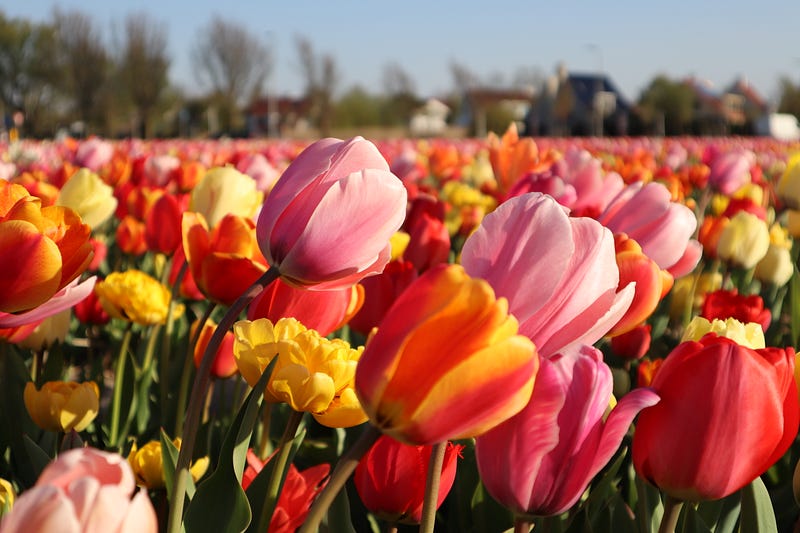
The economic success story of the tulip starts one thousand years ago with the Seljuk Turks, who brought the flower from central Asia to Persia. The courts of the Persians were soon decorated with the beautiful colors of tulips. From Persia, the tulip became a status symbol around the Middle East in the centuries to follow.
From the gardens of the Ottoman sultans in Istanbul, the tulip found its way to the Imperial Garden of the Habsburg empire in Vienna, where Carolus Clussius cultivated tulips. Clussius was appointed director of the then newly established Hortus Botanicus at Leiden’s University. The first tulip in the Low Countries blossomed in the year 1592.
To everyone’s surprise, the salty sandy soil of the west coast of the Netherlands proved suitable for the flower to grow. The introduction of the tulip coincided with what nowadays is referred to as the Dutch Golden Age. Merchant families in Amsterdam and other places around the Low Countries became the wealthiest people on the globe in a few decades’ time.
The dominating Calvinist culture in the Netherlands in the seventeenth century promoted soberness. The only way people could show off they were doing well, was by putting flowers in their windows.
Basically, The tulip became the bling-bling symbol of the new merchant class.
The socioeconomic factors combined made the tulip market expand, grow and flourish in no time.
Four hundred years later the tulip is seen as something ‘typically’ Dutch. Isn’t that strange? Doesn’t that show you national identities are a construction? Doesn’t that show you that national identities are just an idea? That it only exists in the mind?
The story of the tulip exposes the flaws in our current economic system. Crisis are inherent to modern capitalism mainly due to speculation.
I’ll take you back to the first decades of the seventeenth century. In the 1620s and 1630s, the cultivating of tulips in areas west of Amsterdam (Haarlem, Lisse, Noordwijk (the latter being my hometown)) was in full swing and the stock exchange of Amsterdam was the world’s largest financial market. Investors started putting money in the tulip business and so the price of tulip bulbs started to rise.
In the 1630s the speckled tulip bulb attracted people the most. We know now that the speckled tulip carried a virus making the colored leaves white with for example red or purple spots.
The tulip harvests of 1632 and 1633 were not great and this made the value of a single bulb go up even more.
In 1634 the Amsterdam authorities introduced a system where merchants could buy contracts for the harvests of next year’s bulbs. Thus the groundwork was laid for the first speculative investing. People started borrowing vast sums of money to invest in next year’s tulip harvests.
The Tulip Mania as we refer to it today, took place from 1634–1637 and is generally recognized as the first economic speculative bubble to burst in history. One speckled tulip bulb would be sold for the value of a large merchant’s house or over a year’s worth of salary of a skilled craftsman. Until, one day, a group of merchants lost their trust in the market. They asked out loud: “How is it possible something as simple as a flower bulb is valued over the price of a whole house?”. The merchants present on the stock exchange lost their trust in the bulb market too and everyone started selling. Within weeks, the price of tulip bulbs plummeted.
Several people committed suicide because they could not pay back the amount of money they’d used to speculate. There is a story of a whole family who jumped in the canals of Amsterdam to drown themselves..
The last economic crisis I’ve experienced during my life was in 2008. A certain type of mortgage in the United States was overvalued and the bubble collapsed. Large American financial institutions like Lehman Brothers went down with it.
In 2020, a virus made the world grind to a halt. The economic backlash will affect all 7.594 billion people on earth one way or another.
Four hundred years ago the first economic speculative bubble burst due to a system humans created. The system is based on constant growth. Whenever there’s a factor interrupting the system, the consequences time and time again loom large.
The world is complex and so many factors can influence our economy. How can you expect a constant linear growth in a world where simply nothing is predictable?
Why didn’t we change the system in the past four centuries? I believe the answer is that the profitability for the individual is too large to change. Speculation has made many people rich over the past four centuries.
The current economic system in place is in my humble opinion simply unsustainable. You could ask the people who committed suicide in 1637 and 1638 in Amsterdam.
The world can’t sustain 7.594 billion people building businesses based on constant growth.
Aren’t we, 7.594 billion people, committing suicide?
In may 2020 I’ve landed a job. It surely wasn’t my dream job. My dream job I’d already landed in January 2020. I’d expected to be working for three different travel organizations and travel the globe for eight months straight and for the first time in life earn some real money.
I will earn a quarter of what I was expecting to earn this year. But still, I feel lucky since I am one of the few freelancers who actually has a job at the moment. I am happy.
Guess in what industry I am currently working!
I work for a large flower distribution center which has a one hundred million euro turnover annually. I work night shifts from 7.00 pm to 04.00 am.
Is it hard work? Yes.
Might there be a future waiting for me in the flower industry? Perhaps.
All I know is that three hundred million tulip bulbs are exported annually from The Netherlands. I am currently earning money thanks to a Seljuk Turkic tribesman who took a flower bulb on his conquest of Persia a thousand years ago. Via the Seljuks, the tulip found its way to the gardens of Istanbul and by the hands of an Austrian scholar the tulip ended up in the fields around Leiden where to everyone’s surprise the salty sandy soil proved perfect for the tulip to flourish.
A thousand years later, I owe gratitude to those Seljuk Turkic horsemen.
Doesn’t this show how interconnected the world is? Doesn’t this show how national identities are a construction in the mind? The tulip isn’t Dutch, it’s central Asian.
Doesn’t the story of the tulip show that speculation and overvaluing products in the market weakens our economy?
The Teachings of the Tulips
- National identities are an imaginary construction.
- Speculation and constant growth are unsustainable.
- The world is so interconnected that I can’t understand why racism still exists in our society today.
We are all interconnected. Stop hate. Stop racism. Don’t be afraid, don’t judge.
Show your true color as the tulip does.
Learn from the Teachings of the Tulip.
Thank you for reading this article. Ralph Deckers is a writer and historian from the Netherlands. He holds a BA in History and a MA in History of International Relations at the University of Amsterdam. Ralph has studied at the National University of Singapore. He’s been traveling and guiding for years and has explored over sixty five countries. Due to the corona crisis his tour leading work evaporated and so he decided to start writing on Medium. He is recognized as a top travel writer.


