
The Taoist Art of Getting on With Things
It starts with absolute acceptance
Before I get into the point I want to make, let me start by saying that I have had my fair share of misfortune to accept. Those who follow my posts will know, for example, that my 21-year-old son passed away from cancer in 2022. Losing a child is arguably one of the most bitter pills for anyone to swallow, so when I speak about ‘absolute acceptance’, I am not doing so from a bubble of delusion.
An introduction to Taoism
The universe is made up of polar opposites — day and night, dark and light, active and passive, male and female, hard and soft. Taoists see this as a universal truth, and ‘the way’ (the ‘Tao’) is to find the optimal balance between two primary opposites, ‘Yin’ and ‘Yang’.
Everything in the universe is yin, yang or a blend of the two. Let’s look at these in more detail.
Yin
Yin is the passive element and includes dark, female, soft, and sensitive.
Yang
Yang is the active element and includes concepts such as light, male, hard, and action.
The interplay between yin and yang
You can’t have one without the other. One gives rise to the other. Darkness exists in the absence of light. Day follows night follows day follows night. Even on the darkest night, there is some light from the stars, and even on the brightest day, there are shadows. That’s why we see a small spot of light in the dark part of the yin-yang symbol and a spot of darkness in the light area.
Taijitu, Yin-Yang or Tai Chi symbol
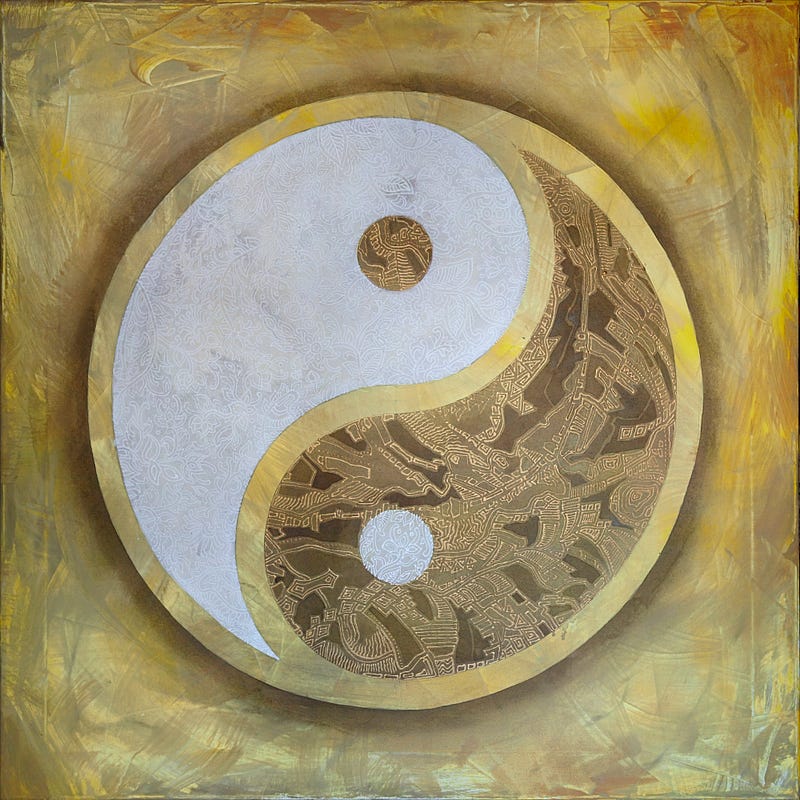
The balance between yin and yang is expressed through the ‘Tai Chi’ symbol (Tai Chi means ‘grand ultimate’, as in ‘ultimate truth’), also known as the ‘Taijitu’ and more commonly as the ‘Yin-Yang’ symbol. The swirling effect of the two fishes, yin and yang, swimming around, shows that the universe is in a constant state of flux. There is a great story for describing this cycle between yin and yang: hawks and doves!
Hawks and doves
Imagine a universe made up only of hawks and doves. Hawks are birds of prey, so they would attack the doves, and that would cause the dove population to shrink while hawks would thrive. Eventually, however, the ever-increasing imbalance would bring about a crisis situation. There would be a shortage of doves, and hawks would turn on each other to survive. The pendulum would change direction. The dove population would recover while the hawks were killing each other off. And so it would continue until the doves were plentiful, and the cycle would begin again.
Yin in yang, and yang in yin
The small ball of dark in the light section and vice versa shows that we can find one in the other. For example, sometimes the strongest thing to do is to yield and the weakest thing to do is to be rigid. There is strength in flexibility and brittleness in rigidity.
If we want harmony in our lives, it is better to seek a balance between the yin and yang forces. People who are too yang — forceful, active, unyielding — will find life tough because things won’t always go their way, and they will experience friction when they meet other people and situations that are like them. We can’t fight fire with fire, at least we’re not supposed to metaphorically. Even in the literal sense, fire is used to create a barren barrier that the fire we are trying to put out cannot leap across — we are fighting fire by starving it of things it can consume.
Likewise, if we are too flexible, too yielding, or too soft, there is a strong chance we will not get to do the things we want to do and will experience a life of going with other people’s demands.
Yin and the art of ‘absolute acceptance’
When you are faced with any situation, no matter how unique or challenging it is, before you can respond effectively, you have to accept and embrace it. What are the options?
Denial?
‘This can’t be true?’
‘This can’t be happening to me?’
‘There must be a mistake?’
‘Please let me wake up from this nightmare.’
Resistance?
‘This is not happening.’
‘I am not accepting this.’
‘I am not having it.’
Complaining?
‘What have I done to deserve this?’
‘This is so unfair?’
‘This is terrible.’
Deal with it
Any time you spend denying, resisting, or complaining about reality is gone forever. It only serves to upset you more. It’s Buddha’s second arrow — the one that adds to the inevitable suffering that comes with being a living person in an uncertain world.
You can’t begin to respond effectively until you accept reality as it is.
Does this mean we can’t question appearances?
No, of course not! Sometimes things aren’t quite as they seem, and we must be mindful of that. If you walk out of the supermarket, and you can’t find your car, or it isn’t where you believe you parked it, it doesn’t mean it was stolen. In this situation, the reality is that you don’t know where your car is. Your memory could be playing tricks on you. The best response to that situation is to look for the car. Only when you are satisfied that it has been moved, do you call the police to report a theft.
Why ‘absolute’ acceptance?
It doesn’t matter how brutal reality is, you must face it. There is no other way. Acceptance might not happen overnight. Bereavement launches a grieving process, and you can’t control how long that will take. After losing my son in May 2022, I would often cry. I just let the body do its thing. There was no other choice. Even now, sometimes I cry without being able to pin down the trigger. Again, I just let my body get on with it. Once it has passed, I experience a kind of reset… until the next time. I absolutely accept the tears for what they are — my heart’s way of healing.
So, acceptance has to be absolute or it’s not acceptance. You can’t have conditional acceptance; ‘I will accept this and maybe a little of that, but there’s no way I am accepting the other.’ That’s foolishness. Spitting your dummy out won’t help you.
What is ‘absolute’ yang, and why is it necessary?
Once you have processed reality, you have to respond to it, but how many of us are doing that? Sure, you show up for work, you pay the bills, you feed the kids, and you function in the world, but how much control do you have over your behaviour really?
Let’s explore ‘procrastination’
Did you take regular breaks from your to-do list today (if you had one), or did your mind wander and drag you to the feed of social media, the latest episode of trash television, or one of those easy chores you didn’t have to do?
Mindfulness helps us to become more self-aware, and that helps us to see ourselves objectively and observe how we behave. It’s often not a pretty sight. For every single task that we do purposefully, there will be plenty of others that are like unconscious reactions or escapes from reality.
Sometimes, the most important task of the day remains out of reach while we do everything else imaginable — call of nature, dusting down the shelves, hoovering the spare room, making a sandwich to satisfy our phantom hunger, and so on.
If you can identify with any of the above, ‘absolute yang’ will help you.
Let go of the ego
Although it demands to be heard and most of us cling to it for dear life, our ego does not serve us well. The ego struggles to accept anything that goes against its narrative of how things should be, and it will hijack your behaviour to serve itself rather than your interests.
Wake-up call: there is no self. The sense of self, which feeds and empowers the ego, is an illusion, but the ego depends on it to maintain its grip. Ironically, your mind created the ego to serve you, but, like an AI-powered defence system that has got out of hand, it is now your worst enemy.
If you want to take command of your actions and ensure that everything you do is purposeful — serving you and your values mindfully — you need to override the ego. If you are in any doubt that there is no self, take a look at this article — https://bigthink.com/the-well/eastern-philosophy-neuroscience-no-self/
A military metaphor
Have you ever wondered why the military is so effective and efficient at getting things done? Getting 100 men, women and children across a crazy river, navigating a route across a desert, setting up a base in the middle of nowhere… whatever needs to be done, the military will make a plan, execute the plan, and get the job done (illegal invasions aside!).
The military way is very simple. The most senior officer defines the mission, and this mission is fed down through the chain of command, so everyone knows what the end goal is. The operation is mapped out, and everyone is given a part to play. The military places a huge emphasis on teamwork and leveraging the power of collective force and intelligence. For the mission to succeed, soldiers must act on orders. I depend on the person next to me, and they depend on me. Imagine if everyday civilians operated in the same way.
Imagine if your body and mind did what it was supposed to do from the moment you woke until it was time to sleep. Can you imagine how effective and productive you would be? You’d still take all the breaks you wanted and do all the fun things you wanted to do, but you’d always be acting purposefully.
Linking the military approach with ‘absolute yang’
Once we accept that there is no self and therefore do not need to be distracted by its needs, what we are left with is a team comprising the body and brain. The body is the physical team, which includes arms and legs for moving and lifting, hands and fingers for tasks that involve dexterity, and our sensory organs for sensing what’s going on around us. The mind is the invisible, intangible team of thoughts and ideas. All of this is held together by our sense of self with the ego at the helm.
The ego’s great at managing the collective mental-physical team, but must not lead it. Remember that egos only serve themselves, but they can manage. Leaders create the plan, and managers communicate the plan to the team and ensure its execution.
Troops don’t question orders unless those orders are clearly going against the mission or the values of the unit. Absolute yang. Orders are received and carried out in a timely manner. Military discipline.
Bringing it all together
The practice of mindfulness improves awareness and helps us to stay present. This improved focus ensures that we are constantly in tune with our internal and external reality, accepting what is, and ready to respond to change.
Absolute yang ensures that we are acting from our mindful centre rather than the ego state, generating and executing plans that serve our higher purpose in alignment with our values. No plan survives first contact, and absolute yin with sensitivity means we can detect and accept change as it happens and respond quickly with absolute yang.
Absolute flow
The practice of absolute yin (acceptance) and absolute yang (timely and appropriate action) ensures the optimal level of mindful engagement with our world.
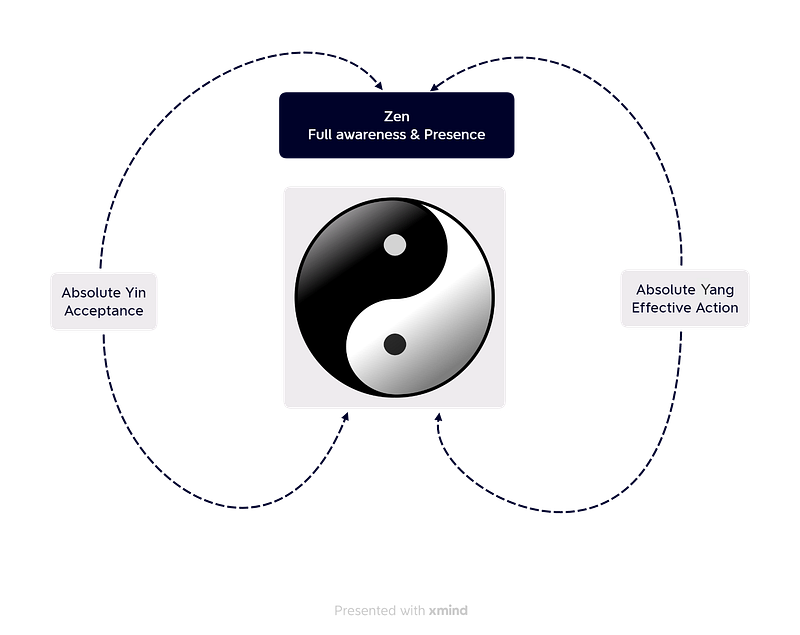
The diagram above shows the relationship between Zen (meditation/awareness), Tao (‘the way’), and how we engage with our world.
Without Zen, we cannot sense the world as it is in the present. Absolute yin means we accept and embrace reality as it is sensed, and absolute yang ensures we take the most effective action from moment to moment.
Note: absolute yin and absolute yang are almost like attitudes of mind that cancel each other out. Absolute yin does not mean we yield to everything and do not seek improvement. Absolute yang does not mean that we never yield and insist on having things our way. Our actions must always be balanced.
What counts is that the flow is not interrupted by unnecessary resistance brought about by the ego and its delusions. Maintaining that flow ensures that we can operate efficiently, effectively and with purpose.