
You Won’t Believe What These Seven Sisters Did to Become Rich and Famous
Growing glory, but a bitter end for these Victorian-era influencers
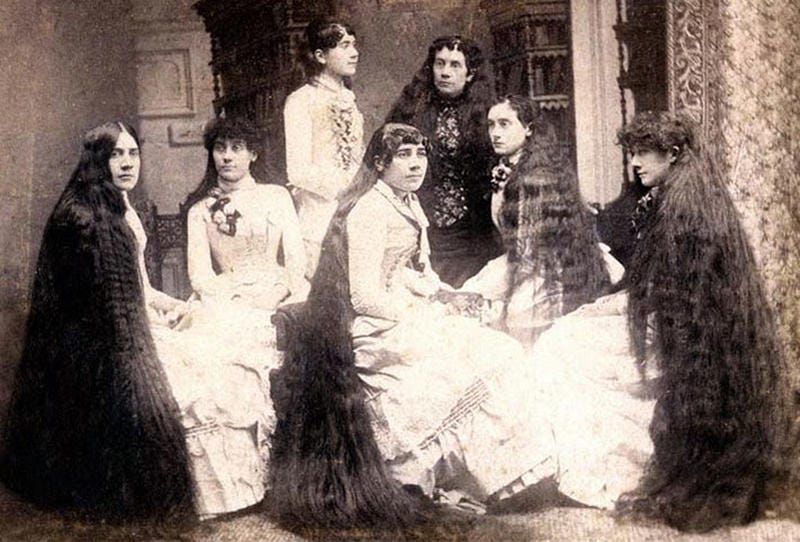
At any given time, one can type the phrase “Sutherland Sisters” into the search engine on eBay and come up with multiple cabinet card photos, advertisements, and other artifacts related to their heyday. They were the 19th-century American equivalent of rock stars, supermodels, and titans of merchandising all rolled into one, or should I say seven? Their story is as strange as it is remarkable.
Magic in a bottle
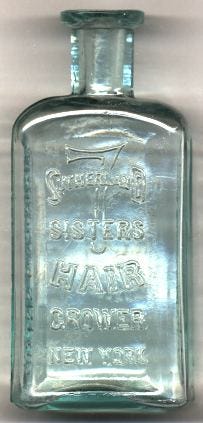
The seven Sutherland sisters, Sarah, Victoria, Isabella, Grace, Naomi, Dora, and Mary, began life in relative poverty on a small farm in Niagara County, NY. Born between 1845 and 1862, as they matured, it became apparent that each could produce a growth of long, luxurious hair. The girls’ mother, Mary Brink Sutherland, encouraged the extraordinary length by nightly applying a foul-smelling concoction of her design to the hair and scalp of each. She claimed this formula was responsible for their phenomenal hair-growing success.
Sister act
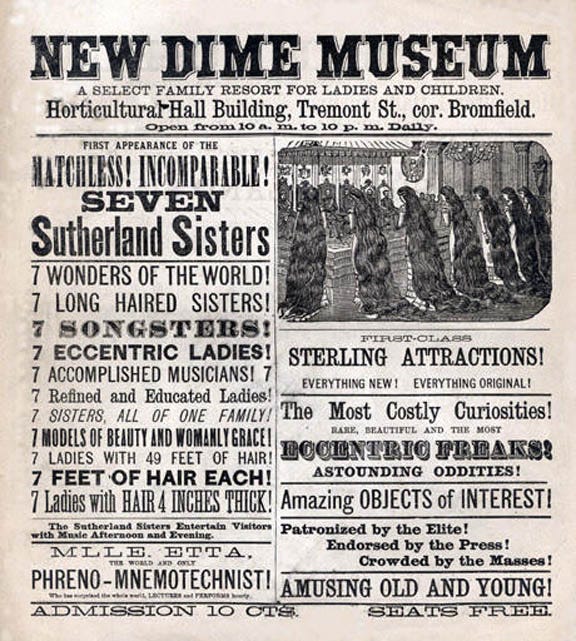
The girls’ father, Fletcher Sutherland, was a colorful character who struggled to provide for his family. The income from the farm was sparse, and the property taxes always seemed to be in arrears. He had to find a way to increase their revenue, preferably one that did not involve manual labor. (He often left his family to do the farm work, while he socialized with his friends in town.)
The family was a musical one, each girl sang and played an instrument, so Fletcher hatched the plan to put them on stage, starting small in church basements, and at local gatherings.
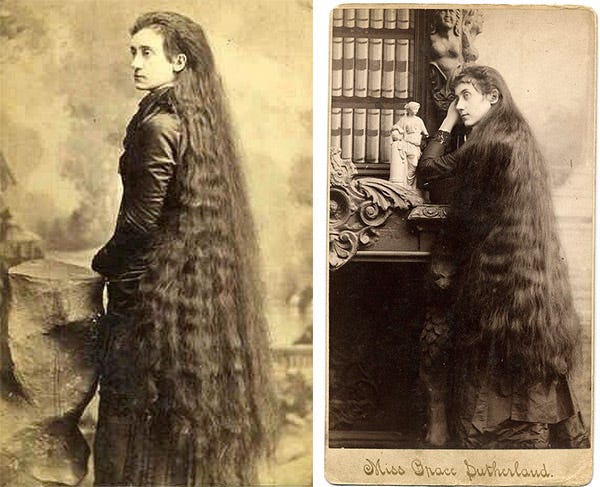
Although the girls were musically competent, Fletcher began to realize that the real draw was their freakishly long hair (a collective 37 feet). He began to capitalize on that. At the end of each performance, the sisters would turn their backs to the audience as one and display their remarkable hair. This dramatic maneuver was a huge success, and in a few short years, they hit the big time.
The Greatest Show on Earth
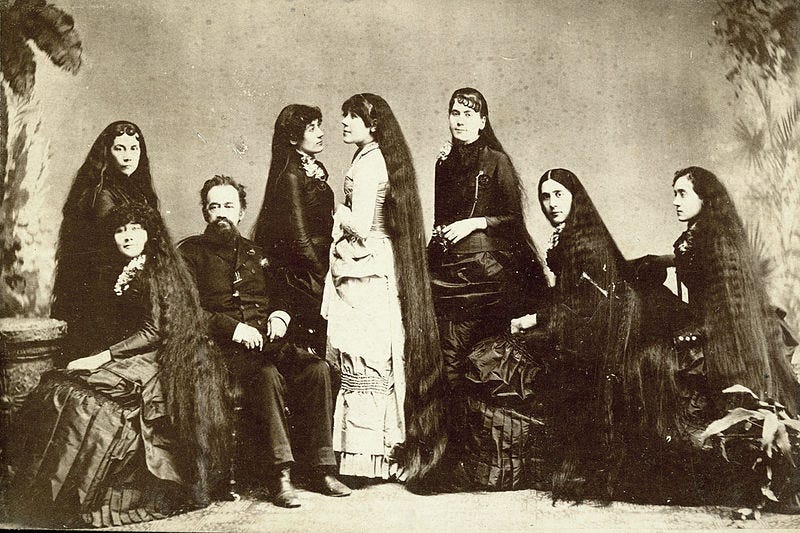
When the sisters were aged 18 to 36, they signed with legendary showman P.T. Barnum. From the early 1880s through the early 1900s, the Seven Sutherland Sisters toured with Barnum and Bailey’s circus, becoming (along with Jumbo the elephant) one of the show’s top acts. They traveled in style by private railway car, and their clothes were the height of fashion with designers paying them to model their creations.
Fans mobbed them wherever they went, some armed with scissors to get a snippet of the miraculous locks for themselves. But big money started rolling in around 1885 when Fletcher, prompted by Naomi’s new husband J. Henry Bailey (who also served as the act’s manager), started brewing, bottling, and selling the family’s secret recipe.
Empire Building
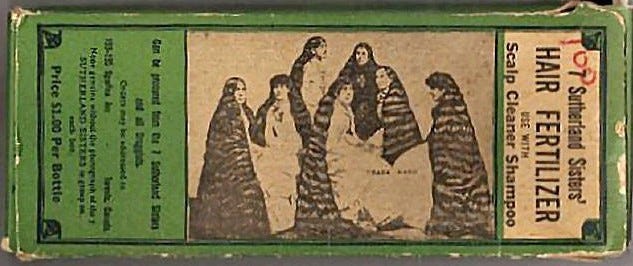
“The 7 Sutherland Sisters Hair Grower” was aggressively marketed in newspapers and magazines with outrageous claims and letters from satisfied “customers” that were all suspiciously similar in tone and style. The ads also featured endorsements by mysterious medical men who swore to the tonic’s efficacy.
It was all nonsense. The Hair Grower, when tested by a legitimate chemist, turned out to be mostly witch hazel and bay rum with traces of hydrochloric acid, salt, and magnesium. But the beauty business is built on faith, hope, and a fair dollop of self-delusion, and the public continued to crave 7 Sutherland Sisters products.
The family added hair dyes called “Hair Colorators,” “Hair Fertilizer,” a scalp cleanser, brushes, and combs to the product line. The items were sold in retail stores as well as in their company stores called “parlors,” including one in New York City. Several of the sisters would visit the parlors and be available at set times for hair care consultations or to simply attract shoppers by standing in the windows.
By 1888, Fletcher and Mary had died, and the sisters had amassed a fortune. At the turn of the century, having made millions, they were among the wealthiest women in America. They lived together in an opulent mansion they built in Warner’s Corners, NY, not far from where they were born. At this point, things started to get weird.
Love, Loss, and Morbid Obsession
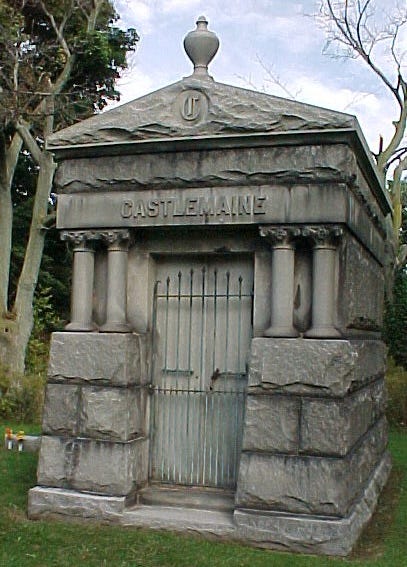
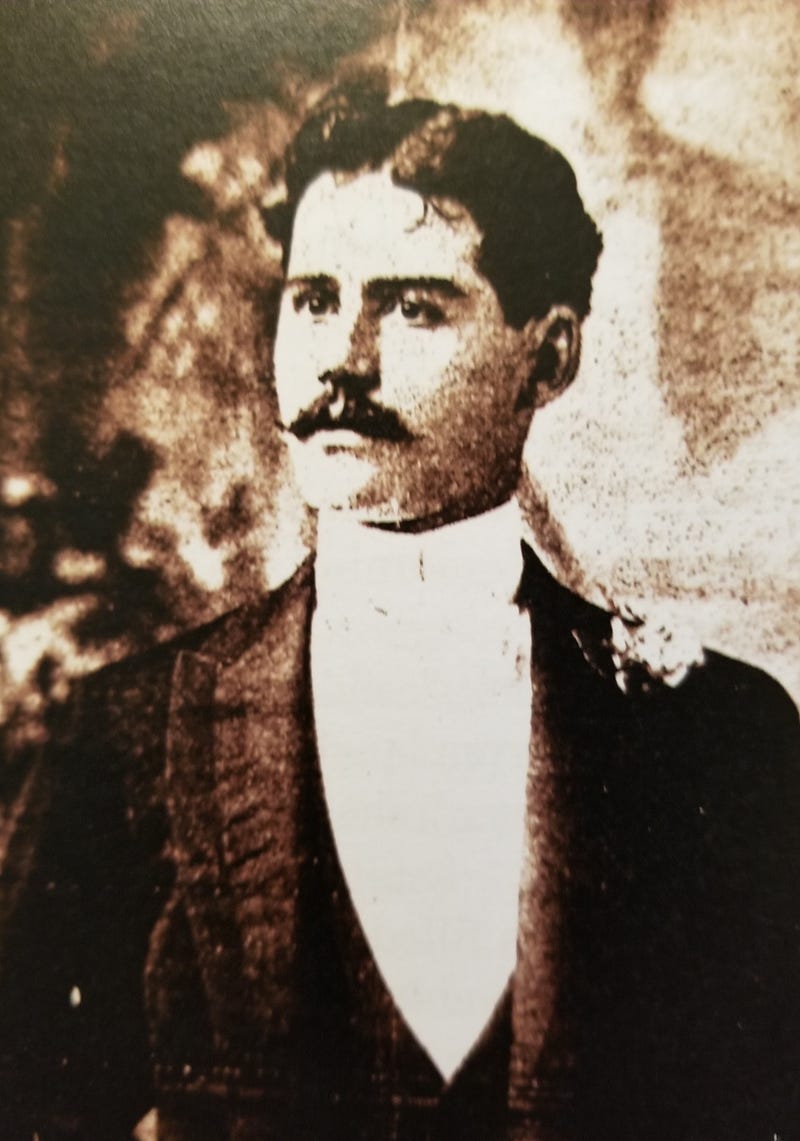
In 1892 when Isabella was 40, she married 27-year-old Frederick Castlemaine. Frederick was handsome, charming, and hopelessly addicted to opium and morphine. The family adored him, and he became a central figure at the numerous parties, entertainments, and antics that the Sutherlands engaged in at the mansion.
The event that most seemed to unhinge the family was the death of sister Naomi in 1893. Her body lay in state in the family mansion for weeks, while her sisters planned an elaborate mausoleum. Eventually, they decided to bury her with her parents in the family plot in nearby Lockport.
The change in burial plans may have partly been because there was a need for secrecy. The sisters were no better with money than their father had been, and they needed to keep it coming in. Six Sutherland Sisters would not do, so they hired a replacement for Naomi, and the show went on.
Tragedy struck again in 1897 when Frederick Castlemaine was found dead in his hotel room while on tour. Whether or not his death was accidental is up for speculation, but Isabella was inconsolable. She refused to let his body be moved for hours, insisting that he was going to wake up. Eventually, others in attendance persuaded her to let them arrange for its transport back to Lockport.
Frederick, like Naomi, lay in state for weeks in a glass-domed coffin in the parlor of the Sutherland mansion, his body un-embalmed. The family gathered around him day and night, singing his favorite songs. Isabella insisted that his mausoleum be fitted with a window so he could get out when he awakened, as she was sure he would. Night after night, she kept vigil at his tomb, weeping and begging him to return to her. Needless to say, he never did.
The Party’s Over
As the women aged, their touring and modeling opportunities dwindled. Isabella married again and split from the family to launch a competing product with her second husband, Alonzo Swain. The couple went broke.
When Victoria was 50 in 1899, she married a 19-year-old and became estranged from the rest of the family. She died three years later and was replaced in the act, as Naomi had been, with a surrogate.
Mary, plagued by periods of insanity, was often locked in her room. Victoria, Grace, Dora, and Mary never married. Sarah died in 1919.
The final nail in the coffin of the family fortune was the age of the flapper. Women were bobbing their hair, and no longer wanted to be burdened by styles requiring hours of maintenance. The production of 7 Sutherland Sisters hair care products ended, and most of the fortune was gone. The remaining sisters’ Grace, Dora, and Mary sold the now crumbling mansion for a pittance and moved into a tiny house in Lockport.
Last stop Hollywood
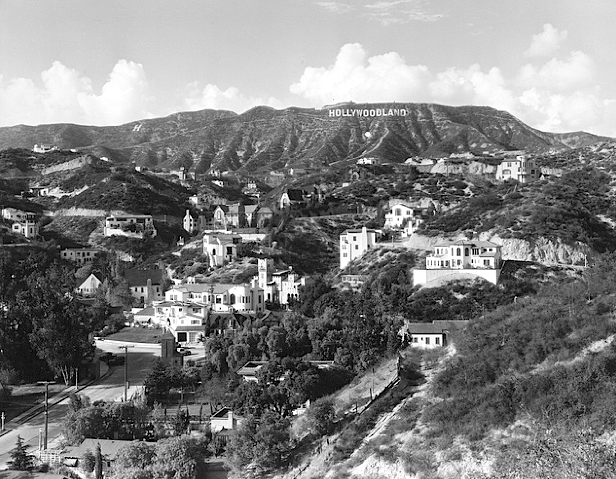
One last hope brought the remaining three sisters to Hollywood in 1926, where there was talk of making a movie about their lives. Discussions with the film studio led nowhere, and before returning home, Dora was struck and killed by a car while crossing a street in Los Angeles.
Her sisters arranged for the cremation of her remains, but lacking the funds to pay for the service, Grace and Mary returned home to Lockport without them. The belief is that they are still there. Mary died in 1939.
When Grace, the last of the world-famous Seven Sutherland Sisters, died in 1946 at the age of 92, her final resting place is an unmarked grave.
“This is the way the world ends, not with a bang but a whimper.” — T.S. Eliot


