
The Reflective Eclectic
The Table
The value of the least valued parts of yourself
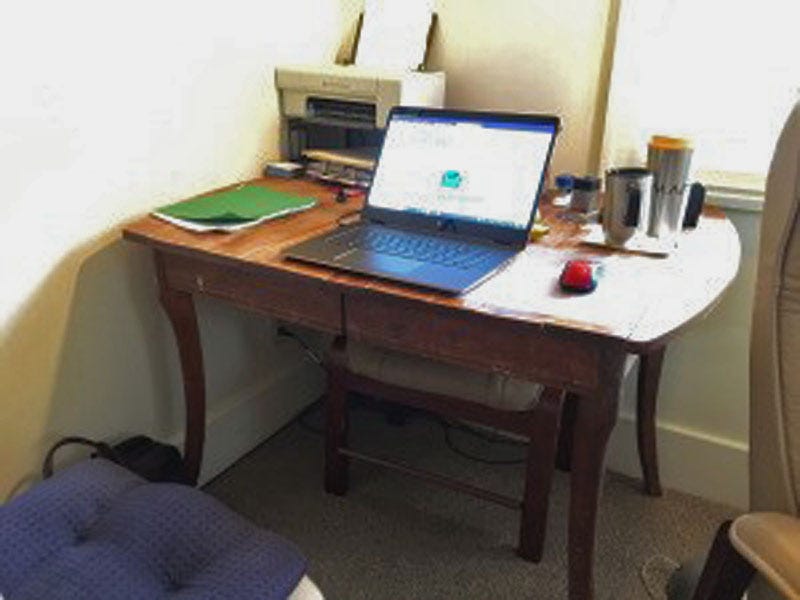
Continuing my series on objects in my office, today I’d like to write about the table I keep my computer on. This table probably never thought it would bear a computer in a therapist’s office and be used to write such high-falutin stuff as this. It began its life as the kitchen table of my grandmother; we called her Grand Mae, and I think of her whenever I think of the table.
It’s not a very nice table, as tables go; but Grand Mae was not a very nice grandmother. She never baked cookies, or read to me, or spoiled me, or told me stories, or took my side against my parents. I don’t remember her doing much of anything but soaking her feet, letting the dog in and out, boiling potatoes and carrots for dinner, and washing the dishes afterward. At least, she was never mean to me. I was more often mean to her. I thought it was funny to untie her apron strings when her hands were busy. The apron would fall to the floor, I’d run away, and she’d sputter, her dentures too loose and her education too narrow to allow her to form an articulate complaint.
Grand Mae represents the part of my family tree I am the least proud of, a branch of Swamp Yankees. That’s the New England version of redneck, hillbilly, or white trash; and Grand Mae’s family was even more backward than most. Her father was a fishmonger, and they lived in a ramshackle shack out in the woods that probably smelled like fish. Every one of her siblings met a violent end, but Grand Mae escaped to become a domestic servant for an imperious couple, the Wightmans. She married and had kids, but when the Depression came along and her husband had to go all the way to Saskatchewan to find work, Grand Mae refused to go with him. Instead, she returned to the Wightmans. They let her fix up an old chicken coop in the backyard for her and her kids. That’s where the table came from.
I can’t blame her for not going to Saskatchewan, even if she did have to bring up her family alone in a chicken coop, but did she have to tell the kids their father abandoned them, leaving them without one red cent when it wasn’t true? He came back at one point and the kids refused to see him because of the lies she told. Years later some letters were found, revealing he asked about the kids and sent money all along.
My father would have had every reason to be angry with his mother after the letters were revealed. If he was, I never knew it. On the contrary, when Old Lady Wightman died and my Grand Mae was out of a job and a home, my father brought her to live with us. That’s how she came to boil our potatoes and carrots, and I began to torment her by pulling her apron strings.
Maybe you have parts of your past or your family that you’re not proud of. Some of mine are summed up by the table. A Swamp Yankee grandmother and a fishmonger great-grandfather, growing up in a ramshackle shack. A domestic servant, single mother, raising her kids in a chicken coop, lying to them about their father. And then there’s me, pulling my Grandmother’s apron strings, without one good thing to say about her. To me, this beat-up old table symbolizes all those parts of my myself of which I am the least proud, but keep, anyway; not because they’re worth keeping, but because they’re mine and who else is going to keep them?
I bet you never thought that the best parts of you could be supported by the worst parts of you, but they can. To prove it, I just have to point to my Grand Mae’s table and the truth, informed by humility, that I write on it.
Keith R Wilson is a mental health counselor in private practice and the author of three self-help books, three novels, and innumerable articles. His third novel, Who Killed the Lisping Barista of the Epiphany Café? is currently being published one chapter at a time in Medium.


