avatarChristopher P Jones

Free AI web copilot to create summaries, insights and extended knowledge, download it at here

4461

Abstract

was the theologian Saint Augustine, who presented the case in a sermon, “The devil exulted when Christ died, but by this very death of Christ the devil was vanquished, as if he had swallowed the bait in the mousetrap… The cross of the Lord was the devil’s mousetrap; the bait by which he was caught was the Lord’s death.” (<i>Sermo</i>, 263).</p><figure id="65cc"><img src="https://cdn-images-1.readmedium.com/v2/resize:fit:800/1*MTdKLPyUyX_at0gsQg5_Dw.jpeg"><figcaption>Detail of right panel of the ‘Annunciation Triptych’ (Merode Altarpiece) (c.1427–32) by the workshop of Robert Campin. Oil on oak. 64.5 × 27.3 cm. The Met Cloisters, part of The Metropolitan Museum of Art, New York, U.S. Image source <a href="https://www.metmuseum.org/art/collection/search/470304">The Met</a> (open access)</figcaption></figure><p id="a556">And so, the fact that Joseph is occupied crafting a mousetrap while Mary is pregnant by a miracle implies that he was a supportive spouse in the remarkable story that was unfolding for his future wife.</p><h1 id="57c3">Further Questions</h1><p id="5759">Still, some details require more clearing up. Notice, for instance, how Joseph is twisted rather uncomfortably on his bench, and how his drilling tool can not be operated by one hand alone.</p><figure id="9d13"><img src="https://cdn-images-1.readmedium.com/v2/resize:fit:800/1*OmtSvaaxR7OOxqlXTRz4KA.jpeg"><figcaption>Detail of right panel of the ‘Annunciation Triptych’ (Merode Altarpiece) (c.1427–32) by the workshop of Robert Campin. Oil on oak. 64.5 × 27.3 cm. The Met Cloisters, part of The Metropolitan Museum of Art, New York, U.S. Image source <a href="https://commons.wikimedia.org/wiki/File:Annunciation_Triptych_(Merode_Altarpiece)_MET_DP273206.jpg">Wikimedia Commons</a></figcaption></figure><p id="c241">Moreover, the workbench top is a cluttered affair, with several of the tools lying on top of each other. 15th century viewers would have noticed this disorder; they might also have associated the array of tools — too bulky to have made the intricate mousetrap — with the tools used to fashion something much larger… like a cross.</p><p id="9bc1">According to the art historian Malcolm Russell, this apparently haphazard arrangement of tools was not haphazard at all: that the two overlapping sets of tools each make a cruciform shape, which along with the tool at the rear — an auger — suggests the three crosses of Calvary.</p><p id="be36">And the curious posture of Joseph holding the drill? In fact he is prising out holes in a wooden board in preparation to insert metal spikes — another implement related to Christ’s torture known as a “spiked fetter” which, according to Medieval traditions, would hang from a chord around the neck and dangle agonisingly between one’s ankles.</p><p id="197d">In short, Joseph is doing nothing less than preparing for the Crucifixion.</p><p id="e578">But what of the bird snare on the windowsill? It is believed that this is a symbol of the Redemption of mankind thanks to Christ’s sacrifice: for inside the trap a bird is waiting to be released. As Psalm 123:7 has it, “Our soul hath been delivered as a sparrow out of the snare of the fowlers.”</p><h1 id="caad">The Wider Image</h1><p id="f8c3">Turning to the central panel of the triptych, it begins to make more sense why the artist has chosen to place Mary in a domestic setting with contemporary architectural details. This is a 15th century Flemish household with a carpenter’s workshop next door. Indeed, it is one of the earliest representations of a Northern European interior in an Annunciation painting.</p><figure id="d18b"><img src="https://cdn-images-1.readmedium.com/v2/resize:fit:800/1*as9YGISOZMh4wFhBwB_oPg.jpeg"><figcaption>Central panel of the ‘Annunciation Triptych’ (Merode Altarpiece) (c.1427–32) by the workshop of Robert Campin. Oil on oak. 64.1 × 63.2 cm. The Met Cloisters, part of The Metropolitan Museum of Art, New York, U.S. Image source <a href="https://www.metmuseum.org/art/collection/search/470304">The Met</a> (open access)</figcaption></figure><p id="88e6">Once again, the impressive details of the painting are almost hard to fathom. Inside her home, Mary reads from the book of hours. Her hair is unbound; she looks relaxed. The Angel Gabriel appears with news of her conception of Jesus.</p><p id="2e78">A common element in paintings of the Annunciation is a dove, representing the Holy Spirit, often shown descending on a ray of

Options

light and touching the Virgin’s head or breast in the moment of Incarnation.</p><p id="dd13">This painting is different: instead of a dove, a miniature Christ Child flies down towards Mary holding a cross. He passes through an oculus — a round window — penetrating the glass as a symbolic reference to the miracle of Mary’s virgin conception.</p><figure id="1e62"><img src="https://cdn-images-1.readmedium.com/v2/resize:fit:800/1*pVvHx-Z4jX75sU5EhmOOtg.jpeg"><figcaption></figcaption></figure><figure id="827f"><img src="https://cdn-images-1.readmedium.com/v2/resize:fit:800/1*LZUXQeDxhl5xfUSS6mErAA.jpeg"><figcaption>Details of central panel of the ‘Annunciation Triptych’ (Merode Altarpiece) (c.1427–32) by the workshop of Robert Campin. Oil on oak. 64.1 × 63.2 cm. The Met Cloisters, part of The Metropolitan Museum of Art, New York, U.S. Image source <a href="https://www.metmuseum.org/art/collection/search/470304">The Met</a> (open access)</figcaption></figure><p id="17df">Notice on the tabletop a candle that has recently been extinguished: it is thought to signify the Holy Spirit (in place of the usual dove). In a brilliant piece of invention, the artist has drawn on the idea that the Holy Spirit descended to the apostles “like a puff of wind” — as some late medieval writers propounded.</p><figure id="d35b"><img src="https://cdn-images-1.readmedium.com/v2/resize:fit:800/1*JRREgblMYEgZY-YnZV__uQ.jpeg"><figcaption>Detail of central panel of the ‘Annunciation Triptych’ (Merode Altarpiece) (c.1427–32) by the workshop of Robert Campin. Oil on oak. 64.1 × 63.2 cm. The Met Cloisters, part of The Metropolitan Museum of Art, New York, U.S. Image source <a href="https://www.metmuseum.org/art/collection/search/470304">The Met</a> (open access)</figcaption></figure><p id="6326">Finally — among this plethora of signs — notice the jug on the table holding a lily, the symbol of the Virgin’s purity. The jug is decorated with a series of intricate markings, thought to be Latin and Hebraic letters that some art historians have decrypted as reading <i>De Campyn</i> — attributed as the artist’s signature.</p><figure id="3b52"><img src="https://cdn-images-1.readmedium.com/v2/resize:fit:800/1*NMygbd2CxWDixKcxOvb7bQ.jpeg"><figcaption>Detail of left panel of the ‘Annunciation Triptych’ (Merode Altarpiece) (c.1427–32) by the workshop of Robert Campin. Oil on oak. 64.5 × 27.3 cm. The Met Cloisters, part of The Metropolitan Museum of Art, New York, U.S. Image source <a href="https://www.metmuseum.org/art/collection/search/470304">The Met</a> (open access)</figcaption></figure><p id="a4ae">And finally, the left wing of the triptych shows the donor — who probably commissioned the work along with the request to appear in the image himself. The painting shows him looking in at the Annunciation through a door. Beside him is his wife, and behind them at the garden gate, a town messenger ready to spread the divine news.</p><figure id="18fd"><img src="https://cdn-images-1.readmedium.com/v2/resize:fit:800/1*wbzhWxjRiyFK5cV6QGZWHg.jpeg"><figcaption>Annunciation Triptych (Merode Altarpiece) (c.1427–32) by the workshop of Robert Campin. Oil on oak. 64.5 × 117.8 cm overall (open). The Met Cloisters, part of The Metropolitan Museum of Art, New York, U.S. Image source <a href="https://www.metmuseum.org/art/collection/search/470304">The Met</a> (open access)</figcaption></figure><p id="bd24">One thing is for certain, this remarkable triptych was a hugely significant work in the development of Early Netherlandish art and is regarded as one of Robert Campin’s most accomplished and complex paintings.</p><figure id="daf2"><img src="https://cdn-images-1.readmedium.com/v2/resize:fit:800/1*igQbKCOI4qGLg6JzYP7H9w.png"><figcaption></figcaption></figure><p id="ba0f">If you liked this, you may also be interested in my book <a href="https://www.chrisjoneswrites.co.uk/masterpieces-of-art-explained/"><i>Masterpieces of Art Explained</i></a><i>, </i>an examination of some of art’s most enthralling images.</p><h1 id="770c">Would you like to get…</h1><p id="a0f6">A free guide to the <i>Essential Styles in Western Art History</i>, plus updates and exclusive news about me and my writing? <a href="https://www.chrisjoneswrites.co.uk/sign-up-art/">Download for free here</a>.</p><h1 id="23f7">Join me…</h1><p id="8fc3">On <a href="https://www.instagram.com/greatpaintingsexplained/">Instagram</a> for more great paintings on the go!</p></article></body>

Discover the Symbolic Richness of Robert Campin’s Masterpiece

The art details that make the Merode Altarpiece
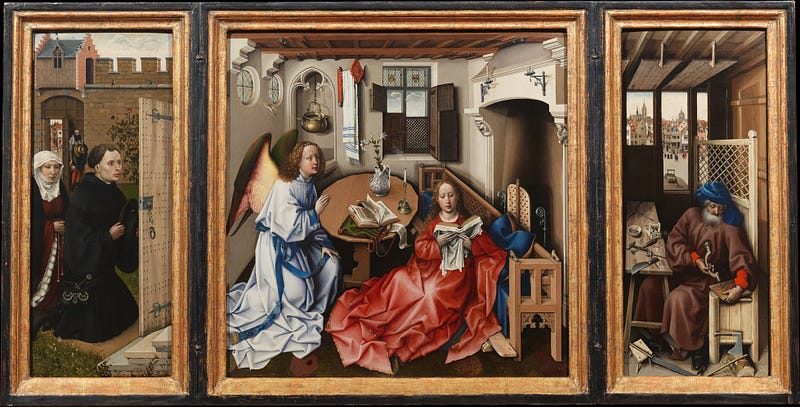
Annunciation Triptych (Merode Altarpiece) (c.1427–32) by the workshop of Robert Campin. Oil on oak. 64.5 × 117.8 cm overall (open). The Met Cloisters, part of The Metropolitan Museum of Art, New York, U.S. Image source The Met (open access)

Take a moment to look at the artwork above, a three-part painting known as the Merode Altarpiece. Artists of the 15th century were highly skilled at making images that worked on several levels, that were visually elaborate whilst also including a variety of symbols to communicate complex meanings.

This painting, from the workshop of Robert Campin — considered to be the first great master of Early Netherlandish painting — is a superb example.

The central panel shows the moment when the angel Gabriel appeared to Mary and told her she would become the mother of Christ. The two outer panels play a supplementary role in the meaning of the work, and can be folded shut or displayed open.

Now let me draw your attention to the third panel that has long fascinated experts. It shows Joseph at work in his carpenter’s shop.

Before we look at the finer details, just enjoy the tremendous sense of place created by the artist here: the prodigious detail of the workshop, the precisely described tools, and the windows with their shutters lifted up, behind through which we can see an entire townscape complete with two church spires, probably based on the Flemish town of Liège in modern day Belgium.
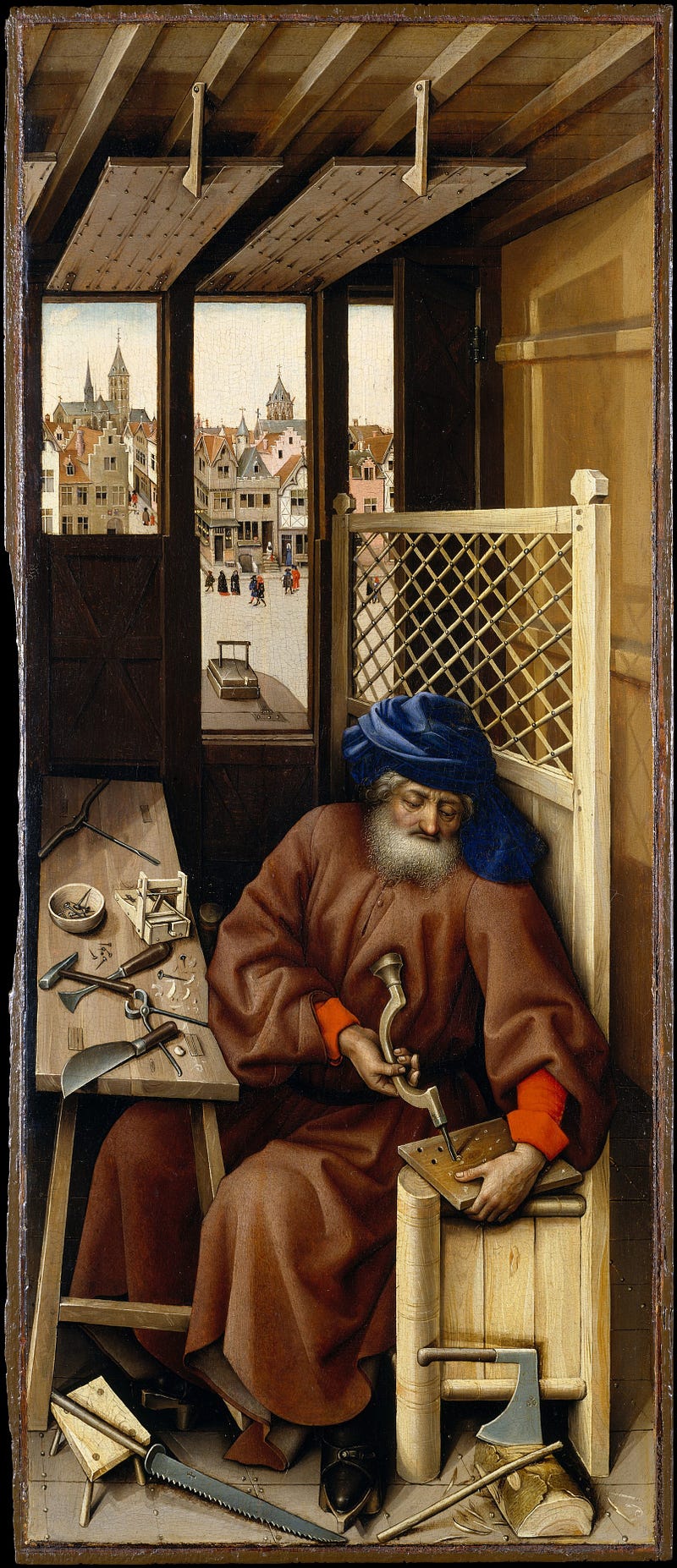
Right panel of the ‘Annunciation Triptych’ (Merode Altarpiece) (c.1427–32) by the workshop of Robert Campin. Oil on oak. 64.5 × 27.3 cm. The Met Cloisters, part of The Metropolitan Museum of Art, New York, U.S. Image source Wikimedia Commons

Now, notice on the windowsill behind Joseph a curious contraption, which looks a bit like a butter dish but is in fact a bird trap. From the position of its parts, the string and the fallen cage, this trap has just closed, most likely with a small bird inside.

Now notice on the workbench next to Joseph is another type of trap — partway through construction — this time a mousetrap.
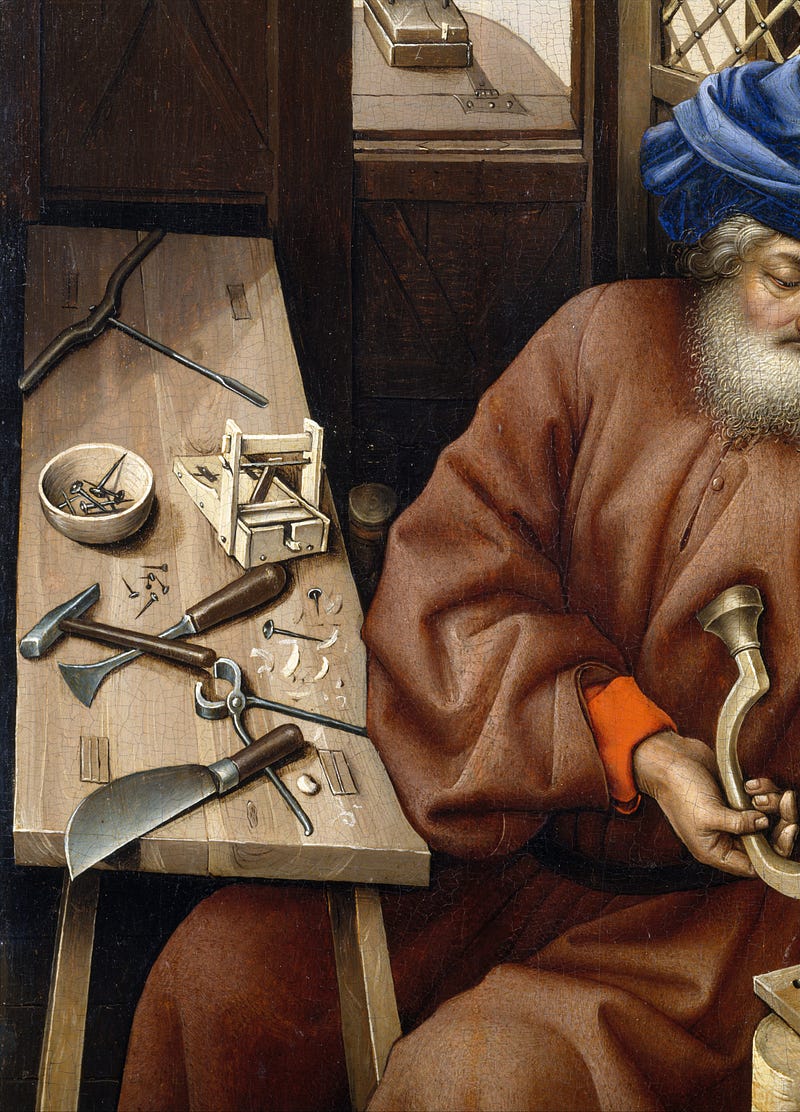
Detail of right panel of the ‘Annunciation Triptych’ (Merode Altarpiece) (c.1427–32) by the workshop of Robert Campin. Oil on oak. 64.5 × 27.3 cm. The Met Cloisters, part of The Metropolitan Museum of Art, New York, U.S. Image source The Met (open access)

So much care has been taken over the painting of the mousetrap, including its precise mechanism and accompanying tool, that it’s impossible to imagine that it too doesn’t carry some symbolic significance.

What adds to the puzzle is that in Medieval paintings like this, it was rare to find Joseph depicted, principally because Mary and Joseph did not marry until after the Annunciation. Far more typical were depictions of Mary alone in her walled garden or private chamber, visited by the angel in solitude.

So how do we account for the presence of Joseph and his various animal traps?

The Devil Ensnared

The most likely explanation is that the mousetrap is meant to stand as a metaphor: for the entrapment of the Devil by Christ’s Crucifixion.

The idea — as originally noted by Meyer Schapiro in his celebrated essay on the altarpiece — was this: that the Devil celebrated Christ’s death on the cross, yet because the Crucifixion had redeemed mankind from sin, so the Devil was deceived like a mouse entering a baited trap.

A notable exponent of this metaphor was the theologian Saint Augustine, who presented the case in a sermon, “The devil exulted when Christ died, but by this very death of Christ the devil was vanquished, as if he had swallowed the bait in the mousetrap… The cross of the Lord was the devil’s mousetrap; the bait by which he was caught was the Lord’s death.” (Sermo, 263).

Detail of right panel of the ‘Annunciation Triptych’ (Merode Altarpiece) (c.1427–32) by the workshop of Robert Campin. Oil on oak. 64.5 × 27.3 cm. The Met Cloisters, part of The Metropolitan Museum of Art, New York, U.S. Image source The Met (open access)

And so, the fact that Joseph is occupied crafting a mousetrap while Mary is pregnant by a miracle implies that he was a supportive spouse in the remarkable story that was unfolding for his future wife.

Further Questions

Still, some details require more clearing up. Notice, for instance, how Joseph is twisted rather uncomfortably on his bench, and how his drilling tool can not be operated by one hand alone.
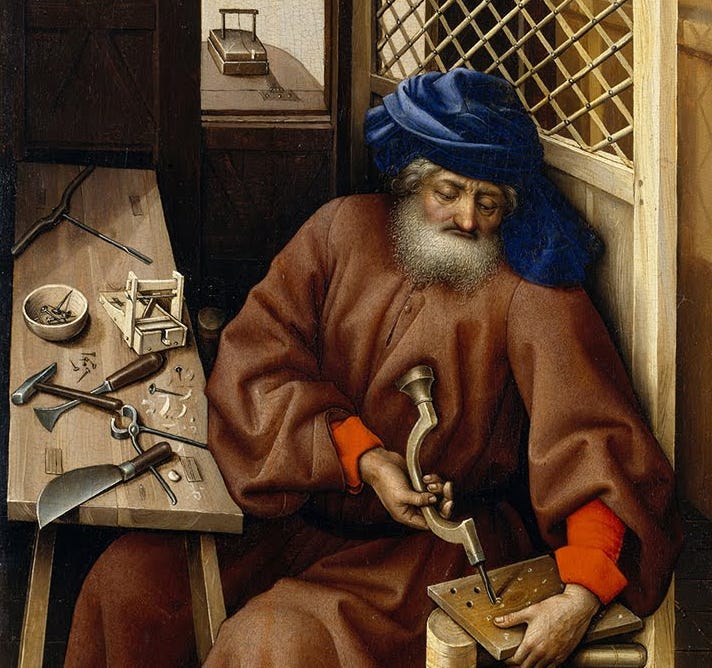
Detail of right panel of the ‘Annunciation Triptych’ (Merode Altarpiece) (c.1427–32) by the workshop of Robert Campin. Oil on oak. 64.5 × 27.3 cm. The Met Cloisters, part of The Metropolitan Museum of Art, New York, U.S. Image source Wikimedia Commons

Moreover, the workbench top is a cluttered affair, with several of the tools lying on top of each other. 15th century viewers would have noticed this disorder; they might also have associated the array of tools — too bulky to have made the intricate mousetrap — with the tools used to fashion something much larger… like a cross.

According to the art historian Malcolm Russell, this apparently haphazard arrangement of tools was not haphazard at all: that the two overlapping sets of tools each make a cruciform shape, which along with the tool at the rear — an auger — suggests the three crosses of Calvary.

And the curious posture of Joseph holding the drill? In fact he is prising out holes in a wooden board in preparation to insert metal spikes — another implement related to Christ’s torture known as a “spiked fetter” which, according to Medieval traditions, would hang from a chord around the neck and dangle agonisingly between one’s ankles.

In short, Joseph is doing nothing less than preparing for the Crucifixion.

But what of the bird snare on the windowsill? It is believed that this is a symbol of the Redemption of mankind thanks to Christ’s sacrifice: for inside the trap a bird is waiting to be released. As Psalm 123:7 has it, “Our soul hath been delivered as a sparrow out of the snare of the fowlers.”

The Wider Image

Turning to the central panel of the triptych, it begins to make more sense why the artist has chosen to place Mary in a domestic setting with contemporary architectural details. This is a 15th century Flemish household with a carpenter’s workshop next door. Indeed, it is one of the earliest representations of a Northern European interior in an Annunciation painting.
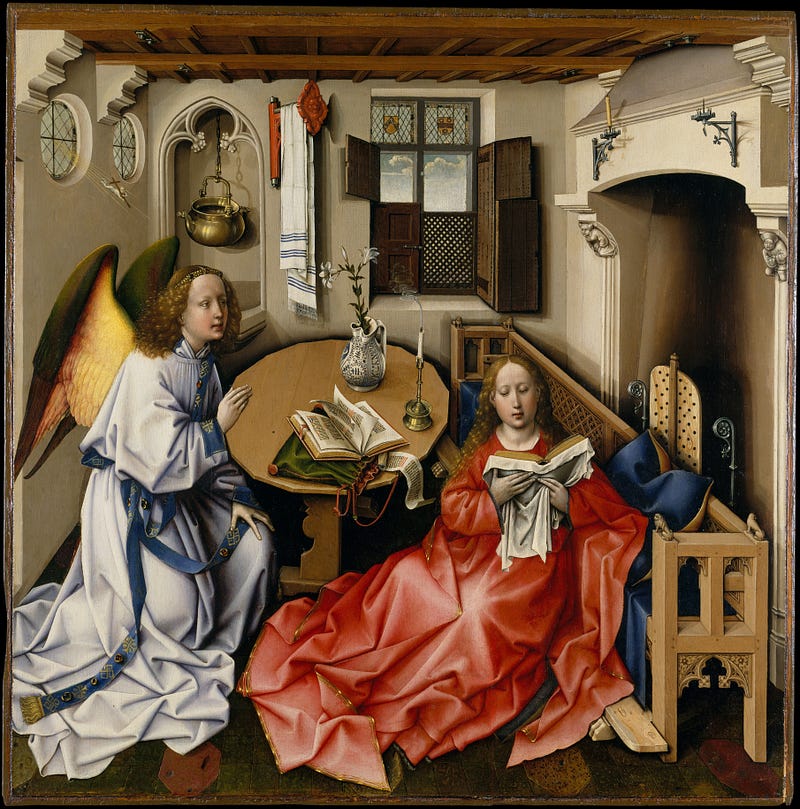
Central panel of the ‘Annunciation Triptych’ (Merode Altarpiece) (c.1427–32) by the workshop of Robert Campin. Oil on oak. 64.1 × 63.2 cm. The Met Cloisters, part of The Metropolitan Museum of Art, New York, U.S. Image source The Met (open access)

Once again, the impressive details of the painting are almost hard to fathom. Inside her home, Mary reads from the book of hours. Her hair is unbound; she looks relaxed. The Angel Gabriel appears with news of her conception of Jesus.

A common element in paintings of the Annunciation is a dove, representing the Holy Spirit, often shown descending on a ray of light and touching the Virgin’s head or breast in the moment of Incarnation.

This painting is different: instead of a dove, a miniature Christ Child flies down towards Mary holding a cross. He passes through an oculus — a round window — penetrating the glass as a symbolic reference to the miracle of Mary’s virgin conception.
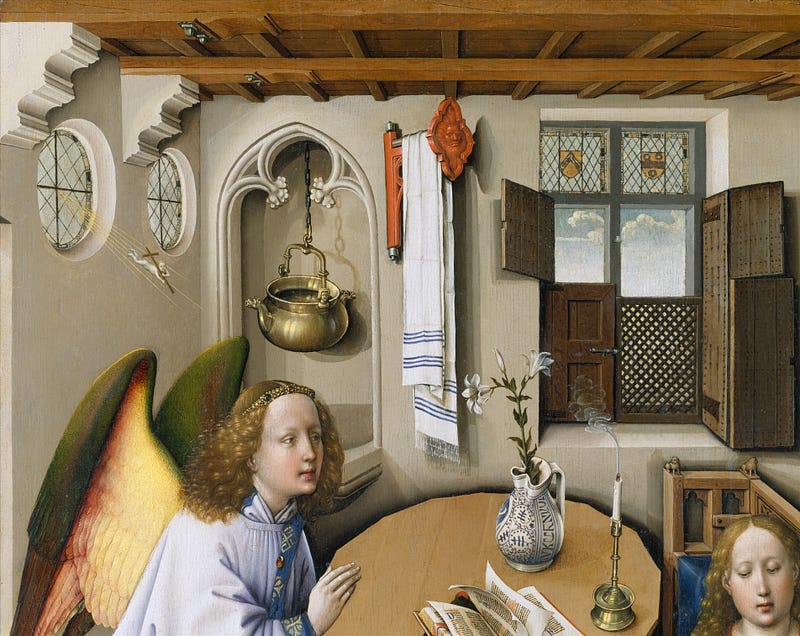
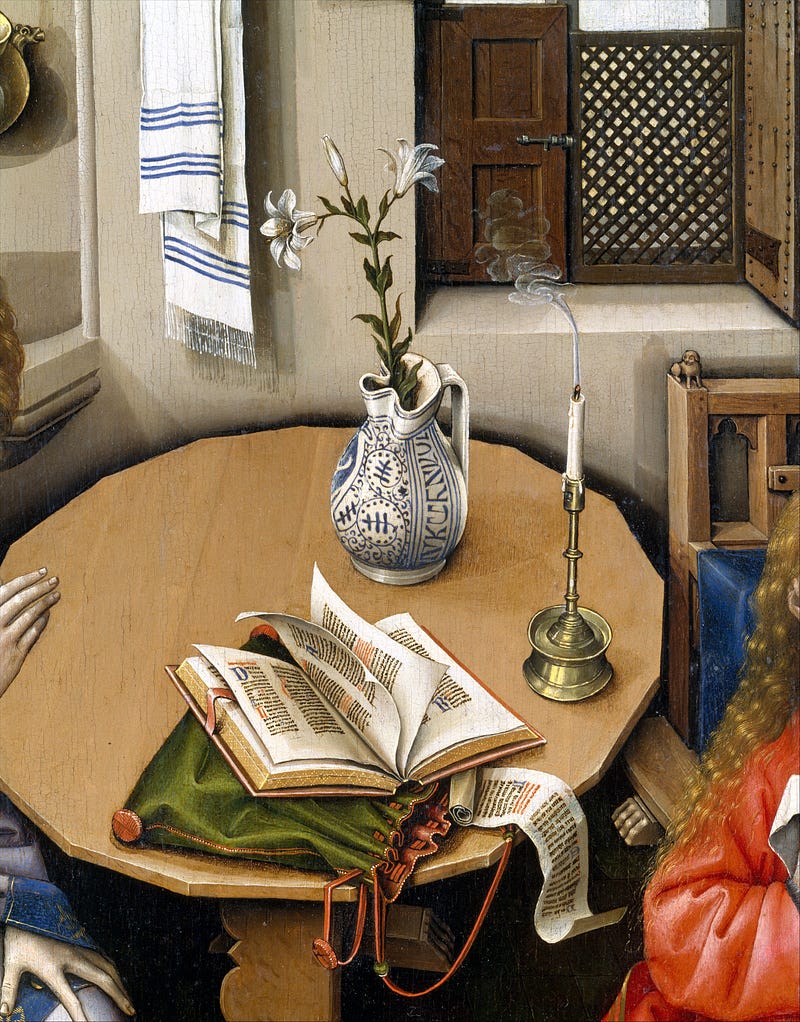
Details of central panel of the ‘Annunciation Triptych’ (Merode Altarpiece) (c.1427–32) by the workshop of Robert Campin. Oil on oak. 64.1 × 63.2 cm. The Met Cloisters, part of The Metropolitan Museum of Art, New York, U.S. Image source The Met (open access)

Notice on the tabletop a candle that has recently been extinguished: it is thought to signify the Holy Spirit (in place of the usual dove). In a brilliant piece of invention, the artist has drawn on the idea that the Holy Spirit descended to the apostles “like a puff of wind” — as some late medieval writers propounded.
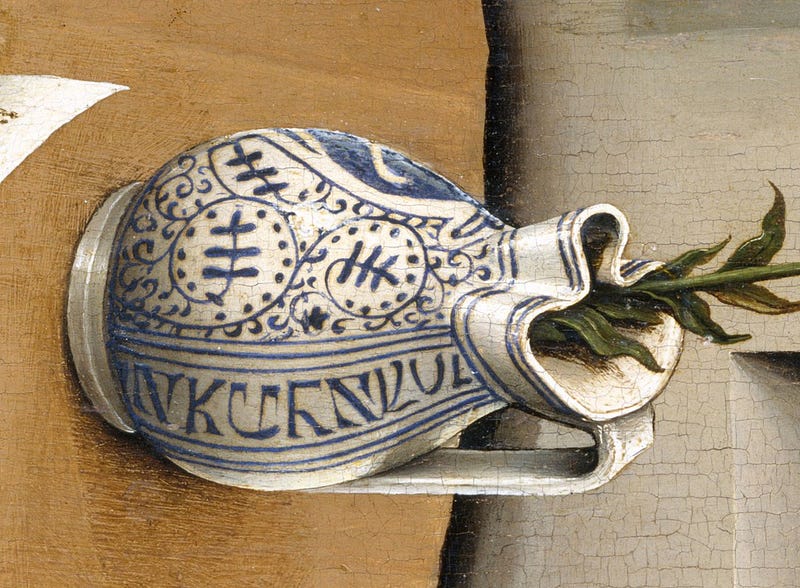
Detail of central panel of the ‘Annunciation Triptych’ (Merode Altarpiece) (c.1427–32) by the workshop of Robert Campin. Oil on oak. 64.1 × 63.2 cm. The Met Cloisters, part of The Metropolitan Museum of Art, New York, U.S. Image source The Met (open access)

Finally — among this plethora of signs — notice the jug on the table holding a lily, the symbol of the Virgin’s purity. The jug is decorated with a series of intricate markings, thought to be Latin and Hebraic letters that some art historians have decrypted as reading De Campyn — attributed as the artist’s signature.
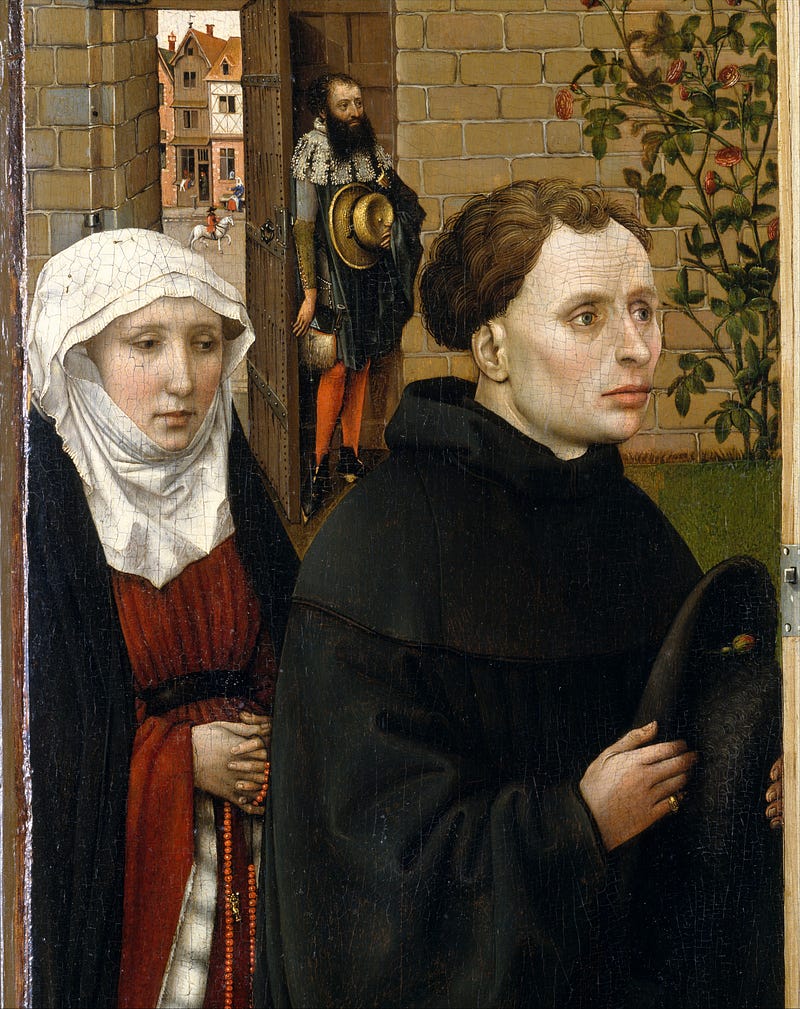
Detail of left panel of the ‘Annunciation Triptych’ (Merode Altarpiece) (c.1427–32) by the workshop of Robert Campin. Oil on oak. 64.5 × 27.3 cm. The Met Cloisters, part of The Metropolitan Museum of Art, New York, U.S. Image source The Met (open access)

And finally, the left wing of the triptych shows the donor — who probably commissioned the work along with the request to appear in the image himself. The painting shows him looking in at the Annunciation through a door. Beside him is his wife, and behind them at the garden gate, a town messenger ready to spread the divine news.

Annunciation Triptych (Merode Altarpiece) (c.1427–32) by the workshop of Robert Campin. Oil on oak. 64.5 × 117.8 cm overall (open). The Met Cloisters, part of The Metropolitan Museum of Art, New York, U.S. Image source The Met (open access)

One thing is for certain, this remarkable triptych was a hugely significant work in the development of Early Netherlandish art and is regarded as one of Robert Campin’s most accomplished and complex paintings.

If you liked this, you may also be interested in my book Masterpieces of Art Explained, an examination of some of art’s most enthralling images.

Would you like to get…

A free guide to the Essential Styles in Western Art History, plus updates and exclusive news about me and my writing? Download for free here.

Join me…

On Instagram for more great paintings on the go!

Art
Art History
History
Inspiration
Christianity
Recommended from ReadMedium