
The Sweet Spot of Conversation

I used to think the verbal conversation should be conducted differently in private and professional situation. In private situation, there are many different setup conversation between: parents-me, siblings-me, friends-me, neighbours-me, and so on. In professional situation , you name it: boss-me, older colleagues-me, younger colleagues-me, mentee-me, and so on. As an introvert with over-analysing habit, the idea of requiring slightly different communication with different people confuses me.
At the beginning of my career, I attended several different communication skills training: “Communication skill training” — that’s the actual name, “Presentation skills training”, “Influencing people”, and “Leading without authority”. I realise one thing that each of this training would like to teach me is how I convey my message to be heard; furthermore: for my message to be accepted. If it is such an easy skill to have and could be covered by these four trainings, I would not have the recurrent problems for any types of conversation. It is difficult to find the sweet spot of conversation.
I have read a lot of articles, books, and listened to podcast and TED talks, hoping there is one solution to find my communication style and to master any conversations I have. Of course it was not happening that way. I changed my strategy to audit my conversation history. Here, my journaling habit comes in handy: I went through the last five years journals and analysed my verbal conversations behaviour and results.
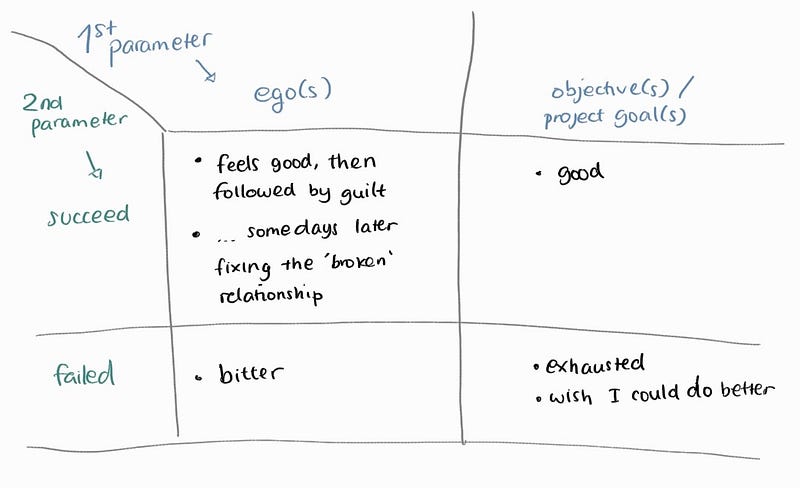
The first variable I set is my motivation, with the parameters:
- Fighting for my ego(s)
- Working toward the objective (e.g.: project goals)
The second variable is the outcome of the conversation, with the conversation result:
- Succeed: the decision made based on my input
- Failed: the decision made based on other’s input
Then I created the 2x2 matrix. For each conversation configuration, I found (not so surprising) feeling pattern I had after the conversations happened:
Ego(s) driven
Hard to admit, but there were some occasion that I have the motivation to fight for my ego(s), even when the conversation is conducted at work. There are several reasons why it happened:
- I was “failed” on the previous conversation so now it is my turn to prove I am the right one (~ revenge mode)
- The unproven self-statement that I am better than someone on certain topic (~ superior mode)
It is not surprising that fighting for my ego results in more emotional conversation than rational one. Assume that I “win” the conversation and get what I want, guilt will certainly come as the next guest. Automatically, I feel that I broke the relationship. Then comes the uncomfortable self-obliged task: to fix the relationship hoping that everything would be okay. On the other hand, though I was “lost” in the conversation, I am left with bitterness. That’s it. Nothing good come out of my ego(s) to have any conversation.

Objectives driven
Apart from getting older helps me to focus on objectives more, my profession also enforce me to drive the conversation based on the objectives. As an engineer, I use to work based on the data. Data can prove or disprove my ideas. But I learned through experience that the data itself is not sufficient. it is important to have the “why” besides the data.
“Why” + data = Objectives
On my early career, I was assigned to a new project. I did a thorough research to find out how I can implement this. Most of the sources comes from theoretical point of view and I did some prototyping of the software. I sat down on the project preparation meeting with other stakeholders. I felt I know it all, I will get their buy-in. After I presented things I’ve done, one statement I heard from the Marketing Manager had pulled my feet back to the ground. He agreed to some features I’ve defined but for one feature that I thought was cool, he said this, “That is a good feature. The reality is: customers won’t use it because they don’t need it.”
Most of the time, I would feel rejected when someone said something like that. But from the way he expressed his thought, I could genuinely feel that, “This software isn’t about me. It is about fulfilling customer requirements.” I blamed myself a little bit to not do enough research about customer requirements or perform any competitor analysis. But there is a reason why the company hire me as an engineer, and the marketing manager to work on the marketing stuff.
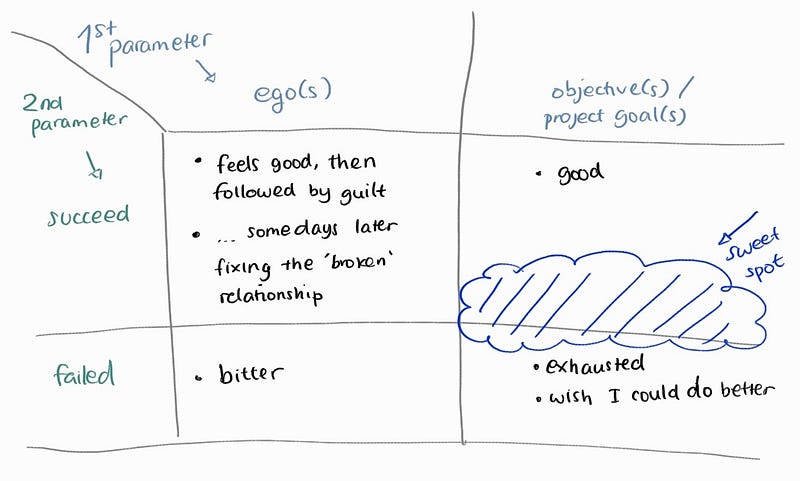
This is the sweet spot I learned: Conversation is about two or more people bring the best they have to the conversation. With all of these input, we agree what best solution could be. Different opinion or view should not undermine anyone’s skill, but it should enrich the objectives. Though it still might be a hard conversation with bit emotional and higher voice involved, people can sense if we are still talking about the objectives or our own ego.
The reason I brought this topic and share my experience because the insights I got from Dale Carnegie : How to Win Friends and Influence People. From his book, I found another way to understand the meaning of something (on this context: conversation / communication) from “failures” instead from the ideal situation or theoretical point of view. The book described a lot of case studies about communication that went well and wrong. It gave me the idea to check the real my own case studies.
Any other platforms to improve our communication skills are valid: training, webinar, books, podcast, coaching, etc. To really make a change and improve our skills, I believe we should not forget to revisit our current communication skills and make a strategy how to improve from that point. I hope you’ll have fun to find your sweet spot of conversation using think about your own conversation configuration matrix (or other format) and the parameters that matter for you : )
It takes guts and humility to admit mistakes. Admitting we’re wrong is courage, not weakness.- Roy T. Bennett, The Light in the Heart
Another recommendation to watch about communication / conversation: