The Surrogate Employer for Lifetime Employment
De-Employment as The New Normal
THE COMING OMICRON CRISIS
The world has triggered a race against time to contain and manage the spread of the new Omicron covid19 variant. More than 20 countries have recorded cases of the Omicron variant. However, scientists have yet to determine conclusively its severity, transmissibility, and impact on the efficacy of current covid19 vaccines. There is currently widespread speculation that Omicron may be more resistant to covid19 vaccines than existing variants like the Delta variant.
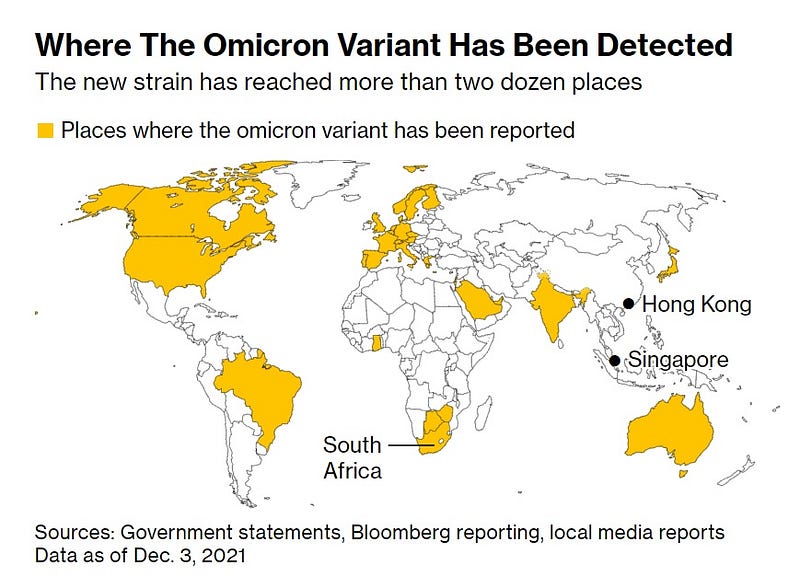
A least 70 countries and territories have imposed travel restrictions from several African countries following the Omicron discovery in South Africa early this week. Early research suggested that it could well have been in circulation as early as September-October 2021.
The World Health Organization (WHO) however cautions that “the prohibition of travel is not informed by science, nor will it be effective in preventing the spread of this variant”. It also admitted that the Omicron variant contains a number of genetic mutations, and has therefore a high likelihood of global spread.
WHO again — “The only thing the prohibition on travel will do is to further damage the economies of the affected countries and undermine their ability to respond to and also to recover from the pandemic”.
In Singapore, the signs of the looming Omicron covid19 crisis are already showing. The Delta variant has already dampened hiring demand. In June 2021, the Ministry of Manpower (MOM) polled companies to receive only a 64% response with plans to hire, down from 73% only in March 2021, just prior to the Delta onslaught. Omicron’s arrival is expected to create panic knee-jerked reactions to return to closed borders, curb travels, and further reduce economic activities.
Remember 2020? I have a strange sense of déjà vu of impending recession all over again — declining orders, falling sales, narrowing profit margins, increasing relative costs, inventory build-up, fewer competitors, fewer customers, and increasing difficulties in accounts receivables.
Embracing De-Employment as the New Normal
Given the demo-psychographics of the talents most susceptible and vulnerable to layoffs, de-employment becomes again the innovative, empowering, and integrative human resource management (HRM) solution best suited to manage talents long before their layoffs are deemed necessary.
I remember only vividly the unprecedented layoffs affecting mostly middle-aged executives with University degrees and Poly Diplomas, as well as other higher-skilled workers. Among them included skilled and experienced professionals, managers, executives, and technicians (PMETs), aged from as young as 40–49 years old. Most of them were also unable to find a job within 6 months of their layoff from early 2020 through 2021.
A NEW TALENT MANAGEMENT STRATEGY NEEDED
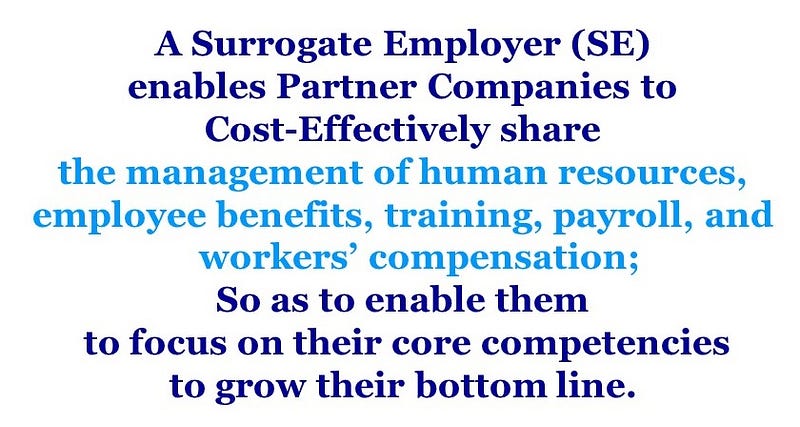
Companies facing high risks of layoffs happening, again, sometime in the next 6–9 months can manage the risks by adopting a strategy of de-employment. Embarking on the de-employment journey, the company prepares its employees as it enters into a joint-employment relationship with a “Surrogate Employer”.
A Surrogate Employer (SE) reinforces the corporate culture concurrently as the company engages the competitive forces that are affecting the business. On the one hand, the SE empowers the company’s recovery strategy by focusing on its core competencies to restore and grow its bottom line whilst pursuing vigorous costs reduction. On the other, the SE augments the company’s talent management team by assuming responsibilities for the strategic reconfiguration of its talent pool leading to whatever necessary re-calibration and re-sizing in order to service the increasingly challenging marketplace more successfully.
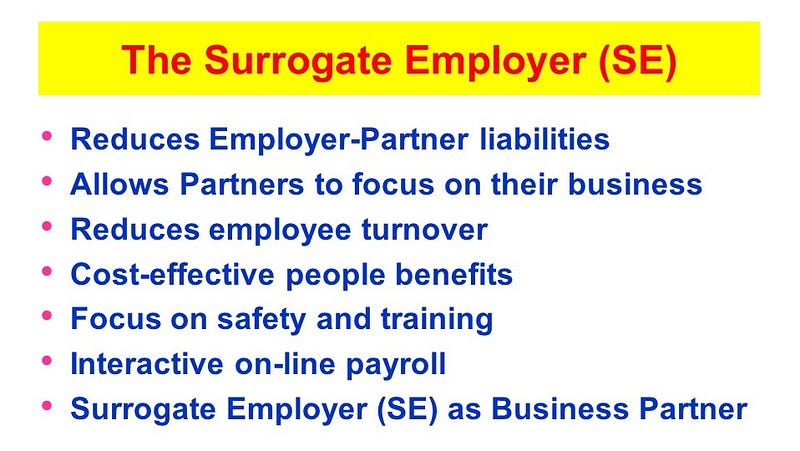
The goal of de-employment is business recovery with a particular emphasis on key talent retention, redevelopment, and excess talent deployment. Strategy and talent management are the twin challenges of the de-employment strategy. Strategy focuses largely on the external competitive space, and talent management in de-employment involves radical and fundamental internal organizational restructuring.
Organisational re-structuring aims at reducing layers and widening job scope through job re-design, job merging, job sharing, and jobs elimination. This deploys a lean thinking approach to eliminate wasteful cost drivers and, more importantly, the re-tooling of talent through re-skilling, redevelopment, and redeployment for and in anticipation of business recovery.
Important HR tools like a shorter workweek, wage/benefit cuts, working online/off-office, mandated vacation, and outsourcing workers to other companies can be attempted, but recognize that these are merely short-term measures that merely postpone the inevitable.
What is crucial in a de-employment strategy is to assure continual smooth business operations without the often-disruptive effects and morale-depressing sentiments from layoff exercises.
This means the transfer of the entire (or most of the) workforce — including a large number of prospective redundant and excess workers — to the SE, who is now tasked with the mission to assure continuous income flows, not necessarily at their previous levels, to those workers who are not needed by the company either on a full-time or part-time basis.
This way, the company can reduce its labor-related costs immediately by paying only for talents that it actually needs. The other redundant and excess talents are engaged by the SE to work in other companies.
The de-employment strategy promotes income assurance in the participating workers, instead of job security. Layoffs would be a thing of the past. They will be continually engaged rather than occasionally employed. Their works are assignments as they perform them not always at physical workplaces but at designated service hubs or centres, which may be virtual or through social media cyberspace or on the internet.
They are not controlled through adherence to some fixed reporting times but managed through agreed performance milestones or indicators. They also commit to at least 100 hours of continuous learning and development per year, so as to be empowered and eventually become truly independent to pursue their desired career experiences.
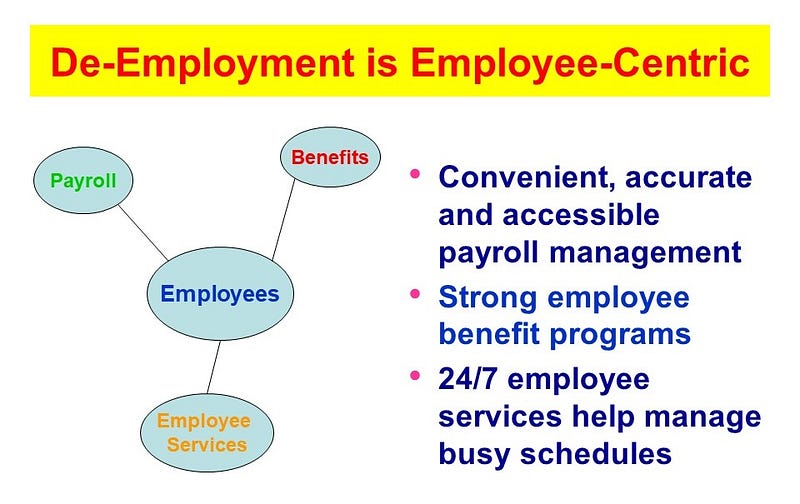
Companies participating in de-employment no longer worry about layoffs as bad times begin to rain. They retain their relevant key talent on a full-time or part-time basis as mutually agreed with the SE. Talents with flexible skills are able to work at more than 2 service hubs or centres to multiply their income streams. And they can work at their own pace and place without infringing the legal restrictions on working hours or working during holidays and rest days.
The SE is essentially a community of talents who are well educated, skillful, and experienced (like PMETs, for example). Their SE provides such portable benefits as CPF, medical, dental, vacation leave, and various other additional welfare benefits usually enjoyed by regular employed workers. They can seize available opportunities for multiple enhanced income streams from assignments to various SE clients. Their skill-sets are continuously revised, upgraded, and re-calibrated to ready them for future jobs which are yet unknown.
The crucial difference between de-employment and HR out-sourcing is that the SE is contractually part of the company as a business partner, instead of an outsourced labour contractor. The SE and the company have joint coaching and mentoring responsibilities for their talents. Their relationship entails regular feedback and communications with each other and with their talents.
In this manner, de-employment assures the sustainable relevance of talents to the companies. They are also co-decision makers with regard to talent engagement, deployment, and redistribution. Talents can be converted from de-employment status to direct employment status in accordance with agreed conditions.
De-employment is the best alternative to layoffs by maximizing returns on human capital and talent. Workers should not simply be discarded in layoffs as some useless garbage in a business downturn. For sure, surviving soldiers are not killed when battles are lost. Instead, they are systematically collected, re-organised, retrained, re-equipped, and re-motivated to await mobilization for the next battle that would hopefully bring forth eventual victories and success.
Corporate sustainability and business success depend on the strategic leverage of human talent. Leaders know that human talent is the highest and most decisive form of technology that makes the key competitive difference in sustainable strategy.
Please enjoy my recent Articles.
You can also subscribe to my stories and social media posts via your email.
Enjoy more interesting Articles by signing up to Medium here: https://thefuturistoracle.medium.com/membership