
The Surprising Reason Europeans Are so Much Happier Living in Cities than Americans
“Collision Spaces” make a town
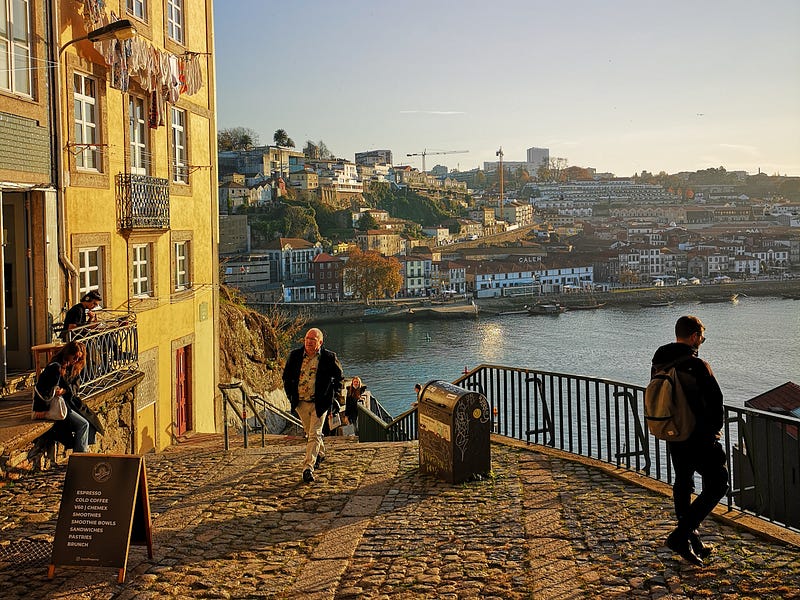
You don’t need data to figure out Europeans are happier living in cities than Americans — and happier in general — you just need to visit a European city.
But why? Why are Europeans so much happier in their noisy, busy metropolises than Americans who apparently fricking hate them?
I want to know. So I bugged all my European friends to see what their opinions are on the subject and I did a little digging around.
There is one surprising reason that comes up again and again…
Enter stage left the “Collision Space”
My European friends always tell me they love living in cities because they are like “big small villages.” You are almost guaranteed to bump into people each time you walk down the street which makes you feel like you belong. That you have a community.
These mini-interactions often happen in what my city planning friend calls collision spaces (not an official term so they tell me, but I love it so I’m running with it).
A collision space does what it says on the tin — it’s a space where you can literally bump into people you know.
If you lived in Stars Hollow with the Gilmore Girls, your collision space would be Luke’s Diner. If you were in Friends, it would be Central Perk. Cheers? Well, it would be…Cheers, obvs.
IRL, collision spaces don’t have to be bars or cafes — often they are just out on the street.
When I lived in Logroño in northern Spain, I had a friend who couldn’t walk 100 meters before she bumped into someone she knew. After a few months, it started to happen to me too. One night my husband and I went on a tapas crawl down the town’s central street. At the beginning of the night, there were just two of us. By the end, we had bumped into so many people, we became a party of 12.
The way European cities are built encourages collisions because they are designed around squares and plazas. Most importantly, these squares are still places to have a drink, a snack, a chat. Live longer than 6 months in any city in Europe — even big’uns like Barcelona or Berlin — and I dare you to not collide with someone you’ve met elsewhere in the town whilst you go about your daily business.
Take away collision spaces — or don’t design them in the first place — and you take away the opportunity for these essential micro social interactions, made even more important by the fact that they occur in a public space. As this article offers:
Sociability is the basis of many of the cultural activities and events that make life on the square joyful and meaningful. In these sociable interactions people do not encounter each other in terms of specific roles, for instance, employer-employee, or cashier-customer, but as complete human beings. The status of each, their social or economic position, knowledge, or fame is not as important as personal qualities, graciousness, cordiality, and charm.
Nice, eh.
American suburbs make collision spaces impossible
Whilst Europe kept compact, America built out. The sheer size of the country means urban sprawl is possible — now over half of America’s population lives in suburbia.
Think about the average suburban American town and you’ll probably imagine rows upon rows of houses. Demarcated lines fencing off single-family homes. No stores, restaurants, or bars within walking distance meaning a car is not just a nice-to-have but a necessity.
Most importantly, when you’re faced with row upon row of housing and nothing else, there are no collision spaces. No plaza to walk through on the way to the market, no thriving coffee shops.
It’s not just America. Much of the UK is similar to this too although to a smaller extent. My parents live on a housing estate with no amenities and have to walk 20 minutes to the nearest collision space (but at least they have sidewalks).
Suburbs = no collision spaces. No collision spaces = no chance for micro-interactions. No micro-interactions = a whole lotta sad, lonely people. That’s not just me talking, that’s the data:
According to the ONS, those who felt out of touch with their neighbourhood also reported feeling lonely either “often” or “always”.
And therein lies the rub. American cities are not built with human interaction in mind. They used to be but now, the car is King and it rules city planning.
Not so much in Europe.
THIS is why I love Europe so much
It’s eluded me, the reason why Europe tugs at my heartstrings so much in a way America or the UK never has been able to.
The more time I spend in continental Europe, the more I realize — it’s because Europe encourages community and human interaction. And collision spaces allow an outsider like me to participate in that community.
It’s a quick hey how are ya to the guy who has been serving me wine for the last few weeks as we pass each other on the river Douro in Porto.
It’s the bumping into another traveler I met at an event in Split as we stand in line for coffee in Zagreb.
It’s sitting on a square, face to the sun, as a friend passes by and sits with me for a few moments in Spain.
It’s the hundreds of micro-interactions that happen with people I know well — and not so well — that makes me feel part of a community, even if it’s only temporary before I move on to my next adventure. And these interactions only exist because there are spaces specifically designed for that purpose.
Live there, and those collision spaces become even more vital.
Collision spaces make me happy. They help to make Europeans happy. They facilitate what every human on earth needs — human interaction.
Take them away and take away the soul of a city.
Sign up to Simple and Straightforward for essays, reading recommendations, and waste-reducing recipes to help you live more simply, slowly, and sustainably.