
The Subtle Art of Getting Good Feedback (Exactly When You Need It)

Everywhere I go, people are talking about feedback. The conversation echoes across workplaces, classrooms and in every kind of personal growth book, podcast and article.
Feedback is like fertilizer for humans. We need a lot of it in order to grow. Unfortunately, there never seems to be enough of it around and, when there is, it’s often not the right kind.
As an ex-research academic and writer, I’m used to getting a lot of feedback. As a learning design specialist, part of my day job is to think about how and when students should be primed to get it.
You could say I have feedback on the brain.
When you start to dig into it, there’s a lot of nuance around how to get good feedback. For example:
- What type of feedback do we need and when?
- Who gives good (or bad) feedback?
- What flavour of feedback do they offer and how is it useful?
- What is our relationship to the person who gives us feedback?
- How do we feel about the feedback we get and what does it do for our ability to digest it?
I want to explore the emotional rollercoaster that is getting feedback, and see if we can unearth some helpful advice in order to ‘do feedback well’.
Let’s start by getting to know the 3 horsemen of feedback a bit better — the cheerleaders, critics and coaches.
The fellowship of feedback
I was chatting with a writer friend of mine a while ago when she landed me with this question:
‘I can give you feedback on your new story, sure, but who do you want me to be? Your hype person, a ruthless art critic or an expert advice giver?’
A recent interview by Adam Grant reminded me of this [source] when he spoke about the 3 types of feedback givers:
- Cheerleaders
- Critics
- Coaches
He argued that coaches are the wizards of growth. They’re the feedback givers that really matter. As well-meaning as the others might be, cheerleaders and critics get in the way of good feedback.
This isn’t wrong, exactly, but I suspect it’s a bit more complex. I think all feedback givers bring something unique to the table and perhaps we shouldn’t dismiss the other two quite so easily.
Who are the cheerleaders, critics and coaches?
As my writer friend alluded to, we are capable of slipping on any of these feedback-giver hats as the circumstance dictates.
As a friend, I might be a cheerleader, rooting from the sidelines but I’ll activate critic mode if a product I’ve paid good money for doesn’t meet my expectations. When it’s about my day job, I put on my coaching cap, dishing out nuggets of wisdom crafted through hard-won experience.
Certain roles can overlap too.
A friend with experience might switch between cheerleader and coach as the situation demands, but this reality can blur the question of who we should be getting feedback from.
The table below gives an example of what I mean here.
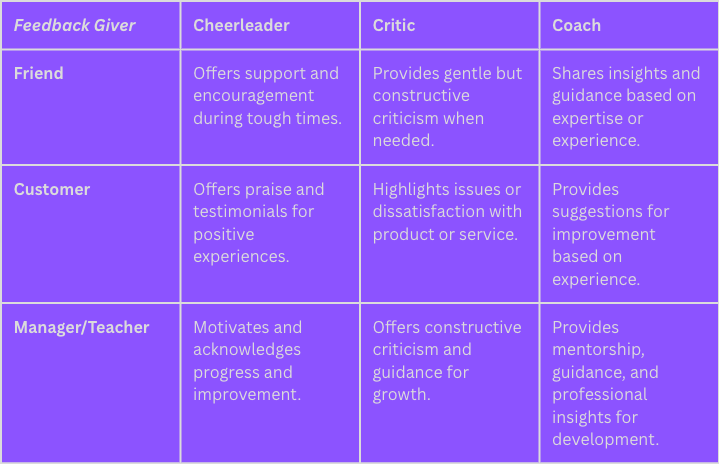
When we begin to peer behind the curtain, feedback starts to seem as much about relationships and feelings, as it is about stone-cold facts.
It highlights something that tends to get overlooked when we talk about getting feedback — the role of emotions.
Emotions influence the feedback we need (and the feedback we get)
Maybe talking about emotions when it comes to getting feedback rankles with some of you. Adam Grant certainly focused on getting feedback as transactional and, seen in this way, coaches definitely give the most bang for one’s buck.
Sure, there might be some wiggle room for feelings between those who extol the virtues of ‘tough love’ compared with people who prefer a softly-softly approach, but it still boils down to this: expert advice goes in and an improved skillset comes out the other side.
But think about your own experience for a moment.
How did you feel the last time you were up for a performance review at work? What was it like when your personal trainer friend suggested that skipping your mid-afternoon chocolate bar once in a while might be a good idea?
There’s something very emotional about getting and giving feedback.

Fear seems to be a pretty common emotion associated with it. There’s no end to well-meaning advice suggesting that we have to feel the fear and do it anyway and, getting feedback, is indeed a scary thing. It’s uncomfortable precisely because it can feel like we are staring into an abyss of uncertainty and hope.
But I’d argue that getting feedback runs the full gamut of the human experience.
It’s the anxious husband, worried that the dinner he lovingly made will have his family reaching for the curry-house takeaway menu, who feels intense relief when his wife says she wouldn’t mind if he made it again next week.
It’s the student overcome by feelings of anguish as they wait on exam results and the crushing shame that comes from realising they didn’t do as well as they’d hoped.
It’s the employee raging behind the back of the idiot manager who clearly has no idea what they’re talking about when they politely make suggestions for improvement during an annual performance review.
Feedback has the power to make us feel guilty about our failings or proud of our achievements. There is some evidence for this. One small study of university students in Australia found that feedback between students and lecturers aroused no less than 10 different basic emotions and a cornucopia of more nuanced ones. [source]
Emotions can hit us hard when we are the giver of feedback too.
Most people don’t particularly enjoy doing it, even when they view giving negative feedback as part of their job. One study found that 44% of managers said they found giving negative feedback stressful or difficult [source].
It’s understandable, isn’t it?
Who wants to be the bearer of bad news? It’s why the old complement sandwich (nicety — critique- nicety) is so popular amongst managers and teachers. Makes the whole unpleasant business easier to swallow.
To add to this thought, consider the idea that we might be open to even the toughest feedback so long as we’re primed to receive it.
I used to go to this spin class where the instructor would scream at us for 45 minutes to go faster, climb harder, and sweat more. Strangely, I loved it, but in another mood, I could imagine telling the instructor where to stick his sprints and climbs, and walking out in search of a gentler guide.
So mood can influence the type of feedback we reach out for, which in turn affects what we get and when we get it.
But what about our relationship with the giver of the feedback? How we feel about them greatly influences whether their words resonate or fall on deaf ears.
Trust can alter the value of the feedback we receive
I have a deeply ingrained instinct to distrust positive feedback. Whether it's a cheerleader, critic or coach, if someone showers unilateral praise on my efforts, my brain dances with suspicion. The voice in my head will argue that this person mustn’t be as clever as I thought they were because they haven’t seen through my nonsense or else they are just a really nice person who doesn’t want to hurt my feelings.
It’s not only the sunny side of feedback that can have us questioning the motives of others.
Criticism from strangers on the internet? That stuff might reasonably be greeted with a side-eye until it can be backed up with additional evidence.
So, trust also appears to be tied up with our emotions which, consequently, affects how we listen to the feedback we get.
I’ve witnessed students go from zero to boiling point at the suggestion that they might need to tighten up their research a bit. Despite my years of experience, they slammed the door on my feedback, writing it off as the result of me ‘not liking them’ or having a narrowly focused disinterest in their point of view, neither of which was true.
I didn’t take it personally. I get it. It’s painful to work hard at something only to be told that it could be better. For the most part, once these students had a chance to cool off, they’d see that I wasn’t out to get them, but I was often left wondering if the damage was already done.
Our radar for the quality of the feedback we get and, consequently, what we do with the information, can go haywire if we develop a deep mistrust of the messenger. We can reject the message, even if it’s a good one. Equally, if we are particularly fond of the person in question, we might be inclined to inflate the good stuff they tell us [source].
Our gut feelings tend to call the shots over our rational judgment which can lead us to reject good advice and accept bad suggestions.
We can’t side-step the question of trust either. We need feedback precisely because we lack the knowledge necessary to judge the quality of our actions on our own. We have to trust that the feedback giver has either the experience or clarity of vision that we ourselves lack.
We arrive at a place where the act of asking and getting feedback is driven by our emotions, and our willingness to hear and act on the advice is led by our sense of trust in that person.
Which begs the question: where does this leave us?
Can our emotions steer us wrong when it comes to feedback?
Maybe.
I can easily see myself trusting someone I shouldn’t because the feedback is soothing- even if it’s not all that helpful. The kicker, for me, is that I’m not convinced that this is necessarily a ‘bad’ thing.
At the beginning of this article, I said I thought that all 3 types of feedback givers had a unique role to play and that we shouldn’t dismiss the cheerleader and the critic simply because they lack the coach’s diagnostic expertise.
If we think of our emotions as little brain signals guiding us towards something, maybe they can lead us to the right sort of feedback, right when we need it the most.
Imagine you’ve been grinding away at a project for ages. You think you know what you’re doing but you also feel demoralised and there is just sooo much work still to do. A friend, whose vibes align with your own, comes along and praises your work with a well-placed ‘go, get-em, tiger,’ and, hey presto, you’re feeling good and back on track.
However, it’s not difficult to think of a scenario where this could go wrong. What if you’re fishing for an honest appraisal of your work, but instead of a straight-talking critique you get a roadmap for change, leaving you confused and headed straight for frustration central?
So how do we get (and listen to) the right feedback at the right time?
So we’ve identified the three types of feedback givers, seen how our emotions can steer us rightly or wrongly towards the sort of feedback we want and we’ve learned how trust issues can sneak their way in and prevent us from taking appropriate action in a way that could serve us well.
So what do we do?
It’s no walk in the park but before you ping someone for feedback, take a breath and ask yourself a few questions first:
- What sort of feedback do I need right now? Am I seeking an attaboy or a blueprint for my next move?
- Who am I going to ask?
- Do I trust them and is it reasonable for me to do so?
- How is getting feedback hitting me emotionally? Am I likely to Hulk out if I hear something I don’t like or will I be relieved that someone has given me a roadmap to follow?
In their book ‘Thanks for the Feedback’ Douglas Stone and Sheila Heen offer some useful techniques for managing our emotions as we navigate the path towards feedback. Identifying our triggers, delaying our reactions or engaging in self-reflective exercises can help us to create distance between the feedback we receive and the feeling we have around it. This seems like pretty good advice to me.
There are no guarantees though.
We might still fall foul of bad advice or throw away the good stuff. It’s human nature to occasionally tune into voices that will lead us astray. But if we’re mindful of what we want from feedback, and if we can understand how our emotions and trust play their part, then we can set a course towards getting good feedback, exactly when we need it, even if we don’t get it right all the time.