
TALES OF A CODING FACTORY
Coding Factory In The 2000s
Not bad in theory, but a nightmare in practice
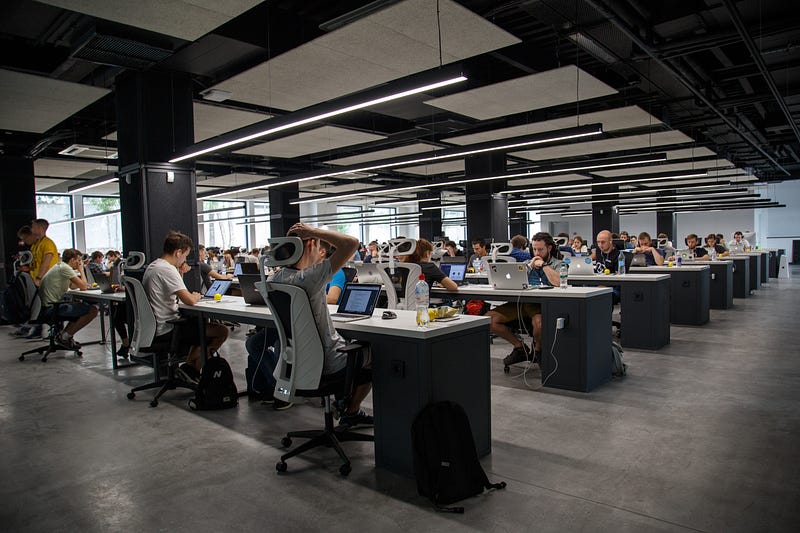
A coding factory, what a brilliant idea.
Imagine this: the analysts are located in another country state. They do all the design beforehand — I mean, ALL of it: Classes, methods and their arguments, variable names, the business logic — everything is beautifully represented with UML diagrams (Unified Modeling Language: do you remember?).
The design is sent to the coders located in another place with less tax and a cheaper cost of living, which translates to smaller salaries.
Many of them are interns and programming for the first time —after all, it’s just about interpreting the diagrams and writing the program.
All (or at least most) work is planned initially and executed with supervision later in building construction and factories. Why can’t such a model be applied to Software Development?
Not bad in theory
AlteresIT had the same question and put it to the test. A company located in St. Lauro, Brazil. They partnered with the public sector and SmartTech, a private, multi-billion-dollar company from the US. The goal was to become a centre of excellence and grow the IT sector in the small town.
The coding factory belonged to SmartTech and was located inside AlteresIT. It was more or less a 100 sq/m room, separated and restricted from other areas. Not everyone could go in; only those with a badge used to unlock the entrance double glass door.
There were multiple cameras inside, no internet connection for the developers — anything necessary to guarantee that the customers’ code is safe — this was a major selling point. The room was shared between Java and Cobol developers, and the manager would sit in the room’s corner.
There was only one computer with access to Google outside the factory. Because: why would anyone need Google when everything is already designed in detail?! By the way, before I forget. The month/year was March/2005 when I joined.
There weren’t many social media websites, or at least it was not a thing. I recall the search engine Altavista was still being used alongside Google! And definitely, there was no StackOverflow. I had one of those flip phones: small, could make calls, text, play snake, and other cool features.
Nightmare in practice
While the idea of a coding factory may not sound bad on paper, what would unfold in the following months would prove the opposite: incomplete design, tight timeline/late delivery, budget overrun, countless hours of overnight work (24 or even 42 hours straight), 33 pounds weight gain, no weekends — to sum it up, a disaster.
It wasn’t all bad, though, I must say. Luckily I didn’t have a family (wife and children) and lived with my parents. It was my first job with programming, and I was learning tons. And there were times I had fun.
I don’t know what’s the deal with working night shifts that make me happy (My wife can’t stand when I say such nonsense), at least while I’m doing it, not so much in the next day or the long term. To add, it was the place where I met the love of my life, my wife and the mother of my son.
During these nights, it’s like everyone is on drugs in some weird way. No one thinks straight; anything is a reason for laughing; it’s mad. Unfortunately, this state of mind comes with consequences, and it’s no surprise: many bugs are also introduced, test data is deleted, and tables are inadvertently dropped.
Sigh..what can you do? I blame the management.
For further reading:


