
FREELANCING
The Strategy I Used to Make $12,000 Freelancing Part-Time On Upwork
Getting hired for jobs you would’ve never thought you could land

Remote work is heating up, which means now is a great time to freelance on Upwork.
I started freelance copywriting at the beginning of 2020 as a side hustle. So far, I’ve made over $12,000.
Factor in the total amount of time I’ve worked and it averages out to $12,000/month.
Along the way, I’ve landed clients way out of my resume’s league, including a nine-figure aerospace engineering company and a multinational biotech corporation.
I’ve gotten these opportunities using a simple strategy I’m going to share below. Whether you’re a writer, artist, programmer or consultant, my framework will help you start snagging Upwork gigs immediately.
I’m satisfied with what I’ve made so far as a side hustle, but the truth is you can use my tricks to 10X what I’ve done.
Understanding Upwork
Before we go any further, absorb this nugget of info:
On Upwork, the only thing most clients care about is if you can get the job done. Resumes be damned.
That means as long as you’re skilled at your craft, you can get hired for jobs you would’ve never thought you could land.
How to Get Hired
Step 1: Target job listings with specific details about what the client needs.
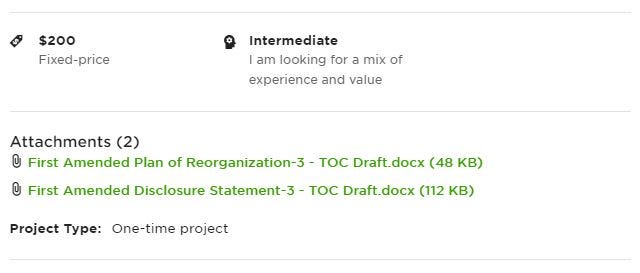
Hint: look for listings that include attachments or links to the client’s website.
These often give you access to all the information you need to do the job ahead of time, a vital component for the next step.
Step 2. Use this information to complete a part of the assignment.
If they need a blog, write the first paragraph. If they’re hiring a graphic design logo, complete an initial sketch. If they’re looking for a programmer, code a portion of their concept.
Step 3. Submit your work as part of your proposal.
In your proposal, include the following:
“I’ve gone ahead and completed the first part of [assignment] — you can see it at this link [insert Google Doc link]”
Step 4. You’re hired!
Now obviously, this strategy doesn’t guarantee you’ll get the job.
But doing part of the work ahead of time drastically increases your chances because it shows the client exactly what they’re getting by hiring you.
This significantly lowers risk and uncertainty for the client, making your proposal instantly attractive.
The best part is that 99% of freelancers aren’t doing this, which means it’s easy to gain the upper hand if you’re willing to do the extra work upfront.
Last month, I used this strategy to land a multinational biotech client despite having zero science background on my professional resume.
How?
First, I analyzed the objective: to turn dense biotech research into blogs.
Next, I analyzed whether I was capable of completing the task.
While I’ve never worked in a science-related industry, I knew I had enough natural interest in science to turn technical information into simple words.
Conclusion: I knew if I was given the chance that I could do the job and do it well.
So I drafted a sample paragraph and outline for a blog and sent it as part of my proposal, along with several writing samples from previous works.
A few hours later, I landed the gig at $60/hour.
“But That Sounds Like Too Much Work…”
Yes, I’m advocating you do a lot of work for free without any guarantee you’ll get the job.
But even if the client doesn’t hire you, your work is never in vain.
Why?
Because you can add it to your portfolio and use it in future proposals.
After submitting 50+ proposals in the last six months, I’ve built up an extensive showcase of writing samples.
My portfolio now covers 10 different styles spanning 20 different industries, and I include it in every proposal. It shows clients I have a versatile skill-set that can be easily adjusted to fit their needs.
A Great Strategy For Every Stage of Your Upwork Career
Earlier I said that most Upwork clients could care less about your resume.
This is 100% true regarding your professional resume.
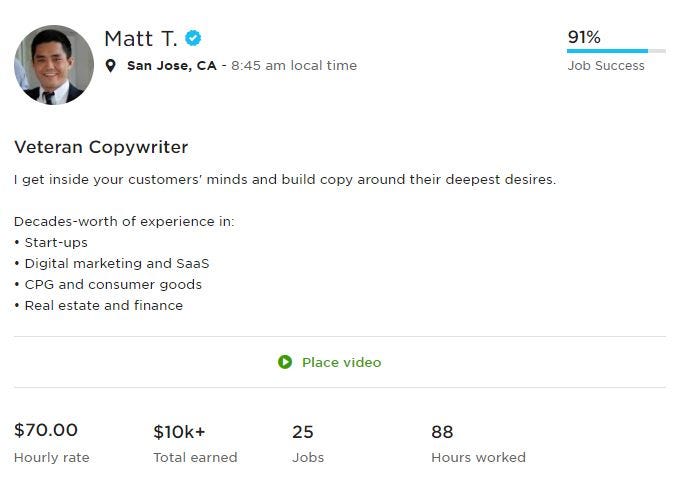
However, there is a resume you have to pay attention to — your Upwork resume, AKA your Job Success Score, and reviews.
Clients (especially those new to Upwork) do factor in these metrics when hiring.
The good news is that even if you’ve picked up a few bad reviews, this strategy still works. In fact, it may be the only way to save your profile.
A few months ago, two clients left negative reviews for reasons I still don’t understand. My Job Success Score dropped to 70% and I had trouble landing new clients.
I knew if I wanted to continue freelancing, I had to make my proposals truly stand out.
So I doubled down on my strategy, submitting proposals with detailed outlines and entire pages of copy.
It worked. I landed two new clients that week, over-delivered on their needs, and got the reviews I needed to climb back to an 80% Job Success Score.
Moral of the story: no matter where you’re at in your Upwork journey, doing the work ahead of time is always a good idea.
Happy freelancing.

- Subscribe to Storius Direct to receive articles like this to your inbox
- Subscribe to Storius Digest to receive a weekly digest with links
Elsewhere: LinkedIn • Facebook • Instagram • Twitter • Flipboard