
The Strategy Consultant’s Way to Counter the Corporate HIPPO (Highest Paid Person’s Opinion)
Good decisions should be based on facts and figures rather than individuals’ opinions

Have you ever felt the frustration of lousy decision-making at work? Choices that revolve around the decision maker’s interests rather than on facts and data?
I have. Many times, as a consultant, project manager, and release train engineer.
I was in the trenches with my colleagues. We did analyses and had ideas. We knew more than our higher-ups.
Yet they ignored many of the facts for political reasons, which is another way of saying for personal interests or power plays.
This happens a lot in companies or social circles.
It works because humans gravitate towards a leader figure. We follow authority.
At work, that’s typically the highest-paid person’s opinion (HIPPO). Or, it’s the loudest individual in the room.
If you’re fed up with this, here is how to assert yourself in 2 steps:
- Figure out the answers to the real problem
- Communicate it using the pyramid principle
Let’s dive in.
How to Recognize and Solve the Real Problem
We over-rely on our expertise and jump to conclusions. It leads to solving the wrong problem or only parts of it.
Why? Because we always want to conserve energy, we tap into our experience even in new situations.
If you’re a hammer, every problem looks like a nail.
For example, imagine you are in a retail business. You’re losing customers even though you’re spending more on ads. You need to figure out why this is happening and how to get their customers back.
Typical mistakes managers make in this situation:
- Jumping to solutions without proper analysis
- Focusing solely on financials
- Blaming external factors only, such as market conditions or competition
- Resisting change
- Groupthink: everyone in the meeting agrees with a proposed solution without critical evaluation
- Neglecting frontline employees’ input
- Not focussing enough on customer feedback
How to analyze the problem
Do the uncommon thing: Approach the problem with an open mind and fully understand it before discussing solutions. Ask the right question. Start with broad, open questions and then narrow them down.
Here are a few examples.
- Ask competition-centric questions such as: What have our competitors been doing differently, and how might that affect us and our customers?
- Ask customer-centric questions: What’s new about our customers, and what do they want compared to two years ago?
- Ask questions about internal processes and resource allocation, such as Can you tell us more about how our ads have been working?
- Ask why as often as needed to get to the proper depth
- Ask for examples
- Ask hypothetical questions such as What if we start using more online ads and social media for our marketing?
- Gather your findings in a problem statement to keep an overview, such as using the TOSCA framework.
- Frame a core problem statement: How can we increase our market share by 10% by adapting our marketing strategy to align with current customer preferences and digital trends within the next six months?
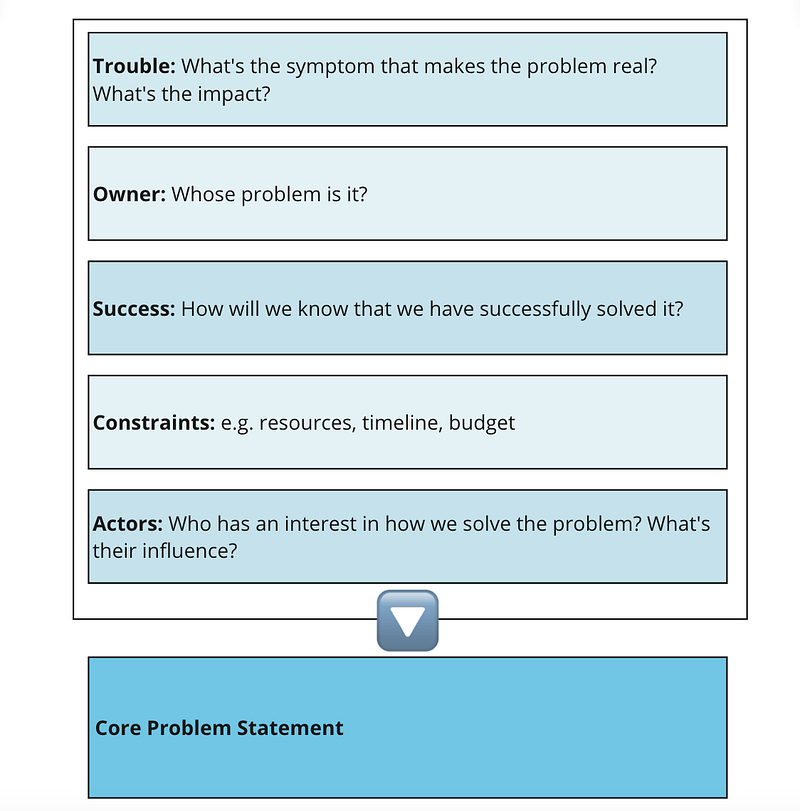
Structure the core problem
Once you have defined the core problem, make it manageable. Break it down into more minor questions you can address individually.
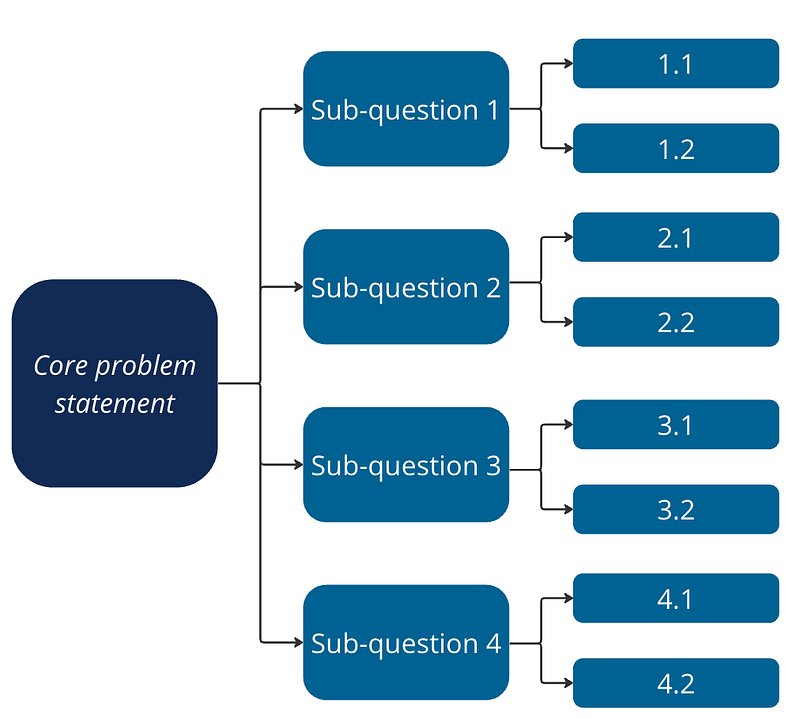
For example:
- How have our current customers’ preferences evolved over the past two years?
- What preferences do new customers have?
- How can we adjust our existing offers to address new customer preferences?
- How can we create new offers to address new customer preferences?
- How can we communicate our offers more effectively?
- What new competitors have entered the market?
Synthesize a solution
Make a plan to answer these questions by defining 3 things:
- What analysis do I need to answer this question?
- How or where do I find this information?
- How much time do I need to conduct the analysis?
For example, you want to answer question 1: How have our current customers’ preferences evolved over the past two years?
- Needed analysis: customer needs analysis
- How: customer survey and 10 in-depth interviews
- Time needed: 1 week
You now have a clear plan that you can easily communicate.
Once you have conducted all analyses, you synthesize a proposal. This means you rank the identified ideas or action items based on their benefit and effort.
For example, let’s say your analysis shows that you have 3 options to solve your problem:
- Expand to a new region
- Spend more on ads
- Develop an app for your customers
You estimate each option's effort and benefit and attribute a number between 1 (low) and 10 (high) to compare the options.
For each option, you then calculate the ratio of benefit to effort. The higher the ratio, the better the option.
You can use a simple 2x2 matrix to visualize this.
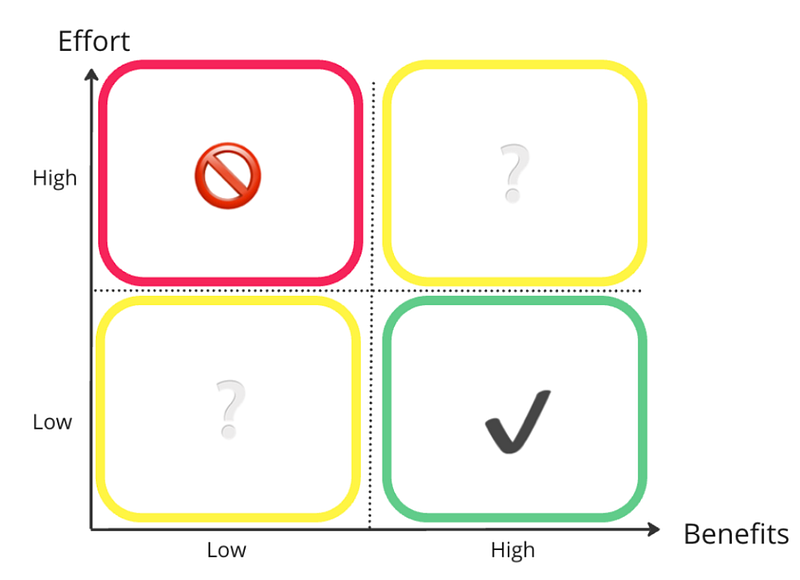
For example:
- Expand to a new region: effort 8, benefit 5, ratio 5/8 = 0.63
- Spend more on ads: effort 3, benefit 2, ratio 2/3 = 0.67
- Develop an app: effort 6, benefit 6, ratio = 6/6 = 1
This would give you the following ranking:
- Develop an app
- Spend more on ads
- Expand to a new region
However, having clarity on the situation is only half the battle.
Your idea is worthless if you can’t package and sell it.
Communicate Your Ideas Like a Pro Using the Pyramid Principle
People looking for information are different from readers of a crime novel. They don’t care about your ups and downs.
That’s why journalists learn, “Don’t bury the lede.”
Instead, start with your key message and support it with facts and figures in a logical structure.
Why?
Because the mind speaks in pictures. People can better understand and remember ideas if they’re organized around a logical structure.
People create visual images to accompany their inner speech even when they are prompted to use verbal thinking.
Think of stars. For millennia, people have seen nearby stars as outlines of figures instead of just points of light. These patterns make it easier to memorize constellations.
Barbara Minto’s Pyramid Principle gives you a blueprint for it.
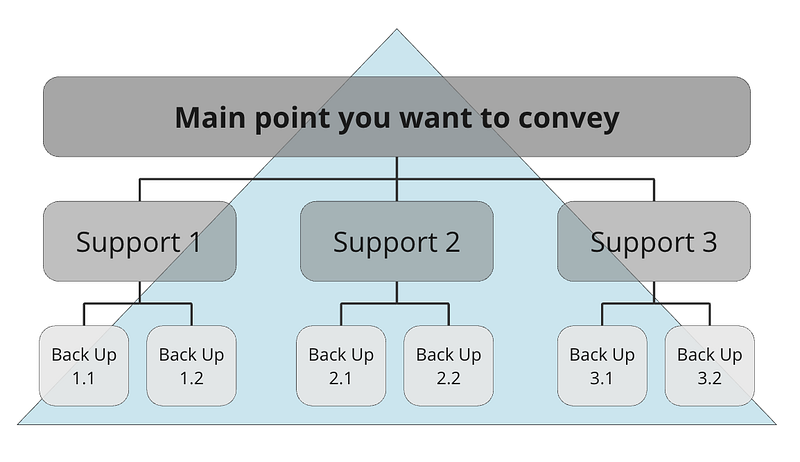
For example:
Main message: We should offer an app for our customers to address the younger generation effectively.
Support 1: Our customers demand an app as they increasingly shop online
Support 2: Our competition has a solid online presence. Hence, we risk losing customers if we offer a different service.
Support 3: We have the resources to build a great app.
You can then show the results from your research, including surveys, market trends, competitor analyses, and feasibility studies, to support the supporting arguments.
You can use the pyramid principle for long-form presentations or short elevator pitches.
The top-down structure is always the same. You only vary the amount of details you add to your supporting arguments.
Key Takeaways
Creating influence has 2 components. Effective problem-solving and communication.
When you face a HIPPO at work, you need to be prepared. Whatever the topic is, these 3 steps will never fail you:
- Frame the right problem
- Dissect the problem into smaller components
- Solve each component
Then, when it comes to communication, you must catch and keep your listeners attention.
Normal attention spans are short. Managers’ attention spans are half of that.
The pyramid principle is your blueprint:
- Start with a strong main message
- Support it with a logical structure of arguments
- Use facts and figures to back up your arguments
You can use this structure for long-form presentations or short elevator pitches by adjusting the amount of details you add to each argument.
Get a free copy of the Problem-Solving Playbook: Lead & Succeed!


