
The Stranger — Albert Camus
A brief review
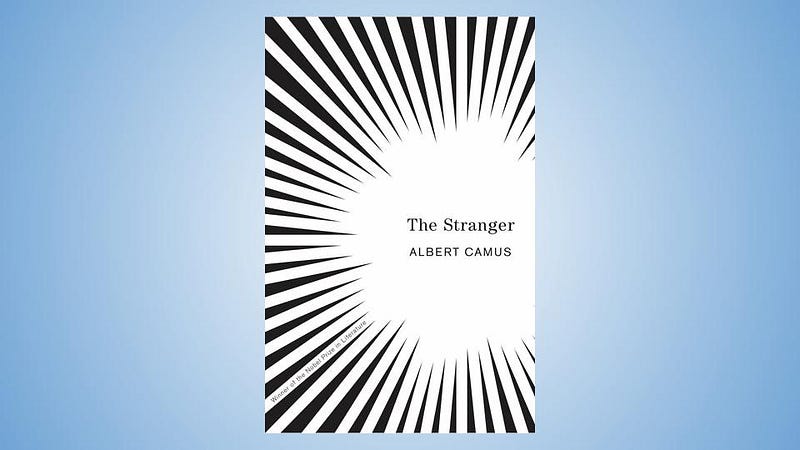
My first encounter with The Stranger was in high school. It was part of a literature project that entailed books by Albert Camus, Nigel Barley, Claude Lévi-Strauss, and other writers who devoted their careers to the untrodden and unorthodox, not only philosophically, but also culturally and geographically. Back then, in my late teens and primarily concerned with finishing the book on time, I ploughed through it without absorbing the deeper philosophical concepts that this novel so beautifully portrays. Now, stuck at home in the midst of a global pandemic and plenty of time on my hands, I decided to revisit this classic again.
Throughout the book, Camus’s philosophical tenets of absurdity and existentialism are clearly shining through. In essence, absurdity here refers to humanity’s futile attempt to impose meaning and rationality on a meaningless and irrational universe. This concept is reflected by the behavior and thoughts of Meursault, the main character in the novel. His external world is governed by emotionless observations of his physical surroundings, albeit sometimes quite detailed in nature. This becomes clear after the first two sentences of the book: “My mother died today. Or maybe yesterday, I don’t know.”
Moreover, he does not seem to find particular joy in anything other than the scent of flowers carried by a light breeze on a warm summer evening. His internal world, his thoughts leading up to his actions, are completely disorderly and irrational, eventually causing him to commit a random act of violence on a beach outside of Algiers and, later on during his trial, stating the unbearable heat of the sun as the reason why he did it. Here, Camus’s existentialist views are coming to the forefront. Existentialism refers to the experience of individuals as free and responsible agents through their acts of will. It also emphasizes that very few, if any, actions are void of negative consequences, as the physical world is indifferent toward humanity.
The meaninglessness of human life is deeper explored after Meursault’s arrest. Camus argues that life has no purpose and that death is the only certainty in life and, because eventually all humans will have to face it, all lives are equally meaningless. After accepting this fact, Meursault understands that it does not matter whether he is executed now or dies of a natural death 20 years later. This realization seems to liberate him from false hopes and his fantasies of escaping execution, enabling him to finally be content with life and make the most of his remaining days.
Finally, The Stranger reflects Meursault’s predominant interest in the physical world, showing very little emotion throughout. During his mother’s funeral, he doesn’t shed a single tear, but is rather preoccupied with complaining about the sun beating down on the funeral procession. Furthermore, he is completely indifferent to his girlfriend Marie’s marriage proposal. He understands that it’s the societal norm and agrees that they could get married if Marie wants to, but makes it clear that it doesn’t really matter to him. This again reflects Meursault’s interest in the physical, rather than the emotional. However plain the descriptors used for the barely present emotions, Meursault’s narration becomes quite elaborate and vivid when describing the physical world around him: “The sky seemed to split apart from end to end to pour its fire down upon me.” is used to describe his suffering underneath the scorching summer sun.
In closing, The Stranger is a wonderful representation of Camus’s philosophical views and his admirable writing style. I greatly enjoyed this book and I believe you would too, whether you want to explore Camus’s views of absurdity and existentialism or just escape reality for a minute and be transported back to a 1942 Algiers.
Camus, A., 2013, The Stranger (S. Smith, Trans), London, Penguin Classic. (Original Work published: 1942)


