The Strange Tale of The Real Eleanor Rigby & How She Raised $250,000
Eleanor Rigby inspired Paul McCartney from beyond the grave, not once but twice.
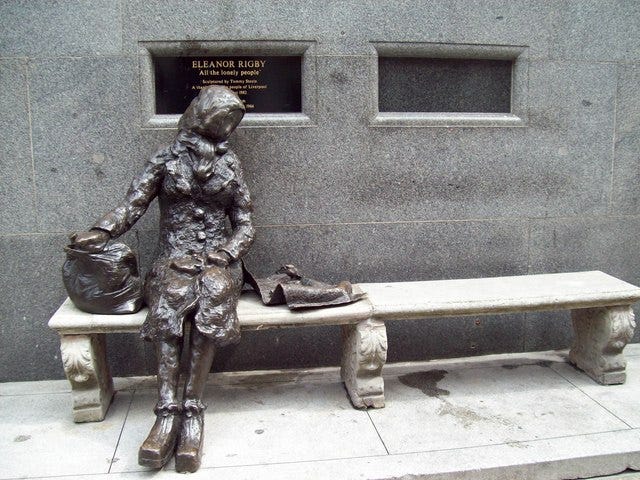
Eleanor Rigby, the eerie second track on The Beatles’ iconic album Revolver, has a bizarre backstory that’s as mysterious as it is captivating.
It has sparked rumors about the song’s characters being inspired by real people and raised questions about who truly penned Eleanor Rigby’s lyrics.
There are many conflicting claims. For instance:
- John claimed he penned most of the lyrics.
- McCartney disagreed yet has contradicted himself throughout the years.
- Others claim lyrical contributions, including a childhood friend as well as George Harrison, who was credited with allegedly writing the main hook.
The song’s characters were indeed actual people from Liverpool, buried in a cemetery near where John and Paul first met. This strange twist raises some interesting questions. In this piece we will unpack the answers to the following questions and hopefully get some clarity on the true story of the famous Eleanor Rigby:
- Were the lyrics based on the real-life Eleanor Rigby and Father McKenzie, or was it just a coincidence?
- Who was the real Eleanor Rigby?
- Lastly, why did Paul secretly own a document that Eleanor Rigby signed?
Ola Na Tungee? No Can Say…
The tune’s working title was Ola Na Tungee (or Ollamatingee, depending on the source). According to Paul, the 1960s singer-songwriter Donovan was the first person to hear the song in its infancy with the pot-oriented slant of “Ola Na Tungee, Blowing his mind in the dark with a pipe full of clay. No one can say.”
Decades later, in an interview Donovan substantiated McCartney’s account.
Donovan: One day, I was alone in the pad, running through a few tunes on my Uher tape recorder. The doorbell rang. It was Paul on his own. We jammed a bit. He played me a tune about a strange chap called ‘Ola Na Tungee.’
Yet, in 1978, McCartney had also previously stated:
Paul: It started with sitting down at the piano, getting the first line of the melody, and playing around with words. I think it was originally ‘Miss Daisy Hawkins.’
But it’s possible that Paul was talking about a later stage in writing the song as he kept refining the lyrics. This makes sense, as Paul confirms Donovan’s account almost two decades later.
Paul: Donovan’s got a funny story of me at his house in London before we went to India, I show up [singing] ‘Ollamatingee blowing his mind in his mind in a car…’ and that turned out to be Eleanor Rigby.
Regardless of its earliest origins, the crucial question is who or what inspired the theme of loneliness in the song, especially considering its darker tone compared to the group’s previous string-only hit, Yesterday.
In 2018, Paul described the idea that sparked the theme:
Paul: When I was really little, I lived on what was called a housing estate….there were a lot of old ladies, and I enjoyed sitting around with these older ladies because they had these great stories, in this case, about World War II. One, in particular, I used to visit, and I’d go shopping for her — you know, she couldn’t get out. So I had that figure in my mind of a sort of lonely old lady.
Later, in 2021, in his autobiographical book Lyrics: 1956 to the Present, he provided greater detail about the “lonely old lady.”
Paul: Growing up, I knew a lot of old ladies — partly through what was called Bob-a-Job Week, when Scouts did chores for a shilling…..I wanted to write a song that would sum them up. Eleanor Rigby is based on an old lady that I got on with very well. I don’t even know how I first met ‘Eleanor Rigby,’ but I would go around to her house, and not just once or twice. I found out that she lived on her own, so I would go around there and just chat…. we’d sit in her kitchen. So I would visit, and just hearing her stories enriched my soul and influenced the songs I would later write.
Writing The Words of a Sermon No One Will Hear
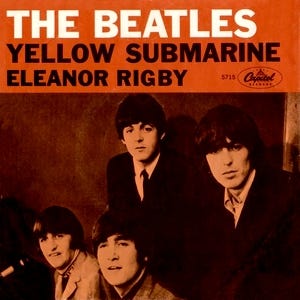

There’s no doubt Paul came up with the initial concept and inspiration for Eleanor Rigby.
Apart from In My Life, Eleanor Rigby stands out as one of the few songs on which Lennon and McCartney strongly disagreed over authorship in later years. Like McCartney, his recollections vary dramatically.
In a 1970 Rolling Stone piece, Lennon recalled, “I wrote a good half of the lyrics or more.” In Hit Parade Magazine, Lennon stated that they both wrote the lyrics but maintained, “I wrote a good lot of the lyrics, about 70 percent.”
However, others were reportedly involved in the songwriting process, including Pete Shotton, a childhood friend, and their road manager, Mal Evans. Lennon discussed this in detail during a 1980 Playboy Magazine interview:
Lennon: We were sitting around with Mal Evans and Neil Aspinall, so he [Paul] said to us, hey, you guys, finish up the lyrics. Now, I was there with Mal, a telephone installer who was our road manager and Neil who is a student accountant, and I was insulted and hurt that Paul had just thrown it out in the air. He actually meant he wanted me to do it, and of course, there isn’t a line of theirs in the song because I finally went off to a room with Paul, and we finished the song.
That same year, when asked about it again, Lennon labeled it as “Paul’s baby,” adding he only “helped with the education of the child.”
So, was it seventy percent? Fifty percent? Or did he aid Paul in finishing the song, as he mentioned in the 1980 Playboy interview, as they had done countless times before?
With Eleanor Rigby, the closer you think you’re getting to an answer, the more questions emerge.
George Harrison, George Martin, and even Pete Shotton, a childhood friend of John’s, have been either directly or indirectly credited or suggested as having contributed to the lyrics by various sources.
Pete Shotton claims he helped Paul find the name McKenzie by flipping through a phonebook, a story also confirmed by McCartney (the original name was Father McCartney). Additionally, Shotton credited George Harrison for the song’s memorable lyrical hook, “Ah, look at all the lonely people.” And Ringo brainstormed the idea of Father McKenzie “Darning his socks in the night.”
Decoding who wrote each line is as tricky as solving the song’s ultimate mystery. What was the real inspiration for the name Eleanor Rigby?
Paul maintained that “Rigby” was inspired by a shop in Bristol, while Eleanor was a tribute to Eleanor Braun, an actress The Beatles had worked with in Help! But the true story behind Eleanor Rigby is more haunting than anyone could have imagined, especially for Lennon and McCartney.
Who Was The Real Eleanor Rigby?
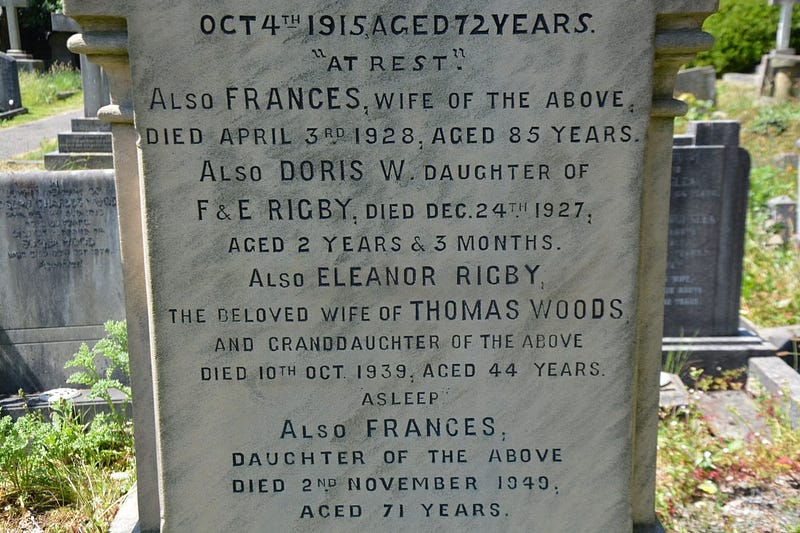
In 1984, an article revealed that Eleanor Rigby was an actual person who had lived and died in Liverpool, England. This revelation changed everything. Equally remarkable was the revelation that she was buried in the same cemetery as a real-life “Father” McKenzie. And where was this cemetery? Just meters away from where John and Paul first met in 1957.
Eleanor Rigby, born in Woolton in 1895 as Eleanor Rigby Whitfield, faced early hardship when her father died shortly after her birth. Interestingly, Rigby was her middle name, as evidenced by a baptismal record from St. Peter’s Church in Woolton. Once this piece of the mystery unraveled, significant details about Eleanor’s life emerged.
Records indicate she lived at 8 Vale Woolton, Liverpool, as a child and in Woolton for most, if not her entire life. Despite a challenging upbringing marked by early losses, she later worked as a scullery maid at a hospital and married Thomas Wood in 1930 at the same church where she was baptized. Though unfortunately brief, her life appears to have been fairly typical.
Eleanor Rigby died on October 10, 1939, at the age of 44. She was buried at a cemetery across the street from St. Peter’s Church in Woolton.
Buried along with her name…
Indeed, “buried along with her name” is Father McKenzie, a.k.a. John McKenzie. Despite the oddity of their close proximity in the graveyard, there’s no evidence that they knew each other. John McKenzie passed away in 1915 at age 73, when Eleanor was approximately 24. Additionally, there’s no indication that John McKenzie had any ties to the priesthood.
Yet, just when it seems we’ve peeled back all the strange coincidences that happened since the song’s release in 1966, in 1990, another baffling turn of events reignited Eleanor Rigby’s near-ending story — and its mystery doesn’t disappoint.
Someone Was Saved…
In 1990, Annie Mawson of the Sunbeams Music Trust received an envelope with Paul McCartney’s logo. Instead of a letter, she found a 1911 hospital payroll sheet signed by E. Rigby, a scullery maid. This century-old document was sent by McCartney after Mawson had requested his support for her music-based charity.
The obscure payroll sheet signed by Eleanor Rigby raised $250,000 at auction. However, the circumstances surrounding how McCartney acquired the century-old document remain a mystery to this day.
McCartney wasn’t directly inspired by the real-life Eleanor when crafting the track; instead, Eleanor Rigby from Woolton, Liverpool, inspired Paul McCartney 90 years after her death from beyond the grave by raising $250,000 for a charity that aids thousands through the power of music.
Who could ask for a better ending to Eleanor Rigby’s real-life story?
As always, thanks for reading.
-Daniel