The Story of the Smart Samaritan
He knew better than to take unnecessary risks. (A modern re-imagining of Luke 10:30–37)
BREAKING NEWS!
In his sermon today, the famous Galilean evangelist, Jesus of Nazareth, commented on a recent news story concerning a man who, while traveling between Jerusalem and Jericho, was set upon by thieves, robbed, and left for dead.
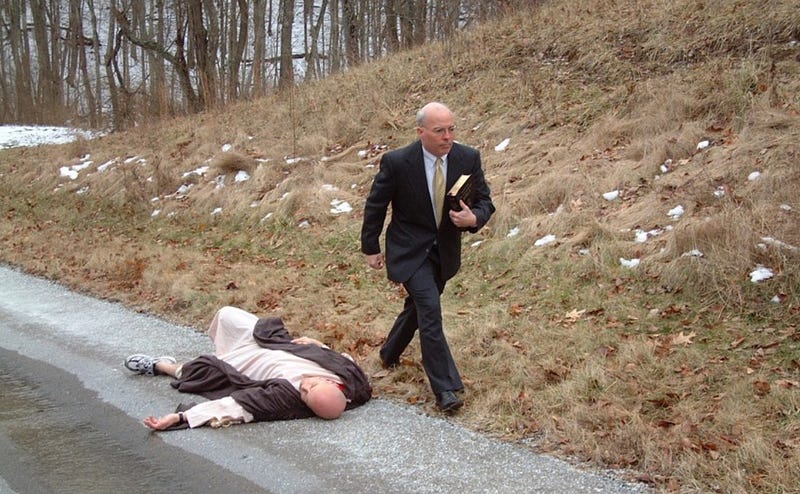
In his recounting of the episode, the Nazarene prophet first focused his listeners’ attention on a priest who came along and saw the unfortunate victim lying on the side of the road. The priest was on his way to a luncheon meeting of the district ministerium where he was to be the featured speaker. Already late, he just didn’t have time to stop and offer help to this disreputable individual who probably didn’t really need it anyway. After all, the man was likely just some drunk who fell into a roadside ditch to sleep off his binge. So, the priest quickly crossed over to the other side of the road and hurried on his way.
A little later, a Levite came along and also saw the man lying there. Mindful that he must not contaminate himself if he was to maintain the purity necessary for carrying out his duties in the Temple worship service, he too crossed over to the other side of the road and went on his way.
The Smart Samaritan
Next, the evangelist continued, came a Samaritan. He saw the desperate man lying there unable to help himself, and was moved with compassion. It so happened that he had some first aid materials in the pack on his donkey’s back. But as he opened the pack and started to pull out the bandages and oil he could use to bind up the man’s wounds, the Samaritan began to think.
The man’s skin looked a little swarthy; he definitely wasn’t a native-born Samaritan. Could it be that he was an immigrant from one of those undesirable darker-skinned countries? He remembered that King Herod had made it quite clear that only immigrants from countries with lighter-skinned inhabitants were acceptable.
Maybe the man was a refugee from Ethiopia or Egypt or even, God forbid, from Syria. Everybody knew those Syrians couldn’t be trusted. This man could be carrying some disease. Or maybe he was just pretending to need help while the other members of his gang lay hidden in the brush waiting for some overly compassionate do-gooder to stop and try to take care of him. It was probably some kind of terrorist plot!
Having thought the situation through very carefully, the Samaritan decided that although he was really a very compassionate person, it would be taking too much of a chance with his own safety to offer help to this person who pretended to be in such desperate circumstances. Besides, it wasn’t really his responsibility. Let the man’s own people take care of him.
Feeling sure that he was doing the prudent thing, the Samaritan decided it was too dangerous to even pass by on the other side of the road. That’s just what the terrorists lying in wait wanted him to do! So, he quickly reloaded his donkey, turned around, and went as swiftly as he could back the way he had come.
The moral of the story
In highlighting the take-away of his sermon, Jesus commended the young Samaritan for his wisdom in realizing that his own safety was the most important consideration, and was not to be foolishly risked out of concern for the plight of someone less fortunate than himself.
At the end of the service, Jesus announced the passage he planned to preach on in his next sermon:
For I was hungry and you gave Me food; I was thirsty and you gave Me drink; I was a stranger and you took Me in. (Matthew 25:35, NKJV)


