
The Story of the Engineer and the Scientist
Engineers study the know-how. Scientists think and study the know Why.
Engineers solve problems that, given acceptable assumptions, are known to adhere to the laws of nature and thus can be described through Mathematics. They are called "derivations," because they are "derived from assumptions." Engineers, in general, answer the questions of "How?" Scientists posit a behavior of nature and try to represent it with Mathematics, then prove it by testing it in a laboratory. Scientists try to answer the question of "Why?"
Ackoff, in his lecture "From data to Wisdom," — "Knowledge conveyed by instructions, answers to how-to questions. Understanding is conveyed by explanations, answers to why questions."
The term engineering, ingeniero in Spanish, is derived from the Latin ingenium, meaning "cleverness," and ingeniare, ingeniar in Spanish, meaning "to contrive, devise." (Source Wikipedia).
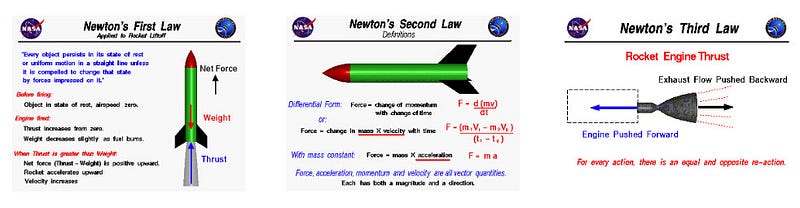
For example, Orbital Mechanics and Astrodynamics were originally contrived by Isaac Newton with the help of two men that ushered the age of reason in 1642 (Source — "Fundamentals of Astrodynamics," By Roger Bate, Donald Mueller, Jerry White). Tycho Brahe, an observer of space and data taker, and Johann Kepler, a mathematician, who reduced that data to a mathematical description and created the three laws of planetary motion. Isaac Newton "explained the laws of motion with equations. We, engineers, still use equations today to calculate body motion in space (see the concept visually here or some of the deduction methods here).
Side story (Same Source): "In 1665 Newton was a student at the University of Cambridge when an outbreak of the plague forced the university to close down for 2 years. These were to be the most creative periods of Newton's life. The 23-year-old genius conceived the law of gravitation, the laws of motion, and developed the fundamental concepts of differential calculus."
Obviously, the great scientist Einstein came along later and, with deeper reasoning, came up with E=mc² and much more to help science with a new understanding of the universe. Einstein's work for science shuttered all the work Isaac Newton had done (except Calculus, of course).
I had a hint about the difference between Science and Engineering when I was taking calculus at the university. In order to save money, the administration had decided to minimize course duplication between "Departments." Thus, they asked the Engineering college to cut the teaching of Calculus for engineers and allow the Mathematics college to teach it. We were asked to define the "Riemann Integral, in one of the calculus exams." My answer was, "it is the sum of the partitions under the curve taken to the limit." I flunked the test. The teacher, who was also the author of the Calculus book we were using, wanted a three-page, step-by-step rigorous definition. It wasn't until my Junior year that I learned the usefulness of calculus when we were given a couple of semesters of "Calculus for Engineering."
However, I learned the real lesson when I took a class in Combustion Engineering from Professor Victor J. Skoglund on approximating an answer for engineering purposes with certainty. He was the best teacher I had at the university back in the mid-60s. He also wrote the book "Similitude: Theory and Applications." I used all that knowledge to design a good Thermal System for the Shuttle and Space Station.
Apollo was built with slide rules; we started with slide rules in college and finished with calculators, and used an IBM 360 for our numerical analysis techniques, which I took with me to work in Aerospace System Design.
While using slide rules, some people in our exams and homework were using three decimal places for their answers; Doctor Skoglund asked us, "how can you read the third decimal place in a slide rule?" When nobody could explain it, he scolded us for guessing and told us, "I can accept two at the most." Other than that, you are fooling yourselves. two decimal places are all that is needed for Engineering work." He then told us that story, which I never Forgot.
What is the difference between an Engineer and a Scientist, you say? IF you place an Engineer and a scientist at either end of an infinite hallway, with a very enticing price in the middle (The answer to the universe at its limit).
Then, ask the Scientist to get the price; the scientist will say, “I can’t.” “Why you ask?” The scientist will say, “I will never get there! I will walk halfway, and I will have halfway to go. I again will walk halfway and will still have halfway to go. I will do this per Infinitum and will never get there!”
IF you ask the Engineer to go get the price, you will have to hold him back to ask, “why?” The engineer will say, “close enough is good enough.”
The story can also be found here.