
The Story Behind the Siberian Ice Maiden and Her Tattoos
A princess with a tattoo of a griffin-like creature buried with a cosmetic bag and six horses
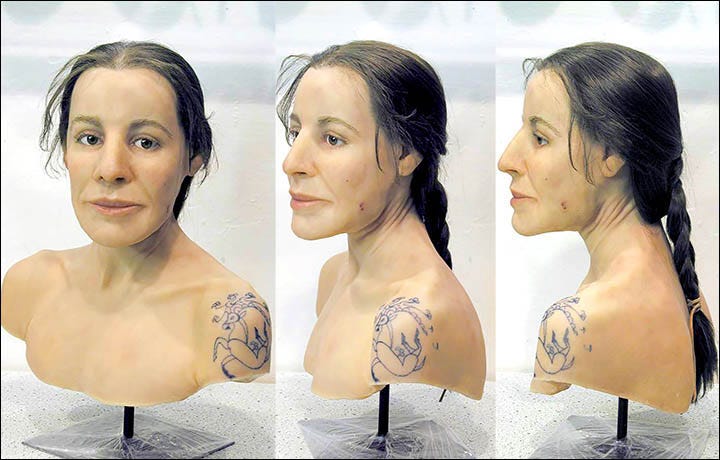
In 1993, Russian archaeologists discovered an intriguing find in the Ukok plateau near the Russia-China border. They had got information about a grave robbery. Digging at the grave site they stumbled upon a giant block of ice.
The team, led by Dr. Natalya Polosmak of Novosibirsk’s Institute of Archeology and Ethnography, began melting the block.
They found the mummified body of a 25-year-old princess known as the Siberian Ice Maiden. Polosmak and her staff found the princess had tattoos!
Her well-preserved body revealed an ancient culture’s rituals. When I first learned about her, I was curious about the meaning of her tattoos.
What about her belongings and her companion horses? How did she die at such a young age? Was it a suicide or a human sacrifice?
These questions drove me to explore more about this mysterious woman who died over 2500 years ago.
The grave, a treasure of knowledge
As the archaeologists began to melt the ice with buckets of boiling water, they discovered harnesses, saddle pieces, and a table where a meal of fatty mutton had been kept for 2500 years.
The mutton was rotting and gave a foul stench.
There were six horses in total. The marks of a pickaxe on their heads indicated that they had been executed.
Then there was only more ice.
The archaeologists worked painstakingly to melt the remaining ice and at last found some sable fur. When they removed the fur, a shoulder appeared with a “brilliant blue tattoo of a magnificent griffin-like creature” in the words of Polosmak.
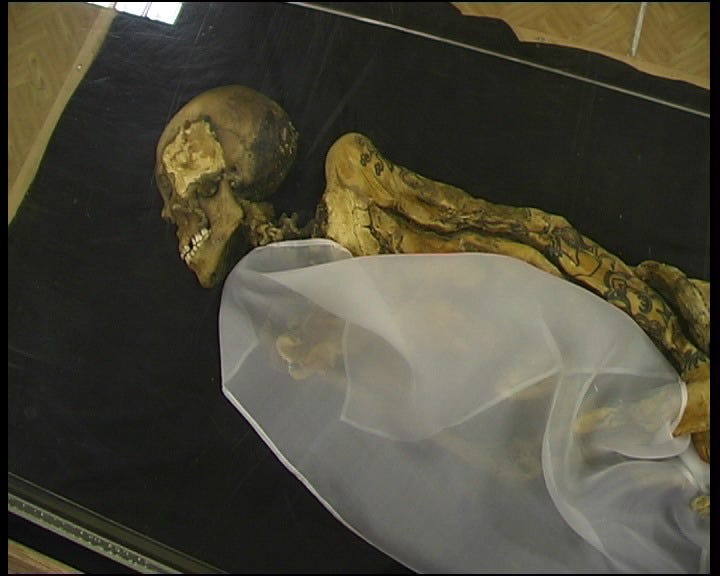
It was the body of a young woman, between 25 and 28 years old. She came to be known as the Ukok Princess or Siberian Ice Maiden.
Polosmak’s team extracted the mummified body, which was in excellent condition. The archaeologists were unable to determine the cause of death because all her internal organs, including her brain, were removed.
But, two decades after her discovery, experts at the Russian Academy of Sciences have an explanation.
She died of breast cancer, most likely. According to the MRI scans, Dr. Andrey Letyagin believes she developed breast cancer in her early twenties. The asymmetry in the MR signals from the scan, according to Dr Letyagin, shows she had a tumor in her right breast.
The disease’s excruciating pain worsened over time, weakening her. It is possible that she fell off a horse, fracturing her bones not long before her death.
She was in a lot of pain and relied on cannabis to help her. The presence of cannabis in her grave is proof of this. High-ranking members of Eurasian nomadic civilizations widely used cannabis.
The Ice Maiden’s skin remained intact, embalmed with herbs, grasses, and wool, according to Dr. Polosmak’s team. The horses were sacrificed and buried alongside the princess. They dressed her in a silk top and a striped woolen skirt. As the highest-ranking members of nomadic societies wore silk, it is safe to assume she was a princess.
The Ice Maiden had a cosmetics bag on her left hip, showing that she cared about her looks. There were fragments of an eye liner pencil made of vivianite, a type of iron phosphate that gives a blue-green color.
They also unearthed a small plate containing coriander seeds, probably used for medicinal purposes.
The archaeologists’ biggest surprise, however, was that the princess was bald! Her hair was a wig consisting of two layers of female hair, and they shaved her head. On the top of the wig, there was a felt spike with fifteen gold foil birds on it.
What do the findings reveal?
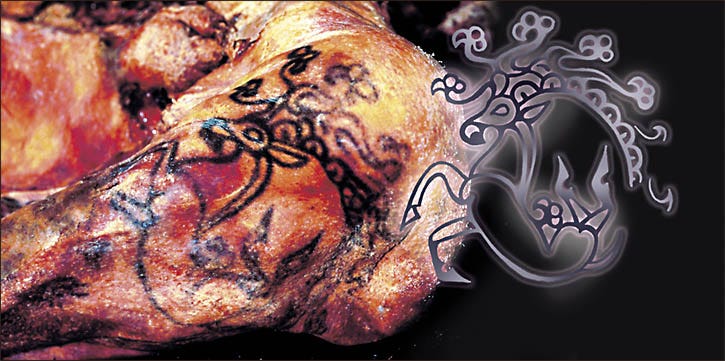
Tattoos, according to Polosmak, are a symbol of beauty. Back then, the goal was to appear as gorgeous as possible. Because the tattoo was visible, she placed it on the shoulder to appear as attractive as possible. The Ice Maiden had tattoos on both arms and fingers, but the one on her left shoulder was preserved for the best. According to Polosmak, the visible shoulder tattoo resembles a griffin’s beak.
Other tattoos included sheep and a snow leopard.
Because of the animal-style painting, archaeologists assume the princess was of Scythian heritage, as they have discovered similar artwork in various parts of Russia, Central Asia, and Europe.
Scythians were a nomadic people who lived in the Eurasian Steppes during the seventh and third centuries BCE. While some historians used to term Scythians for all early nomads, it is incorrect. Not all early nomads who lived in the Eurasian steppes spanning from Siberia to the Black Sea were Scythians.
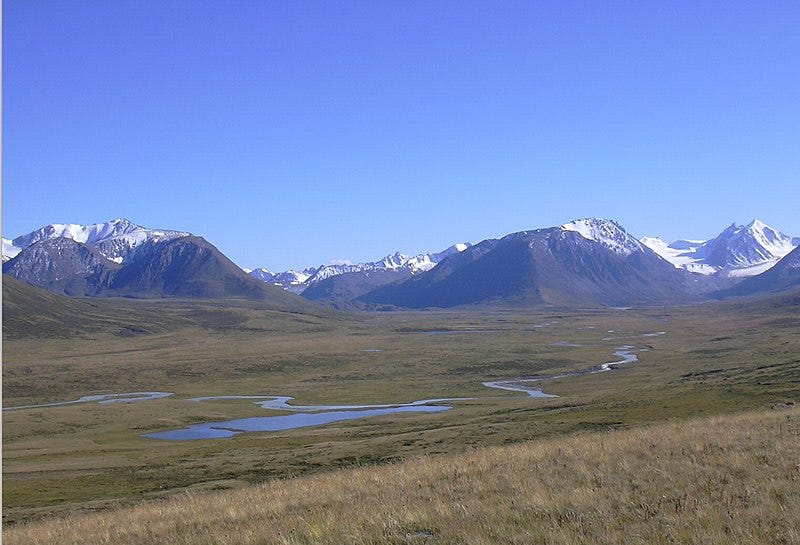
The excavation of the Ice Maiden sparked a major debate since inhabitants in the Altai region, where she was buried, believe the grave belonged to one of their ancestors. People in the area believe in shamans and regard the removal of mummies from ancient graves as a bad omen.
The origins of the Ice Maiden are hotly debated in Russia. According to DNA analysis conducted by the Russian Academy of Sciences, there is a significant difference in the DNA make-up of the Ice Maiden and modern Altai people. Scientists and archaeologists believe she was a member of the Pazyryk culture, a Scythian nomadic civilisation that flourished between the 6th and 2nd centuries BCE.
Her facial characteristics were more Caucasoid than Mongoloid. While it is now a point of contention, it is important to remember that ancient nomadic cultures were always multi ethnic. The Xiongnu Empire, the first major nomadic Empire from the Eurasian Steppes, was a confederacy of tribes of many races.
People in the Altai region, where the mummy was discovered, were outraged that she was being showcased to tourists from all over the world. They took the Ice Maiden to Korea and Japan, where she was treated like a rock star, with crowds gathering to see her.
The authorities in the area where she was discovered reacted by prohibiting additional excavations. They designated the area as a “zone of peace.”
Russian authorities eventually returned her body to the Altai museum, but they are still studying it.
The discovery of the Siberian Ice Maiden represents a watershed moment in archaeology.
Do you think her excavation has aided in the study and understanding of ancient peoples and their customs? Or was it a case of defying local customs and stealing graves?
There is little doubt that the Ice Maiden has helped us comprehend that though ancient peoples from 2500 years ago were different from us in many respects, they also had many commonalities with us. The biggest one is a fascination with cosmetics and external appearance.
Another interesting fact revealed by the Ice Maiden is her use of cannabis to relieve pain caused by breast cancer. Cannabis’s significance in medicine has received attention of late, yet it is an old practice that has been lost in time. We had not yet developed science at the time, therefore many individuals relied on trial and error to gain an understanding of pain treatment.
Check out the following story if you’re interested in Eurasian civilizations and forgotten empires built by the peoples of the Eurasian Steppes.
If you enjoy reading tales of the past, consider subscribing to Medium using my referral link (affiliate) and gain unlimited access to stories.
References
- John Man (2019) , Barbarians At the Wall: The First Nomadic Empire and the Making of China, Penguin Randomhouse.
- Siberian Princess reveals her 2,500 year old tattoos”. Siberian Times.
- Iconic 2,500 year old Siberian princess ‘died from breast cancer’, reveals MRI scan. Siberian Times
- Polosmak, Natalia (October 1994). “A Mummy Unearthed from the Pastures of Heaven”. National Geographic: 80–103.


