

The State of the journalistic Chatbot
In February I wrote a piece called “What is conversational journalism?”, which looked into the contemporary use of chat as a tool for newsrooms. Now, a couple months later, there are thousands of bots available on Facebook Messenger and of course on Kik, Slack, Telegram and even Skype. Which is reason enough to take a look again and try to classify the journalistic chatbots out in the wild.
Please note, that my definition of “chatbot” is fairly broad for the sake of the article. I will refer to a piece of software, which a user can interact with using an conversational interface, as a chatbot.
So far I was able to define three broad categories of journalistic chatbots: The conversational Searchbars, The weird Ones and The content-first Ones. All these bots are user-facing and not build for the use inside a newsroom, as for example NYTs Blossom.
The conversational Searchbars
We have yet to see a fully automated journalistic chatbot, but the bots from Techcrunch(Messenger), CNN (Messenger), Forbes (Telegram) and the Washington Post (Messenger) are pretty close.
But: they are also the most boring ones out there. Their functionality is limited to sending you articles, which fit a given keyword or phrase. You can then subscribe to those keywords, which will prompt the bot to send you related articles. Depending on the bot you might also receive a daily dose of the most read or most relevant pieces.
But still: Those bots seem to get traction. In an interview with Digiday, Alex Wellen, chief product officer of CNN, remarked, that people spend on average two minutes with the bots and a double digit percentage of users asked the bot questions.
CNN also sends prompts for users to interact with around important events, like important political debates or the start of Ramadan, for example.
All those bots were build by using the same service: Chatfuel. Chatfuel makes it relatively easy to build a fully functioning chatbot and has also published the Techcrunch bot-template for everybody to use, if you’re interested in building such a chatbot for your own newsroom or blog.
The weird ones
The second category is more interesting, but also harder to grip.
Here Mic. went all in on chatbots and has build some of the weirdest ones so far. But as you will see, there is a strategy to the weirdness and that’s interaction. Where as the CNN/Forbes/Techcrunch bots try to drive traffic, Mics bots are build for user-interaction. So let’s take a look at some:
DisOrDatBot (Kik)
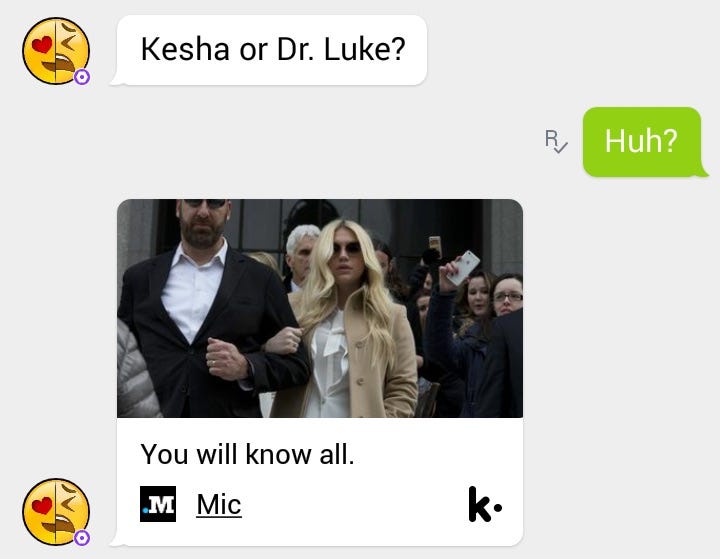
DisOrDatBot is build to ask it’s users simple polls, for example “Kesha or Dr. Luke?”. The users can then choose between both or aks “Huh?” to get more context on the question. After voting closed, the bot will then tell you which percentage of it’s users chose the same answer.
This bot is of course fairly simple, but on the other hand surprisingly engaging. I found myself answering one question after another. I couldn’t find current numbers, but during testing the bot got on average around 65 replies, 28 of which where answers to questions, according to Ryan Campbell. Go figure.
TrumpChat (Kik)

You thought the DisOrDatBot was weird? Well you haven’t used TrumpChat then!
TrumpChat will tell you the news around the presidential race as Trump himself. Well, an automated and fairly caricaturistic version of Trump, which is quite amusing to read and interact with, while still being informative. Again, Mic will sprinkle in links to stories on the topic, but keeps most of the interaction inside the chat.
This bot might not be the most politically neutral, but it is a good example for engaging and new storytelling inside a fairly young medium. It’s yuge!
Emoji News
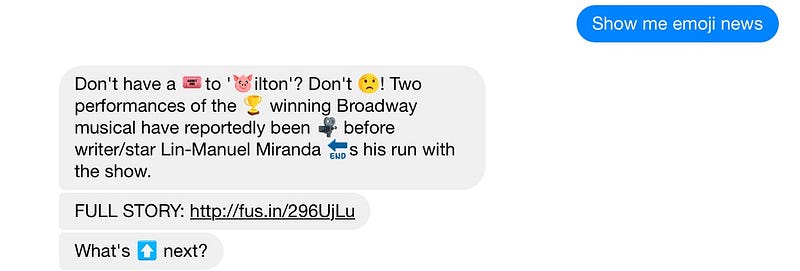
Mic is not alone in building weird bots. Fusions Emoji News is definitely qualifying as weird. Or as 😳 as the bot might put it, because—true to its name—the bot will tell you the news sprinkled with emojis.
I don’t know about you, but I find it really hard to read.
(Oh, and there is a second Emoji News bot, which will answer with relevant(?) news stories to the emojis, you send it. This one was build at a Hackaton by Jan König and his team)
The content-first ones
This is the third category of journalistic bots out there and maybe the least sexy on the technical scale. These bots still rely heavily on human editors, because they were build to not only made you interact with them or drive traffic, but to send you the content inside a chat.
These bots are so far the only ones really leveraging the potential of chat as a medium in their own ways.
Purple
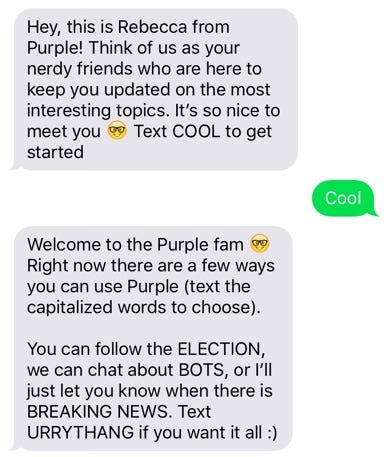
Purple tries to ad a big human touch to its service, by combining pre-written choose-your-own-article threads and live chats with users and the editors behind the bot. Originally build as an SMS-service, Purple made the jump to slack. Good news for everyone—like me—without a US cellphone number. You should definitely give this one a shot!
Quartz
Of course you can’t write an article on conversational journalism, without mentioning Quartz’ app, which seems to be going strong.
In my opinion the success of Quartz’ bot lies within its storytelling and often quirky approach to news. Though, you could say the app is only a more interactive version of Quartz’ newsletter, it still is the best conversational service I’ve played with so far. Quartz is also the only service, which tries to use the whole range of possible media inside a chat by sending not only text, but images, gifs and emojis. Which is something, many other bots are either completely ignoring or using sparely. (But I really hope we will see more of this in the next months, since Facebook finally allows bots to send gifs and audio files)
But please build an Android app already!
So what’s next?
After playing around with those bots and also building and testing some of my own, I am convinced, that bots will find their place in the modern news channel mix of everyday users. Though there are still some things to improve, like a more nuanced way of receiving relevant pieces of information, based on my interests or a more personal tone of voice inside the bots. I think there are also some areas, which might be intersting for journalistic bots to explore. For example a B2B Slack-bot, which could deliver business analyses or a ticker-style bot for emergencies worldwide. I’d also like to see more ways for users to send questions, tips and comments directly into the newsroom.
Hit me up, if you want to talk about journalistic chatbots!
Honorary Mentions
- Politibot is a bot build on Telegram to cover the Spanish election by providing daily briefings with polls, charts and audio files, as well as a database of articles and other information for the users to search. (Thanks to eduardosuarez for mentioning it.)
- “Rumour Filter” is a bot launched by Tencent on the chinese version of WeChat. The bot will tell you, if the link you send it leads to a accurate piece of news or a rumour. The bot works with an ever growing database of links and answers, collected and written by editors. Though it won’t tell you anything regarding politics in China.
- “WTF is brexit” is a bot build into a website and designed to educate users on the consequences of the UKs exit of the EU. Too late you could say, but it still an interesting piece of storytelling you should definitely try out.
- Staying true to it’s interactive approach, Mic also build a “Caption this” Messenger bot. Users are send a picture, with the prompt to caption it. Again, Users also have the option to request the story to every picture they’ve captioned. Try it here: http://bit.ly/1ti8fKB
- Minitextbot is also an interesting service. The bot will give you the 3 key sentences out of every link you’ll send it. It’s availabla for Slack an Telegram. (Thanks to Vladislav Arbatov for bringing it to attention.)
Edit 1: Added Politibot and Minitextbot


