
The State Of Public Space In America Is Disgracefully Abysmal
“Parking and shade are a hot commodity in Los Angeles.”
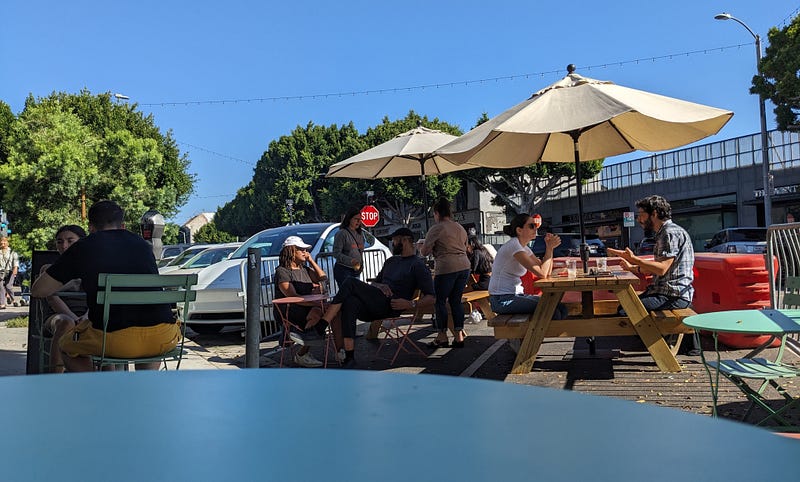
The other day — as I do most mornings — I was sitting outside a cafe on my neighborhood’s main commercial street. As Los Angeles goes, it’s about as good as it gets. I make the best of it enough to thoroughly enjoy it.
As I lingered, an increasing number of people lurked on the sidewalk in front of the cafe, waiting anxiously for space to open up.
At one point, a polite, though relatively aggressive pair— the two ladies standing up in the image that anchors this article — came up to me and asked if I’d let them know when I was leaving so they could have my position in the shade. As they walked to a table in the hot sun, one of them said —
No rush.
The guy talking with his hands in the far right of the picture approached my table as I getting up to leave and asked —
Are you leaving?
The aforementioned two ladies had already secured a shady spot so, not feeling obligated to have their backs any longer, I reaffirmed with the guy and his counterpart that they were seeking shade by saying —
Not enough shade in LA.
His reply —
Parking and shade are a hot commodity in Los Angeles.
If he only realized the extent of the relationship between the two. Or, more directly, the relationship between a lack of space — and shade — and our nation’s over-reliance on cars.
You can’t overstate the impact of cars on our quality of life. Particularly our quality of public life and space.
Parking takes up 22% of the land in metropolitan city centers with 1,000,000 or more people. In Arlington, TX, that number is 42%.
An off-street parking spot requires more than 300 square feet of space for the spot itself and to move in and out of it.
We could go on all day with variations on these statistics from across America. And don’t even get me started on the high cost of free parking.
It doesn’t take data to clearly see:
- We devote a shitload of space to cars and the infrastructure to support them.
- We neglect and short sell other areas of the built environment as a result.
- We have scant space for people, even in the best examples of urbanism America has to offer.
There aren’t enough seats in front of the cafe because there are too many cars on the street. Simple as that. And, sadly, I don’t think it’s a fixable problem.
I mean, people in urban planning and related fields lamented the problem long before I became obsessed with it:
As an urban planning student from 2002 to 2008, I got the bug real bad for pedestrian-oriented built environments — and the public space and public life they facilitate — long before I first set foot in Europe.
I knew that once I experienced what it feels like to be in a place like Spain (or Italy), I’d want to live there. Because we simply don’t have the types of urban settings they have — ones that prioritize people over cars — in the United States. Not even in the places we put forward as some of the world’s greatest cities.
It was a long time coming, but the second I arrived in Europe in 2022, I knew I wanted to live there. The experience blew away my expectations. You can’t say that about most things in life. Especially things you spend years imagining and, subsequently, hyping.
If you love cities and truly want to live like a city dweller, but you want to stay in America, you’re experiencing some serious cognitive dissonance.
To live an urban life in America, you have to settle. Even if you have unlimited funds and can reside in Manhattan, San Francisco, Boston or the most “urban” neighborhoods in other U.S. cities.
You’re still really only half assing it.
In Los Angeles, I’m like one-quarter assing it. Or, actually, three-quarters assing it, right?
Verbal meets mathematical technicalities aside, we romanticize places such as Italy and Spain, but could never live the way they do in the cities of those places. We had the opportunity to, back in the middle of the 20th century, but, in one of the biggest antitrust frauds ever perpetrated on the American public, a handful of corporations colluded to dismantle efficient public transportation and pave the way for the proliferation and dominance of suburbia.
Now we’re a car culture. We act like we hate it. But we fucking love it.
And we’re too far gone to ever meaningfully turn back. If we wanted to. But we really don’t.
There’s zero will. The mere mention of higher densities, discouraging driving and removing parking in favor of public space freaks out the average American citizen. Especially business owners. Even many of the ones who live in cities.
If you live in a city in America, you’re doing urban living lite.
And, obviously, this isn’t even our biggest problem. Far from it.
We’re in the middle of simultaneous retirement and housing crises that will only continue to get worse.
Take housing for example.
The 30-year mortgage interest rate is 8%. This means the monthly payment on a $500,000 home after 10% down, including taxes and insurance, is $4,175. To “afford” this payment — meaning you don’t drop more than 30% of your income on housing — you need to earn $167,000 a year.
But interest rates will come down.
Sure they will. Though, probably not by much.
Whatever the decline, the moment rates start to meaningfully drop, there will be a flood of people entering the market. They’ll send the price of housing higher than it has ever been.
In short, the only way to be a homeowner in America is to already be a homeowner in America or work your balls off to the point of having no life. For most people.
Here again — you have to settle.
Settle for sub-par urban environments. Settle for a housing situation that’s your second, third, maybe fourth choice.
If you’re already in a solid position, scoff away.
For the rest of us — particularly young people and renters in big cities — it’s high time to stop settling.
Obviously, I want a 100% pedestrian-oriented urban environment. So, in roughly a year, I’m moving to Spain to get just that.
It’s at this juncture where the beauty and positivity of this seemingly negative story lies.
You no longer have to do what they have been telling people to do for years. Buy a house. Save for retirement. All of that American dream stuff. Because it’s no longer possible. At least not for people who want to call their shots on the work meets income equation.
Now, you can do whatever it is you really want to do. You don’t have to follow the path your parents followed because even they can take off their blinders and see — without their ongoing financial support — it‘s not happening.
For me, yeah, it’s finally getting to live a true and complete city life. An aspiration that’s been percolating inside of me since I set foot in San Francisco in 1999.
You might hate the city, but love the countryside. Fantastic. Go buy that cheap plot of land and grow your own vegetables.
Be a digital nomad. Live in a van. Embrace co-housing. Maybe start your own project. Move to Cambodia or Mexico or Croatia.
Whatever floats your boat.
The world is your oyster.
In an odd twist, going forward it will be Americans emigrating elsewhere in search of a better life.
Whatever you do, just don’t settle.
Because parking and shade will always be a “hot commodity” in Los Angeles.
(By the way, there’s plenty of parking in Los Angeles and the United States. Estimates range from 700 million to two billion parking places, which works out to between 2.5 and 7.0 parking spaces per registered vehicle.)
To receive a notification each time I publish a Medium article, go here. In future articles, we’ll go more in-depth on the things I touched on today.
To subscribe to my Never Retire: Living The Semi-Retired Life newsletter where we go even more in-depth and get way more personal, including on my plans to move to Spain, go here.


