
The Specter of Death Haunts Neil Armstrong in Enthralling “First Man”: Film Review
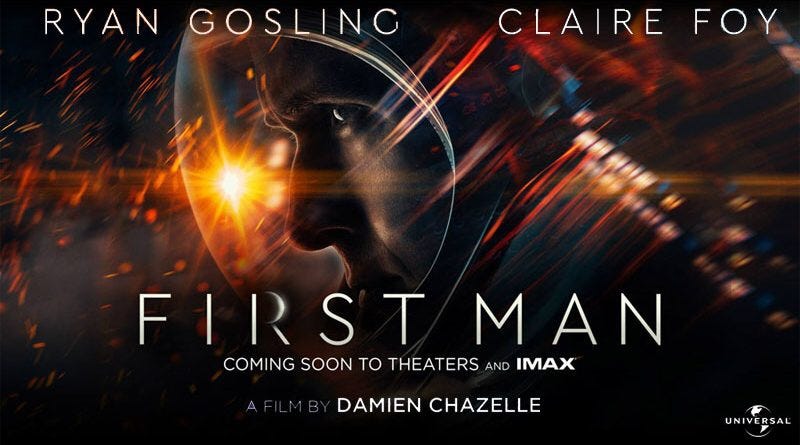
The Apollo 11 mission to the Moon is rivetingly dramatized in the film, which stars Ryan Gosling as Neil Armstrong and Claire Foy as his first wife, Janet. It is likely to be a major player during award season, just like Chazelle’s last two directorial efforts (2014’s “Whiplash” and 2016’s “La La Land”), but its focus on melancholic themes may prevent its breakout potential.
Prior to entering the theater on opening night, I had three thoughts about First Man:
- “How is it possible that the moon landing has never been the subject of a major Hollywood film before?” Sure the walk on the moon has been depicted and referenced in countless films, books and television shows over the past 50 years. But with the exception of a couple of television movies, the story of Apollo 11 has never truly received the big screen treatment.
- “What an unexpected film for Damien Chazelle to choose as his follow-up to La La Land.” After breaking out in a big way with 2014’s Oscar-winning indie Whiplash — an incredibly intense drama depicting the dysfunctional relationship between a talented musician and his emotionally abusive instructor — Chazelle scored even greater acclaim with the 2016 blockbuster musical La La Land, for which he took home the Best Director Oscar. Although tonally at opposite ends of the spectrum, both were contemporary-set films that heavily emphasized musical performance. For him to pick an intimate historical drama about the space program as his next film was not something I anticipated.
- “Wow, they are young.” The film’s director (Chazelle), screenwriter (Josh Singer, who won an Oscar for 2015’s Spotlight), and stars (Ryan Gosling and Claire Foy) were all born significantly after the events the film depicts. I was intrigued to see how an event that was so definitive for an older generation would be interpreted and recreated by a generation of artists that were not alive to see it.
First Man is so captivating that those thoughts quickly left my head when the film’s viscerally terrifying opening sequence began and did not return until after the credits rolled. The film begins with Neil Armstrong conducting what appears to be a supremely dangerous test flight in the Mojave Desert. The focus then shifts to his home life with his wife Janet, son Ricky, and infant Janet, who is dying of cancer. It is apparent 10 minutes in that death plays a huge role in First Man. There are the personal losses experienced by the story’s protagonists. There are the many lives lost in the early days of the space program. And then there is the very real possibility that Neil will be added to the list of fatalities that looms large.
Singer’s screenplay is particularly interested in the debate over whether the U.S. Space Program was worth the cost, particularly the human cost. This discussion is brought up at numerous points during the film, particularly the contrast between the desperation of the American government to beat the Soviet Union in the Space Race and the dissenting voices who argue that the program is too risky and that the money is better spent elsewhere. There is a particularly powerful moment when a high-ranking NASA official tells Janet not to worry because they have everything under control. Janet explodes, “All these protocols and procedures to make it seem like you have it under control. But you’re a bunch of boys making models out of balsa wood. You don’t have anything under control!” It’s a powerful moment that emphasizes the huge risk of the undertaking.
That’s not to say that the film is mired hopelessly in despair. There are numerous sequences that elicit profound senses of wonder and awe, and even inspiration. These scenes work just as effectively as the best moments of Apollo 13 and Gravity and are utterly captivating. In addition to Chazelle’s skillful direction, the film benefits from super production values all around — including extremely realistic set design and visual effects, superb use of sound effects and music (including an original score composed by La La Land Oscar winner Justin Horowitz), and gorgeous cinematography. But for a film that could have so easily settled for being a technical marvel, it is actually more of an actors’ piece than I anticipated.
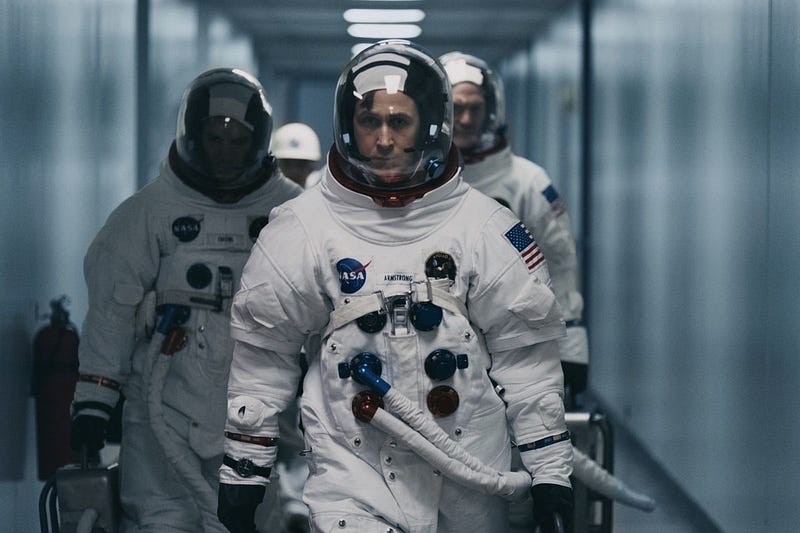
The acting in First Man is utterly superb, but it decidedly not an ensemble film in the manner of previous NASA-set classics like The Right Stuff, Apollo 13, and Hidden Figures. The supporting cast is filled with “Where do I know him from?” middle aged white male character actors who do fine work, but it is really a two-person show. In this sense, the film shares more in common with Alfonso Cuaron’s Oscar-winning intimate piece of space fiction Gravity than those aforementioned sprawling historical films. The film is the story of Neil and Janet Armstrong from the death of their daughter to touchdown following the monumental space mission.
Ryan Gosling gives a remarkably subtle and nuanced performance as Neil Armstrong (who passed away in 2012 at the age of 82). Gosling plays Armstrong as a highly controlled man whose interior life is a mystery to those around him, including his wife. Chazelle fixes the camera on Gosling’s face at numerous pivotal points in the film and whether it’s the wave of nausea coming over him in the simulator, the tears welling in his eyes as he catches a glimpse of the moon’s surface, or the way he stares at his wife from the glass window of the quarantine room, Gosling is profoundly effective. He evokes enormous amounts of emotion without a word. It is the kind of subtle performance by a gifted actor that I wish the Academy would fete more often. But as we saw at last year’s ceremony — when the entertaining scenery chewing of Frances McDormand, Allison Janney, Gary Oldman, and Sam Rockwell triumphed over some gorgeously subtle performances — subtlety tends not to be the Academy’s cup of tea.
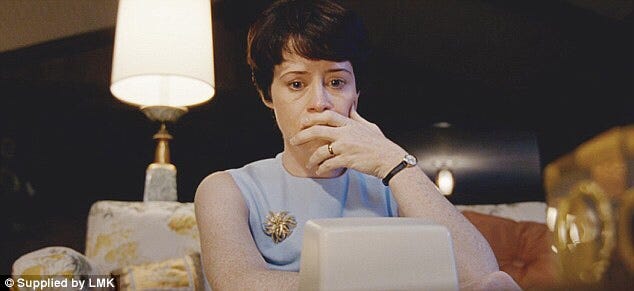
As good as Gosling is, I found Claire Foy to be even better. Foy is much less established than two-time Oscar nominee Gosling, but she is hardly an unknown. She has already earned a Primetime Emmy, a Golden Globe, and two Screen Actors Guild Awards for her two-season stint as young Queen Elizabeth II on the Netflix drama The Crown. In some ways her role as Neil Armstrong’s first wife Janet is similar to that of the monarch. Both Janet and Elizabeth are the mothers of young children in the 1960s struggling with complicated marriages and a life they never expected for themselves. But her performance here is much different. From the convincing American accent to the well-justified hostility, Foy creates something wholly distinct and injects a raw emotionality that ultimately balances the film.
In my opinion, the film has only two notable weaknesses. The first is that there are a few times when the psychological drama unfolding in the domestic scenes feels overly familiar. In these moments, the staging, the themes, and the dialogue feel too reminiscent of films depicting similar time periods and themes. The second is that the portrayal of Buzz Aldrin is glaringly one-dimensional. I have no problem with him being portrayed unflatteringly (he is written as insensitive and arrogant) or the focus being on Armstrong instead of him, but I do take some issue with the lazy way the screenplay lazily under-develops a well-known historical figure who plays such a large role in the story (at least toward the end of the film).
First Man seems well-poised to be a major player during awards season. It seems likely to make more than a few Top 10 lists and garner several Oscar nominations in the technical categories alone. And Gosling and Foy should be strong contenders for Best Actor and Best Supporting Actress nominations, respectively. But whether the film manages to break through in the Best Picture and Best Director categories will be contingent on how well it connects emotionally with voters. Of note, it likely has a better shot of winning over voters than general audiences. I anticipate that enough people will turn out for the compelling subject matter, appealing star, and strong reviews to make it profitable, but I do not anticipate it breaking out. It is too challenging and dark a film.
For me, First Man is not the total slam-dunk that Whiplash and La La Land were, but it is nevertheless superb. It is a well-crafted, thoughtful, and undeniably powerful film that shows a gifted young filmmaker willing to challenge himself, his actors, and his audience. It also does what truly good historical films always do — look back at a familiar event with a critical and curious lens, illuminating oft-overlooked aspects of them. In this case, it’s how dangerous and strewn with tragedy the Space Race really was.
Rating: 4.5/5 stars
One more thing: Much pre-release controversy was generated about the decision not to recreate the iconic planting of the American flag on the moon in the film’s climax. Even Trump weighed in, suggesting that the filmmakers were ashamed of their country. But I found that the omission actually makes perfect sense in the context of the film. First Man is not a story that is primarily concerned with celebrating bravery and patriotism — rather it is concerned with the cost of it all. As such, the film focuses on more thematically relevant actions. (And, believe me, there are a more than sufficient number of American flags on screen throughout the film.)
Other recent film reviews by this writer: BlackKklansman and A Star is Born


