
The Space of What Could Have Been
My mother is ninety-three and lives above my sister’s garage in a converted apartment, but not really. Her body is there, diapered and hunched and mostly immobile, but she is elsewhere. I guide her fingers to the soft ear of a toy rabbit. She smiles wide. This, she never would have done before. Toothy smiles stretched her skin and made her look like a crone, she said. By the time I was ten, my mother was old and done for, her beauty gone and her best years wasted. I told her always that she was beautiful, more beautiful even than Scarlett O-Hara. And always she corrected me: I was beautiful before your father ruined me.
When dementia struck the set and sent all the actors home, leaving my mother in the empty space of a bare stage, she forgot that she’d been unhappy most of her life. She forgot that she despised my father for being a two-timing-filthy-mouthed jackass whose dreams were too big for his brains — and on it went for five decades of marriage. She forgot, too, that she was beautiful and terrified of growing old. The ticker-tape of self-loathing was finally gone.
I sit with her now, surrounded by traces of a lost colony. There, is the clock that hung in the kitchen of my childhood home. There, is the tiny glass bird she managed to save when the Nazis invaded her home. I see her young hand reaching for the bird, a spoon, a pen — for something needed in a moment lived long ago and think: she’s never been more beautiful than now. The resentment that clouded her eyes is gone. Her hair is thin but what remains is perfect silver. “You’re beautiful, mommy,” I tell her. “You have green eyes and hair like moonlight.” “Oh!” she says, smiling at the news of it.
One by one, dementia struck the negative thoughts, carrying off the useless props that cluttered her mind. I was glad to see them go. She used to cover her mouth when she belly-laughed to hide the wrinkling of her cheeks. I tell her a silly rhyme and she tosses her head and laughs, lit from within. She no longer dyes her hair or stares into the mirror, bitter. She begins to forget me, too. It’s a difficult thing to be forgotten by someone you love, and to watch the act of it performed. But there is mercy in it, for some.
There was a suitcase my father made her leave behind when the airlines said they’d gone over limit. It was 1950-something. “My sister will ship it once we get to America,” he told her. By the time I enter the story in the 70s, my mother’s suitcase is gone forever. Inside, is everything she needs to be happy. The suitcase grew more spacious every year, so spacious that it held volumes of Tolstoy and Dickens, rare medical books and exotic herbs, gowns and fur coats, artifacts from far-flung places brought to her by men she should have married instead of my father. Once, when we were being evicted, she screamed at him, saying she could have saved us by selling the pearls that were in the red suitcase. If it hadn’t been for him, she said, we wouldn’t have to flee like thieves in the night.
I asked my father what was in the red suitcase. Were there really pearls and furs? No, he said. Some clothes, and letters I wrote to your mother. Love letters. And a coral necklace, from her mother.
The stories we tell ourselves are powerful things. Sometimes we tell the same story over and over, ensuring the ink will never dry.
I show her a picture of my father and she becomes emotional. “Do you remember him?”
Yes, he was a good man. I loved him.
“Did you?”
Yes. But he’s gone, I think.
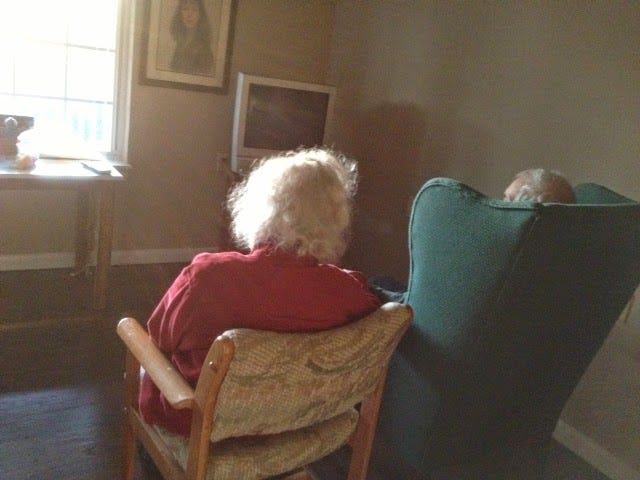
I take her to the Alzheimer’s home where my father is. The stage is sparse. A table, an old television, and two chairs. I set the scene: I tell them they are husband and wife and that they love each other very much. I place her hand in his. She smiles. They like this story. It’s a good story to end on.


