The Society of Spectacle: How a Society of Spectacle Leads to Slavery
Exploring the social and psychological ramifications of a Spectator Society
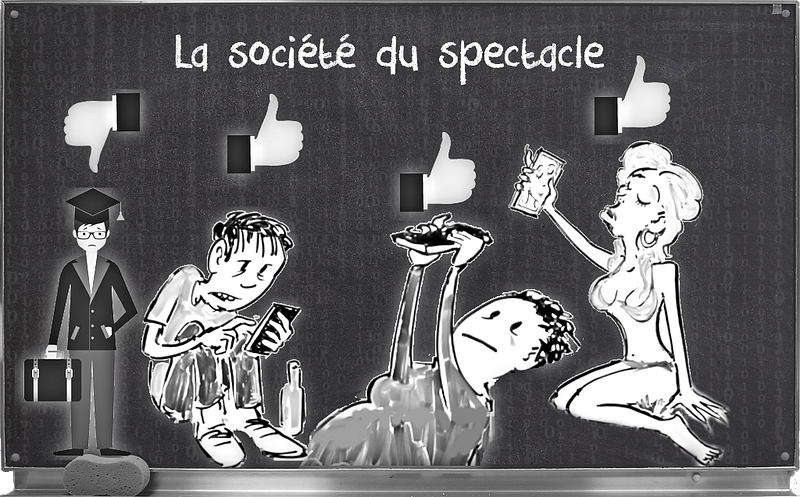
“In a world that is really upside down, the true is a moment of false” Guy Debord
It is often hard to describe in words what is happening with the life of an individual and the condition of current society. However, at the same time, it is also amazing to find out that our current situation has been accurately mapped by the philosophers of the previous century. One such philosopher was Guy Debord [gi debou] who captured the psychological and social state of the individual in such a fine manner that it seems as if the work has been written just now. In this article, we see what ‘Society of Spectacle’ means and how it is affecting our lives.
The Spectacle
Spectacle is consensual collective hallucination like a dream, a mass psychosis, if you will. The spectacle is not just collection of images; it is the social relations between people mediated by images. Spectacle is the instrument which allows the continuation of the status quo.
“Spectacle is the instrument used for the goal of pacifying and distracting the masses. Spectacle is the autocratic reign of market economy. The spectacle transforms our reality into a revolving door of commodifiable images. The spectacle is not a collection of images, but a social relation among people, mediated by images.” Guy Debord
According to Marx, commodities mediate social relationships between people in a capitalist system.
“The wealth of those societies in which the capitalist mode of production prevails, presents itself as an immense accumulation of commodities” [1]
You provide your labor, time and life in exchange for commodities and you yourself are the commodity for the capitalist. The spectacle is the new commodity of our time. Spectacle is the hyper-reality which has taken over the reality. When all social relations are mediated by commodities/images, then individual is nothing but a symbol in the spectacle. In a spectacle, images and noise become more valuable than humans which they supposedly meant to represent. They are no longer just representing the humans and commodities, but they become the commodities themselves. So, to rephrase the Marx in the current context, such capitalist societies accumulate spectacles instead of physical commodities [2].
“In societies where modern conditions of production prevail, all life presents as an immense accumulation of spectacles. Everything that was directly lived has moved away into a representation.” [2]
The outcome of such image-based relationships (i.e., the spectacle) is a society devoid of emotions and humanity thus a non-reality. By disconnecting the masses from reality, a spectacle keeps the masses in a deep hypnotic state in order to preserve the status quo. When all information about reality is the representation of the representation and when images become autonomous, misinformation becomes the norm. It becomes easy to keep people divided. When people cannot find consensus even on the basics of reality, then it becomes impossible to gather people under one ideology. Furthermore, even if people could find a common reality and consensus for the time being, for a particular agenda, it doesn’t take long before new images becomes available and focus of the masses shifts instantly. According to Debord, this is why spectacle destroys the revolutionary potential of a political process.
This is precisely what current social interactions and social relationships among people have these days in society. Everything has been commodified just as earlier times, only that this time it isn’t even the physical commodity which has replaced the reality but a non-entity, an intangible projection. The content/commodity of the present day doesn’t even exist and surprisingly everybody is happy to experience such hallucination and social relationships. When capitalism runs out of physical resource to commodify human relationships, it uses fake assets and mere projections to do the same job. An example is a youtuber talking about a social media celebrity which is just an image based representation of a persona, which commented on an image of another celebrity’s hairstyle, which she got using an AI tool, inspired by a video game character, which in turn is inspired by a comic book character, which only existed in author’s imagination. How meta can it get?!
“The spectacle is not merely the apparatus of media, but the relations between individuals themselves, as mediated by the stream of images that represent their daily lived experience of this pseudo-reality.”
Illusion of Freedom
When we look at the contemporary society and the social media facade, we can’t stop to think about the similarities it has with the decadence of ancient Rome. However, in many ways, even their decadence was better than the heights of current “society”. The social media theater is similar to the gladiator arena except that the warriors have been replaced with cheap tricksters and character-building values (e.g., strength, valor, skill and stamina etc.) have been replaced with superficial persona (e.g., looks, angles, opinions, and material showoff). The spectators are still the same, the immoral addicts, who like drama and bloodshed at the expense of other people. It is only that they want non-stop entertainment in contrast to occasional marathon of events in the gladiator arena.
In contrast to the performers in the gladiator’s arena, — who were conscious of their servitude, current performers on social media are under the delusion of freedom. The freedom to exhibit their private life, the freedom to show moral depravity and freedom to sell their bodies, relationships, emotions and souls.
“We feel free because we lack the very language to articulate our unfreedom” Slavoj Zizek
In the earlier forms of slavery, you were supposed to do the work while knowing that it is a necessary evil, only needed to earn the living. Now the capitalist don’t just want you to do the servitude but he wants you to be happy and proud of your chains. For example, the rich employers mock the poor job candidates by asking a typical question: Why do you want this job? Well, the real answer is because you have to sell your time in order to survive. All other sugar coated answers about passion, ambition and futurism are just a way to keep the slaves from realizing what they really are in — a life of servitude.
In a society of spectacle, the employer-employee relationship is also mediated by images. Your digital resume, your profiles and your digital self-image is nothing but the spectacle — a commodification of your personality, hard-work, labor, and life. It is worse than previous modes of employer-employee relationships because now it is not even just the labor, which is being commodified, but it is you, yourself which is the commodity/image whose value is determined by the spectators in the arena.
Dehumanization of Life
If we glance the human value in society, then we shall see that it had been different in different era. For example, in ancient times, ‘being’ was considered as the essence of human life. Then came the philosophies of becoming, which posited that human life has value in so far as it reaches an abstract ideal. However, in the industrial age, capitalism took over and the value of human was shifted from ‘being’ or ‘becoming’ to ‘having’. The more material commodities an individual accumulated, the greater value society granted to the individual. When the print and media came into existence, the shift from ‘having’ to ‘appearing’ start to happen. However, since most media was physical/semi-physical (e.g., newspaper/theater/TV) so, ‘being’ and ‘becoming’ still existed. In the current digital age, however, a complete shift to ‘appearing’ has happened. It is valuable to appear as some abstract ideal rather than be or become some ideal. The images/appearances are the main commodities these days. Therefore, the essence of human value has been reduced to an image or a spectacle.
Digital Consumerism and Commodification of Human Emotions
Capitalism is not just a system of exchange (i.e., money), it is a system that controls the sociocultural evolution. By commodifying the human relationships, capitalism does the same job as the process of evolution does to an organism in nature. However, in contrast to the natural evolution, capitalism is a product of social engineering, therefore, is an artificial system of values which is detached from its eco-system. Natural evolution was so tied up with the eco-system that no organism was the sole consumer of the nature, rather a cyclic chain of interdependence made sure that the eco-system of nature is preserved. Capitalism as a sociocultural evolution system, on the other hand, causes a uni-directional consumerism of natural resources. And when there is nothing, material left, it has to generate fake commodities in order to survive, hence the emergence of image based digital commodities which have no inherent value but have only been made valuable in order to perpetuate the capitalism. In this way, capitalism is a never-ending fire, which consumes everything and still remains unsatiated.
In the current age, we see that the human emotions (e.g., fear, greed, desire, anger, sadness, etc.) have been commodified on social media. Unlike earlier marketing strategies whereby exploitation of human emotions was about something real/tangible (e.g., commodification of marriages/funerals), current social media is directly tied to the emotional center of the brain. The marketing of digital images and likes/dislikes infrastructure is there to feed off of human emotions. Anything which evokes emotions in human mind becomes viral and provides a substance of addiction for the spectators. The generation of “value” from such commodification of emotions is the spectacle economics. The society, therefore, then becomes not a collection of living, breathing, interacting human beings but rather a collection of emotional responses to digital stimuli mediated by images/spectacles.
Psychological and Moral Ramifications
The disconnect from the reality and commodification of human emotions doesn’t just affect people economically but it has psychological and moral ramifications as well. The psychological problems which were rare in the past are now quite common. Every other individual is suffering from depression, anxiety, ADHD and chronic stress. Intimacy, affection, care and love, all humane things have been mechanized and commodified. Social media influencers have double lives; one the shiny, vibrant, happy and glamorous and second the dull, boring, sad and pathetic real life.
There is an increase in self-help solutions to solve social/collective problems by individual efforts. All of the psychological problems that individuals are facing these days are originating from collective/social problems (i.e., unemployment, inflation, alienation, oppressive practices, abusive power structures and bad economic policies.). None of these can be solved by the efforts of an individual itself (i.e., self-improvement practices). In-fact such self-improvement practices are another commodity of the capitalism and is a multi-billion dollar industry. Social media Influencers and Self-help Gurus are making money off of people’s misery by selling them dust and mirage.
There has been a constant decline in the moral values of the society and it seems all moral values have now been lost. Any immoral act is good as long as it has enough audience to cheer. There exist social media platforms solely for this purpose (e.g., TikTok and OnlyFans). Nobody knows what is better in life; education, knowledge and wisdom or desire, lust and hedonism. Constant creation/consumption of digital content has turned everybody into an addict, looking for the next high moment. A Human being has become a means to an end instead of an end in and of itself. In such a society of spectacle, it is a miracle to remain sane and awake.
Conclusions
Spectacle is the collective hallucination, a mass psychosis, and an instrument of the ruling class. It is the social relationship of the people in society mediated by images, thus creating a non-reality. Under the lure of individualization, spectacle is the individual prison which one accepts willingly and remains in it sedated and pacified. Once under the influence of spectacles, human life gets reduced to mere a commodity. Appearances dominate in a society of spectacle. Human emotions become the most exploited commodity. Even the psychological problems caused by the very system become the commodities themselves. When whole society goes through a mass psychosis it is not valid to expect individual solutions for societal problems. In such a society of spectacle, it is indeed a miracle to remain awake and sane.
References
[1] Karl Marx, “Zur Kritik der Politischen Oekonomie” Berlin, 1859, p. 3.
[2] Guy Debord, ”La Societe du Spectacle”, Buchet-Chastel, 1967