
The So-Called ‘Black Way’ of Thinking Is Ridiculous
And this is coming from a person with “light-skinned” problems
Growing up with mixed parents is a blessing. You’re unique like a polka-dotted zebra in the herd. And for the rest of your life, people will always light up when you tell them your secret:
“Wow — I always knew you were Black and something. I just didn’t know what the something was,” they’ll usually tell me.
My favorite part about being both Black and Puerto Rican is the food. On Thanksgiving, I fill my plate up with both platanos and collard greens; pastelón and black-eyed peas; tostones and hushpuppies. Don’t even get me started with dessert.
Yes, on paper, the mixed life seems great. However, no blessing is complete without its own curse. This rang true during my adolescent life when I tried to dissociate with my mixed-culture.
The Problem With Being Mixed
High school is weird. It’s the human version of the Discovery Channel. You have one group of savage primates next to another, and all of them are very anal about letting anyone into their folds. The hipsters bitch about the football players; the cheerleaders avoid the anime kids, and the stoners don’t care about any of it and keep getting baked. It all screams identity crisis.
Everyone is so desperate to cling to a group because developing an identity on your own seems unfathomable (and this persists into adulthood).
Often many of these groups are formed around culture and race. My school had the Black kids, the Latino kids, and the ambiguous European foreigners, just to name a few. I’m sure these groups — regardless if they were based on race or not — help us feel more comfortable around people we can relate with. As a pubescent, maturing kid in school, you could feel like you had an identity.
This leads us to mixed people, like me, or as I call them, the drifters. Sure, mixed people have some things in common. We can talk about how people are always surprised to find out we’re mixed. Or that our Thanksgivings are lit.
Conversely, we’re a minority within a minority, and we differ much more than we relate. After all, I don’t have much in common with an Asian-White person or a Spanish-Indian guy (the latter sounds like a total hunk).
If I identified based on my mixed race, I would’ve been miserable in high school. The only other person who was both Black and Puerto Rican was my sister. And all of this could’ve made my high school identity crisis a living hell. On the contrary, through a few painful lessons, I found the answer to my identity crisis.
The Answer to My Identity Crisis
As a gregarious drifter, I made friends with everyone in high school. It also helped that I had many interests. I hung out with the basketball and football teams, the anime kids, the hipsters, and even the ambiguous European foreigners.
The one group that I didn’t get along with much was the Black kids and Latinos in my school. Apparently, I was “too White.” They weren’t wrong. Comedians Eddie Izzard and Bill Hicks were my heroes at the time, and it was well known that I was a magician. There aren’t many Black magicians, unfortunately. Moreover, because I couldn’t speak a lick of Spanish, I didn’t have too much luck with the Latino exclusive groups.
These rejections to join a group identity were the best thing to ever happen to me.
Although I was still putting the pieces together in high school, these group exclusions taught me not to identify with my color. I began to figure out that I wasn’t defined by my skin pigmentation or even my culture, for that matter. But instead by my character.
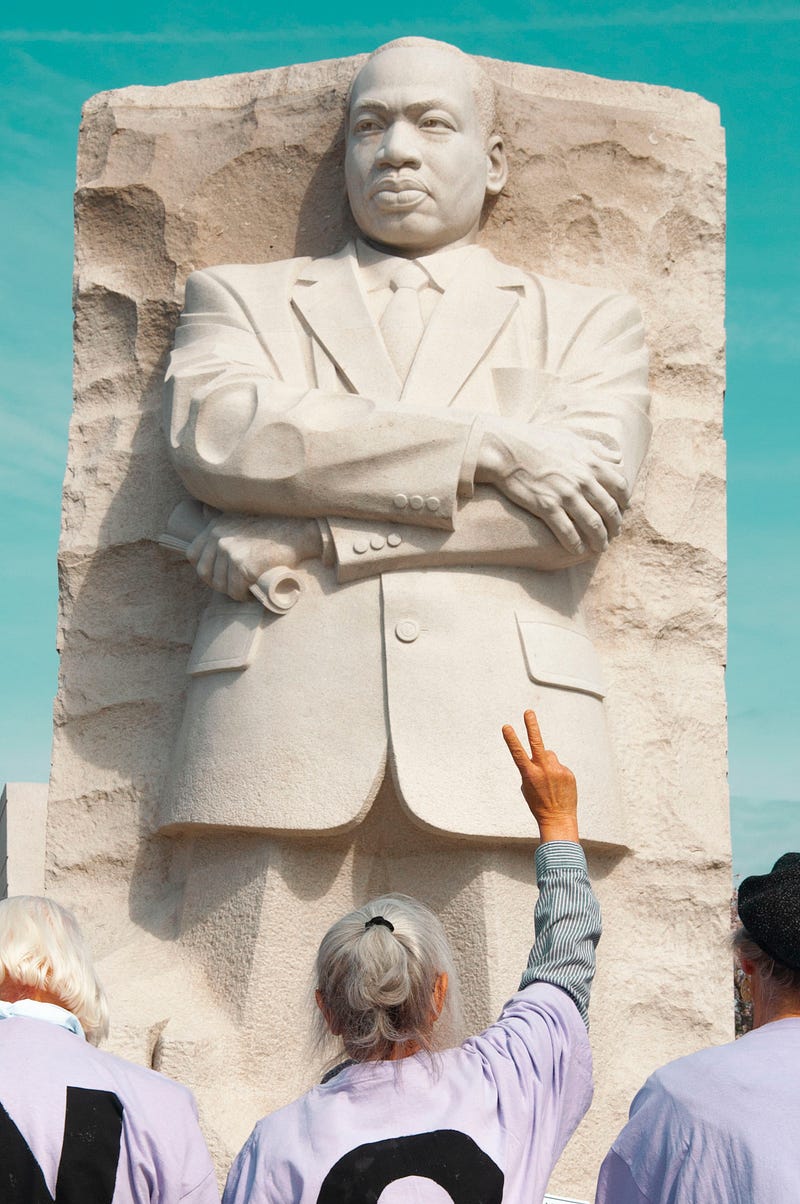
Now that I’m writing this, it sounds a bit like plagiarism:
“I have a dream that my four children will one day live in a nation where they will not be judged by the colour of their skin, but by the content of their character” — Martin Luther King Jr.
As an outcast who couldn’t easily identify with a group based on my skin color, I had the serendipity of having this epiphany at an early age. I made friends from many different backgrounds because of this. However, as I grew older I began to see this salient philosophy challenged.
Especially when it comes to my Black side I’m told there’s a “Black way” of thinking. That this is what a Black person in America should believe. And I should only believe this way because I’m apart of the Black group.
Bullshit. I couldn’t imagine someone telling me this is the “mixed way” of thinking. It wouldn’t make sense. Unfortunately, this is exactly the kind of sanctimonious writing I see all over Medium.
Identifying with your color was once so preposterous that my sister’s dark-skinned boyfriend once said she wouldn’t understand a race issue because she’s “light-skinned.” Events like that make me wonder if people want King’s message to one day ring true. Or if they’re content being identified by their color because at least that means they’re apart of a group.
This isn’t to say that I’m not proud of black excellence. As a writer at LEVEL Editors, for example, it does make me happy to work along so many beautiful and creative individuals of color. It is a blessing to have these often suppressed, unique voices projected onto a mainstream publication.
However, at the end of the day, my Blackness and my Mixedness are not the core of my humanity. I don’t buy into this progressive way of Black thinking that writers imply is actually looking out for my best interest as an African American.
I don’t think the people who voted for Donald Trump are racist, bigoted fascists who need “to be shipped to the moon” (actually real words someone wrote) so that real change can begin.
I have liberal friends, conservative friends, and a few in-between. Heck, I’ve gone out to breakfast with Trump supporters and had a great time (Heresy!!)
I’m defined by my actions and my character, both of which can break down the walls of any social construct.
Thank you for reading.


