
The Skinny on Skinny-Shaming
If that’s all you have to worry about, check your privilege!
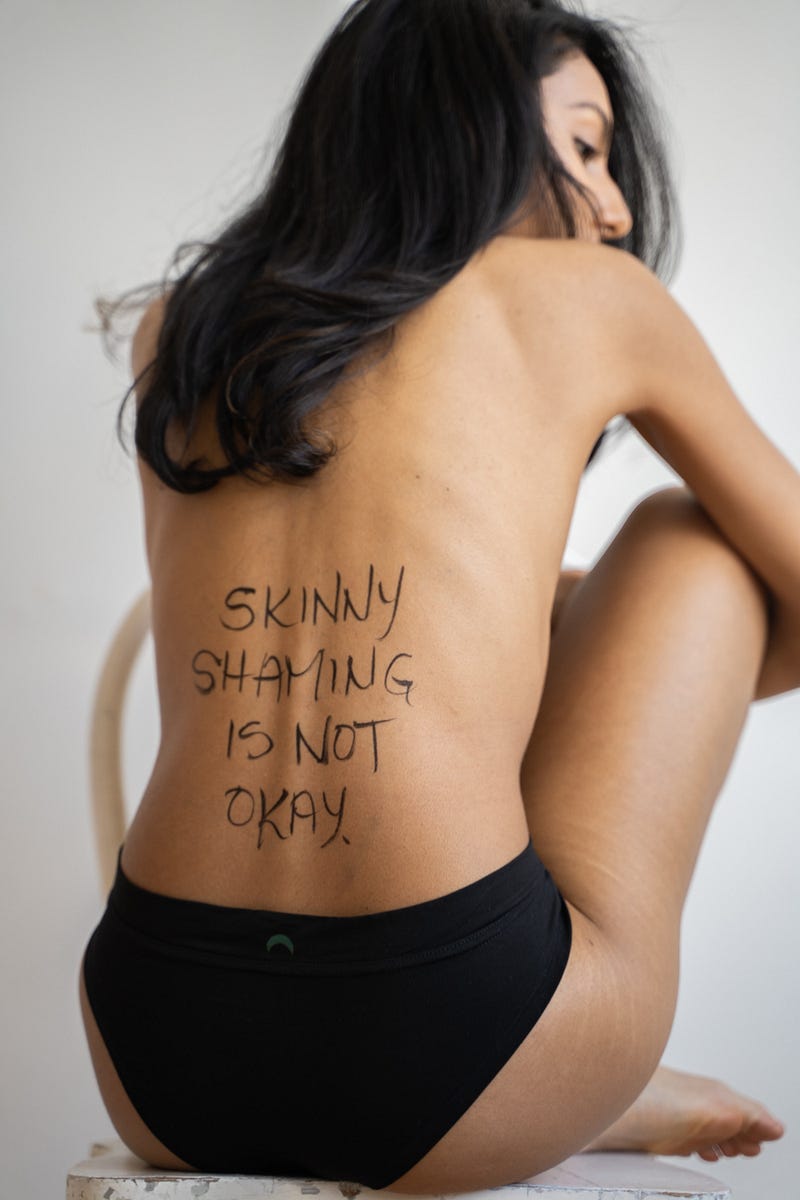
No one ever wants to be late to a pity party. And that includes a number of — dare I say it — skinny women sobbing over the extent of skinny-shaming, pontificating as it were the worst indignity ever. As a sometime skinny person who has witnessed the fat-shaming of friends and acquaintances and moreover, one who has been regaled with racial epithets, I find the whining about skinny shaming distasteful, even offensive, reminding me of privileged outcries against “reverse racism.” Personally, complaints of skinny-shaming always strike me as a bit disingenuous: comparable to all those seemingly self-effacing claims of purported ugliness from tall, slim, blonde, blue-eyed, conventionally attractive women.
Now, just so that hackles are not immediately raised, let me say here that for a good number of decades, I’ve ranged between 100 and 135 lbs. throughout my adult years. So at 5’5”, I know what it’s like to be thin — and to be average.
I’ve also had friends, acquaintances, and colleagues who weighed quite a bit more — including a former best friend who weighed 200 at 5’3.”
In other words, I’ve seen a lot. I’ve noticed the differences between the ways I’ve been treated at my various weights — and how others have been treated at much heavier weights. No pun intended, but the sheer heft of fat-shaming outweighs any purported shaming skinny chicks might receive. Since when was being told “you could eat some more” more pejorative than being called “fat slob” or “fat and ugly/stupid?” Or “you look like a stick” as opposed to “you look like the Blob?” Instead, the closest thing to anything derogatory for the slim is “lean and mean” — an epithet that is perceived more as a compliment today than anything else.
And more importantly, as I’ll discuss later, skinny women rarely have to deal with the negative assumptions or repercussions heaped upon the fat (a word I’m using in a literal rather than pejorative sense) and obese by academe, the corporate world, and medical professionals. Indeed, weight can sometimes operate much like racial discrimination whereby any negative qualities are attributed to one’s race or size.
“You look like a young boy!”
But first, let me begin with my own experiences.
Throughout my childhood and adolescence, I was skinny verging on slim. As a child, grown-ups would poke my ribs teasingly, urging me to eat. If anything, I wanted to be fat like my maternal grandmother, 4'10" and 150 lbs.: everyone liked her friendly, generous, easy-going nature. Why couldn’t I be like that? By contrast, I was skinny and a bundle of nerves, wolfing down snacks like there was no tomorrow. I had evidently inherited my crazy fast metabolism from the other side of my family.
When I arrived at adolescence, however, I began to appreciate my slimness. That’s probably because when I flipped through magazines, I often found women similar to me in physique (even if I wished I were taller). Many actresses and pop/rock stars — including my much admired Stevie Nicks — had figures not unlike mine, i.e., more or less straight up and down with a few curves. I didn’t have too much difficulty finding clothes that fit me either since I was a size 6 in the late ’70s (before sizes were inflated). Not only that, but I couldn’t help but notice that although there were many articles showing women how to look thinner, there were virtually none for those wanting to look bigger.
I should add too that the vast majority of my friends in high school were slim. Some, like me, were prodded to eat. We were told by our various relatives and friends that we looked like “stick figures.” But not one of us complained about skinny-shaming. (This wasn’t even a concept!) Perhaps unlike our current trigger-warning-happy days, we were taught that “sticks and stones may break my bones, but names will never hurt me.” Certainly for me, comments about my physique were like water off a duck’s back. Being called skinny or bony was still miles better than being called chink, jap, or ching chong.
That’s probably because when I flipped through magazines, I often found women similar to me in physique (even if I wished I were taller).
There was also the obvious fact that complaining about being too thin was sorta like complaining about being too rich. It was perceived as a none too subtle way of fishing for compliments.
But more to the point, for all the stick figure comments I got, I still received far more compliments than insults in regard to my weight. Friends told me I was the only “normal” person who could dress like a model and get away with it. And as one of my male friends told me, “of course, you like clothes. Because you look good in them.”
Even after putting on the college freshman 10, I was still getting compliments. In fact, pounds later, I got more from male friends when I weighed 120–5 in the 1980s. My weight gain couldn’t have come at a better time, when a slightly more voluptuous figure replaced the stick figures of the 1970s as the epitome of fashion. Male friends told me I had the “perfect body” — even as female friends began telling me I needed to lose weight.
Strut!
Nearly a decade later in the early 1990s, thanks to stress and getting a new kitten along with all the work that revolved around him (e.g., lifting up sofas to find him), I dropped down to my near-adolescent weight.
At 102 lbs., what was astounding was the new attention I began to get from strangers, even if a few acquaintances began telling me I needed to gain some weight or asking me if I was “ill.” I now found myself whistled at by a bunch of teenaged boys half my age when I wore close-cut sweater dresses with belts that accentuated my 23” waist. Men opened doors for me. Construction workers stopped to ogle me. (Today, I am ashamed of feeling flattered by male validation — but more on that later.) And women were now telling me I was the perfect size. I was happy to be told I “looked like something out of a magazine.”
None of this is to imply that I was conventionally pretty in any way — far from it. But rather that my slimness made my what I considered my too-ethnic-to-be-pretty features more endurable. I took comfort in knowing I was not completely cursed even as I wished my chin were a little sharper, my nose and lips a little thinner, and my cheekbones more chiseled.
I now found myself whistled at by a bunch of teenaged boys half my age when I wore close-cut sweater dresses with belts that accentuated my 23” waist.
What struck me the most, however, was the disparity between the ways a shorter, heavier friend and I were treated — even if she was white.
Sales associates would routinely ignore her, even when she walked in first. Sometimes, as she told me — although I never witnessed it — she would be insulted. She would get snide remarks like “We don’t have anything your size” or “I didn’t know they made that in your size.” On one occasion, a salesman yanked a dress out of her hands, telling her “that is not for a woman like you.”
Dining out was not much better. When she dined by herself, guests would ask to be seated elsewhere. She was often placed in the back and even at dirty tables if she didn’t make reservations. Even worse, a waitress even told her to hurry up because she was allegedly “making everyone else around you sick.” And if I was with her and ordered a large meal — servers would automatically assume it was my friend’s.
Then there were all the random insults she would get just walking down the street. Young couples would look at her and snicker while boys would make oinking sounds. Men passing by in cars asked how much she charged by the hour. There’s no doubt about it: if slim women get shamed for their slimness, fat women get it much, much worse.
Even worse, a waitress even told her to hurry up because she was allegedly “making everyone else around you sick.”
At the same time, during my temping days before I hopped over to England for graduate study, I recall a few obese contractors who complained they rarely got assignments. They had master’s degrees! Clerical training! While shameful, this unfairness didn’t surprise me too much — if only because I had inadvertently caught sight of a tally sheet at my own temp agency which rated the appearance of new applicants. In a world which mostly equates fat with unattractive, I had no doubt how they were perceived.
Real problems faced by the plus-sized
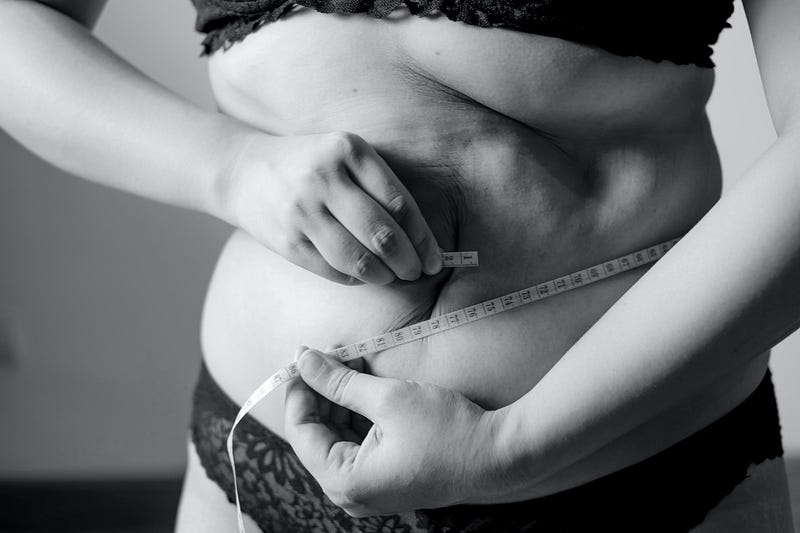
This naturally brings me to the far more serious disadvantages faced by fat women — apart from the barrage of insults. Research reveals that such women face a far greater onus in schools, the workplace, and in healthcare.
For starters, fat people — especially women —are deemed by educators to lack willpower. Hence, a tenured male professor at the University of New Mexico thought he could get away with tweeting, “Dear obese Ph.D. applicants “If you don’t have the willpower to stop eating carbs, you won’t have the willpower to do a dissertation.” I should add that his infamous tweet is highly ironic since I managed to gain some 10–15 pounds every time I completed a degree — including my doctoral dissertation. After all, brain power does require food!
A study by Jacob M. Burmeister, Allison E. Kiefner, Robert A. Carels, Dara R. Musher-Eizenman has also shown that Ph.D. students with a higher body mass index are less likely to be offered a postdoctorate in personal interviews; however, there was no significant difference when interviews were conducted by phone. Looks, in other words, are one of the prime drivers of acceptance.
“Dear obese Ph.D. applicants: if you don’t have the willpower to stop eating carbs, you won’t have the willpower to do a dissertation.”
Likewise, corporate leadership discriminates against fat — and again, fat women in particular. Although 45 to 60% of top male CEOs are overweight, only 5–22% of top female CEOs are so. But the effects of weight discrimination for women are not limited to those vying for room in the C-suite. According to a study by Jennifer Bennett Shinall, obese women earn an average of $5.25 less per hour compared to other women while 11% of HR executives have reported weight as a factor in hiring. The bias is less obvious for men.
Not least, among health care professionals, there’s an even more lethal bias that arguably begins in medical school. A study by R. Puhl and K. Brownell has indicated that students believe that obese patients lack self-control, are less inclined to follow treatments, and are more “unpleasant” than thinner patients. These students also mentioned how the obese were targets of humor among other students, residents and physicians. Yet another study by CR Bagley, DN Conklin, RT Isherwood et al. showed that 24 percent of nurses expressed loathing of obese patients with some going as far as not wanting to touch such patients. A third to nearly half of these nurses also preferred not to treat the obese.
Women considered obese earn $5.25 less per hour than women considered a normal weight.
In fact, other studies by Puhl and Brownell have shown that this bias against fat patients by health professionals can perpetuate obesity and other health issues as patients cope by either eating more or refusing to diet — or by just refraining from seeing a doctor. It’s worth adding that the volume of articles on fat-shaming in the medical profession within the last year is stupendous.
Put briefly, life for the fat is far from a cakewalk — and the woes of skinny shaming simply cannot begin to stack up.
What should infuriate all women — fat and skinny alike
Instead of fuming at skinny-shaming or even fat-shaming, what we women should do is debunk the capitalist, patriarchal determination of what women should look like: because that is the true root of the problem. As long as there is the notion that all women should somehow adhere to notions of femininity as posited by centuries of Anglo-centric thinkers — that women should be slim, delicate, pale, and conform to other Anglo norms of beauty — there will always be contempt showered on those who deviate on one hand from these norms and resentment for those who do. Eat what you want and exercise when you want so long as it doesn’t have a negative impact on your health.
It’s also long overdue for us to ditch the belief the weight and physique can be controlled by willpower. Some people have ectomorphic genes and others do not. And sometimes genes can work in funny ways where we don’t resemble our parents but more distant relatives with different physiques.


Moreover, let’s ditch the even more dangerous and misleading idea that our physiques and weight somehow determine our character. The supposed correlation between slimness, intelligence, and discipline is one that needs to go. Or the belief that those who are slim or bear more chiseled features are more exacting or perfectionist. I reiterate this as a woman who always managed to gain 10 to 15 pounds while completing my various larger projects, whether it be a dissertation or a book. In fact, I’ve often jokingly compared my weight gain during these projects to pregnancy as I called it feeding my brain to nurture my work. If it takes me another few weeks to lose the pounds, who cares?
Weight can only affect our mindsets in so far as how we react to the way we are treated. As challenging as it is not to react impulsively to insults or compliments, we need to remember that we are more than the sum of our pounds — or our appearances. This is particularly true for those of us living in a capitalist society that brainwashes us in order to buttress the lucrative fashion, makeup, personal hygiene, and diet industries (including books). All of these worries about how we look and how much we weigh prevent us from attaining our full potential as human beings.
All told, I can’t help but apply Malcolm X’s words on the Black preoccupation with hair to women’s preoccupation with weight. In his Autobiography, he observes, “I’m speaking from personal experience when I say of any black man who conks today, or any white-wigged black woman, that if they gave the brains in their heads just half as much attention as they do their hair, they would be a thousand times better off.” The same goes for women. Let’s focus on what truly counts — our minds and our character.
© Frances A. Chiu, December 5, 2023. All Rights Reserved.
Frances A. Chiu is currently completing her second book, Reading the Gothic: Matthew Lewis’ Monk for Manchester University Press. She is also writing a book on cat loss, “It’s Only a Cat”: A Guide to Grieving the Loss of a Cat.
For more of the good stuff, follow Fourth Wave. Have you got a story, essay, or poem that focuses on women or other disempowered groups? Submit to the Wave!