
‘The Skater’ by Sir Charles George Douglas Roberts
“The world lay still in the wide white frost …”
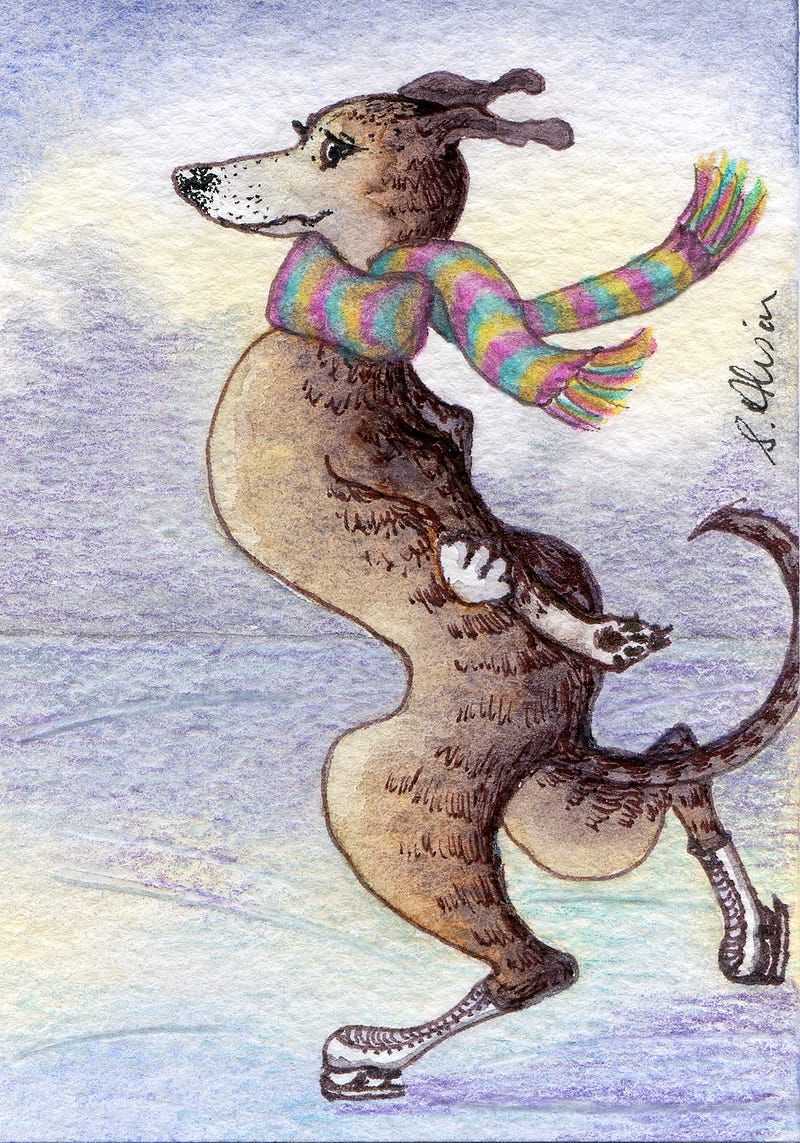
My glad feet shod with the glittering steel I was the god of the wingèd heel.
The hills in the far white sky were lost; The world lay still in the wide white frost;
And the woods hung hushed in their long white dream By the ghostly, glimmering, ice-blue stream.
Here was a pathway, smooth like glass, Where I and the wandering wind might pass
To the far-off palaces, drifted deep, Where Winter’s retinue rests in sleep.
I followed the lure, I fled like a bird, Till the startled hollows awoke and heard
A spinning whisper, a sibilant twang, As the stroke of the steel on the tense ice rang;
And the wandering wind was left behind As faster, faster I followed my mind;
Till the blood sang high in my eager brain, And the joy of my flight was almost pain.
Then I stayed the rush of my eager speed And silently went as a drifting seed, —
Slowly furtively till my eyes Grew big with the awe of a dim surmise,
And the hair of my neck began to creep At hearing the wilderness talk in sleep.
Shapes in the fir-gloom drifted near. In the deep of my heart I heard my fear.
And I turned and fled, like a soul pursued, From the white, inviolate solitude.
Wonderful! So atmospheric. We are so there on the ice — speeding, drifting … And then, so ominous at the end as he becomes uncomfortable in the vastness of nature, having started off gleefully enjoying his part in it, and his sojourn through it.
Sir Charles George Douglas Roberts, KCMG, FRSC is known as the Father of Canadian Poetry.
He wrote a lot of works himself, but also encouraged other Canadian poets of his time.
He wrote much prose, and books as well as poetry, determined to make a living from his writings. His most successful genre was the animal story, but he also wrote historical romances, adventure stories, and novels; also descriptive text for guide books.
One of his cousins, Bliss Carman, is another favourite poet of mine.
In 1907 Roberts moved to Paris, then Munich, then London, where he stayed until 1925. During World War I he enlisted in the British Army. He returned to Canada in 1925 and a new surge of poetry ensued.
He was awarded many honours for his work, which itself experienced a revival a hundred years after his first volumes were released. In 1945 he was declared a ‘Person of National Historic Significance’, and a monument to him was erected in New Brunswick in 2005.
He died aged 83 having just married for the second time.
In his introduction to ‘The Kindred of the Wild’ (1902), Roberts called the animal story “a potent emancipator. It frees us for a little from the world of shop-worn utilities, and from the mean tenement of self of which we do well to grow weary. It helps us to return to nature, without requiring that we at the same time return to barbarism.”
My own creativity is always refreshed by reading the creative works of others — especially some of the classic poems, knowing they were written in a different world at a different time, with a different mindset.
*This poem is in the public domain. Stuff you need to know about the use of other people’s work.
Stuff you need to know about the use of other people’s work:
Susan’s Amazon Page / Susan’s Etsy Store / Susan’s newsletter sign-up
Read more from me: © Susan Alison 2021


